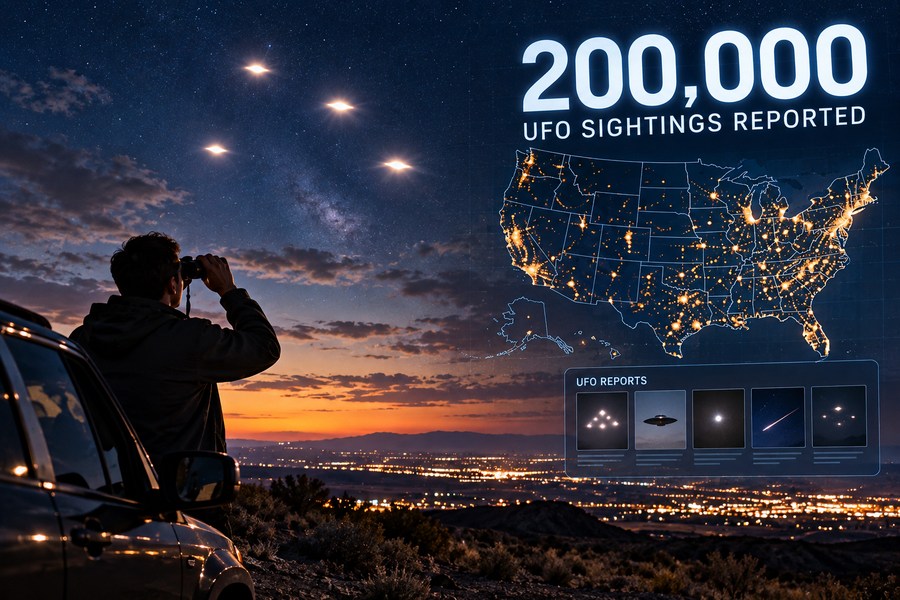
The American UFO debate has reached a striking numerical milestone. In September 2026, the National UFO Reporting Center, commonly known as NUFORC, announced that it had received its 200,000th UFO sighting report. According to the organisation, the milestone was reached during August, marking more than five decades of collecting public observations. The number is remarkable. Two hundred thousand reports represent an enormous collection of personal experiences, descriptions and alleged encounters with unidentified objects. But what does that figure actually tell us? Does it mean UFO sightings are becoming more common? Does it provide evidence that something extraordinary is visiting Earth? Or does it reveal something equally interesting about how people observe and interpret the sky?
What Is the National UFO Reporting Center?
The National UFO Reporting Center is an American organisation that collects reports of unidentified aerial observations. Founded in 1974, NUFORC has operated as a public reporting channel for people who believe they have witnessed something unusual. Its records include descriptions of lights, apparent formations, unusual movements and objects whose identities were not immediately apparent to witnesses. The organisation's long history makes its database a useful resource for understanding how UFO reports have accumulated over time. However, a public reporting database is not the same as a collection of scientifically verified extraterrestrial encounters. The records reflect what people reported. Determining what actually produced each observation requires additional investigation.
What Does the 200,000 Milestone Mean?
The milestone represents the cumulative number of sighting reports received by NUFORC over its history. It does not mean that 200,000 unexplained spacecraft have been detected. It also does not mean that 200,000 reports were filed during 2026. That distinction is essential when interpreting the figure. Some reports may describe objects that were later identified. Others may lack sufficient evidence for any confident explanation. A report can be sincere while containing an incorrect interpretation. For example, an observer may accurately describe a line of moving lights without recognising a satellite constellation. The observation is genuine. The original interpretation may not be. That difference is fundamental to understanding UFO statistics.
Why Do People Continue Reporting UFOs?
The night sky contains more human-made objects than it did several decades ago. Satellite constellations, drones, aircraft and other technologies can produce unfamiliar appearances. At the same time, modern smartphones make it easier to record unusual events. Social media allows footage to reach large audiences within minutes. These developments create an interesting situation. People have more tools to investigate unusual observations, but they also encounter more objects and images that may initially be difficult to identify. Public awareness can influence reporting as well. When UFO stories dominate the news, people may pay closer attention to unfamiliar lights. That does not automatically indicate a change in the number of genuinely unexplained phenomena. It may reflect changes in observation and reporting behaviour.
Which Types of UFO Sightings Are Commonly Reported?
UFO databases contain a wide variety of descriptions. Some witnesses report bright stationary lights. Others describe triangular formations, spherical objects or apparent discs. There are also accounts of objects changing direction or disappearing suddenly. However, witness descriptions do not necessarily correspond to the actual physical shape or movement of an object. A distant light may appear spherical because its structure cannot be resolved. Several aircraft viewed from an unusual angle may resemble a formation. A bright satellite can appear to disappear when it enters Earth's shadow. These possibilities do not explain every report. They demonstrate why visual descriptions require context before investigators can reach reliable conclusions.
Are UFO Sightings Increasing?
A rising cumulative total cannot answer that question on its own. To determine whether sightings are becoming more common, researchers would need comparable reporting data across different periods. They would also need to account for changes in population, technology and public awareness. A reporting organisation that becomes more widely known may receive more submissions even if the underlying rate of unusual observations remains unchanged. Likewise, a dramatic news event can temporarily increase public attention. Researchers must therefore distinguish the number of reports received from the number of genuinely anomalous events occurring. The two measurements are not interchangeable. NUFORC's milestone establishes the scale of its accumulated reporting activity. It does not independently establish an increasing rate of unexplained aerial phenomena.
How Reliable Are Public UFO Databases?
Public reporting databases have strengths and limitations. Their principal strength is accessibility. People can submit observations that might otherwise never be documented. Over time, these reports can reveal recurring descriptions, locations and patterns of public interest. But submissions may vary considerably in quality. Some include precise timestamps and original photographs. Others rely on memories recorded days or years after the event. Camera settings may be unavailable. Distance and altitude estimates may be uncertain. Independent witnesses may not exist. These differences make it difficult to treat every report as equally informative. A large database can support useful research, but its conclusions depend on the quality and consistency of the underlying records.
How Is NUFORC Different From the Pentagon's UAP Investigations?
NUFORC and the Pentagon's All-domain Anomaly Resolution Office serve different purposes. NUFORC collects public reports from individuals. AARO investigates UAP-related cases within a government framework, including information associated with military operations and national-security concerns. Military investigations may sometimes have access to radar, infrared imagery or other sensor data unavailable to civilian reporting organisations. However, even sophisticated equipment does not guarantee that every object can be identified. Distance measurements may be missing. A sensor may capture only part of an event. Independent observations may be unavailable. These limitations are explored in our guide to UAP evidence, which explains why witness testimony and sensor measurements must be assessed together. The comparison shows why investigators must examine the quality of individual cases rather than relying solely on the number of reports.
Do 200,000 UFO Reports Prove Aliens Exist?
No. The number of reports does not establish an extraterrestrial explanation. A hundred thousand observations lacking sufficient evidence cannot automatically establish a conclusion that no individual observation supports. Scientific verification requires information that can be independently examined. For an extraordinary aerial claim, that might include calibrated imagery, reliable telemetry, multiple independent sensors or physical evidence with a documented origin. Without those elements, investigators may be unable to determine what happened. That does not mean every witness is mistaken. It means observation and interpretation must remain separate. Our examination of whether UFOs are real explores the difference between documenting an unexplained observation and establishing its origin.
Why the Milestone Matters for Future UFO Research
The most valuable aspect of NUFORC's milestone may be the historical record it represents. Reports collected across decades offer an opportunity to examine how descriptions, technology and public interest have changed. Researchers could investigate whether particular categories of sightings correspond with satellite launches, astronomical events or other identifiable activities. They could also examine how reporting behaviour changes following major news stories. Such work requires careful statistical methods. The database is not necessarily a representative sample of the entire population, because people choose whether to submit reports. Nevertheless, a large collection of observations can generate useful research questions. The challenge is turning those observations into reliable evidence.
What Happens After 200,000 Reports?
The milestone does not settle the UFO debate. Instead, it highlights how much information has accumulated and how difficult it can be to interpret that information consistently. Future research may benefit from standardised reporting forms, better preservation of original recordings and improved comparisons with aviation and astronomical data. Independent verification will remain essential. The next important breakthrough in UFO research may not come from collecting another enormous number of sightings. It may come from obtaining a smaller number of exceptionally well-documented observations. For now, NUFORC's 200,000 reports demonstrate that public fascination with unexplained aerial phenomena remains substantial. Whether any individual report represents something genuinely unfamiliar must still be established through evidence. Two hundred thousand reports are a significant historical record. They are not, by themselves, proof of extraterrestrial visitors.
Sources and Further Reading
All-domain Anomaly Resolution Office — Official Website
National UFO Reporting Center — NUFORC Logs Its 200,000th UFO Report
National UFO Reporting Center — Reports by Month
NASA — Unidentified Anomalous Phenomena Independent Study