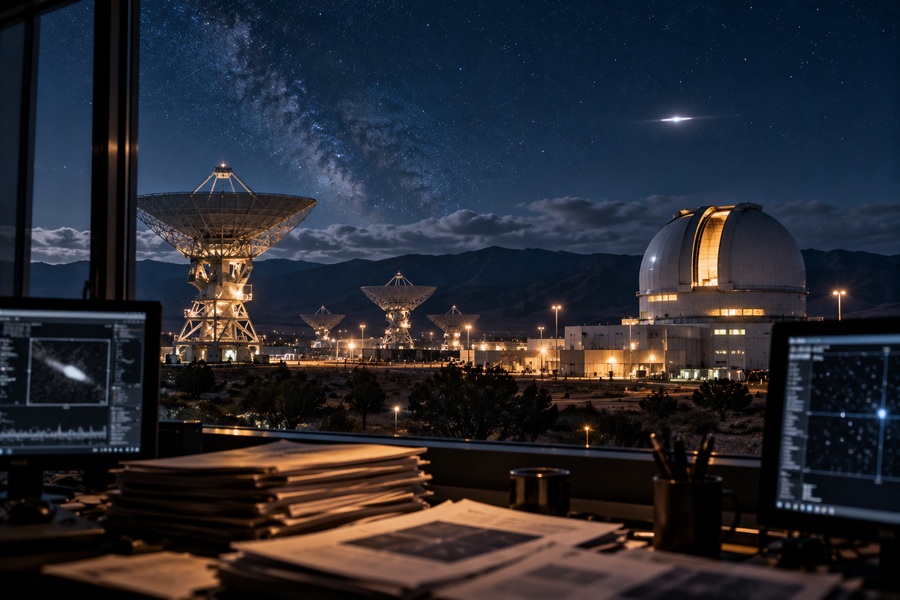
The debate surrounding NASA and unidentified anomalous phenomena has taken another turn in October 2026. This time, the central question is not whether an unusual object has appeared in the sky, but whether the public has access to all the relevant information.
The wider discussion raises an important question: how can the public determine whether an agency has released all the records relevant to a particular subject?
The question deserves examination, but it should not be confused with proof that NASA is concealing evidence of extraterrestrial spacecraft. A dispute about access to records is not the same as a verified discovery of alien technology.
To understand the controversy, it is necessary to examine NASA's documented UAP work, the limits of public archives and what meaningful disclosure would actually require.
What Has NASA Officially Released About UAP?
NASA has publicly acknowledged that unidentified anomalous phenomena deserve scientific investigation.
In September 2023, the agency published the final report of its independent UAP study team. The report examined how scientific data, observational methods and modern analytical tools could improve future investigations.
It did not announce the discovery of extraterrestrial spacecraft or confirm that unexplained sightings were caused by non-human intelligence.
Instead, the researchers highlighted a fundamental difficulty: many UAP reports lack the high-quality information needed to establish what was observed.
A photograph may show something unusual without providing reliable measurements of its distance, size or speed. Witness testimony can be valuable, but it may not contain enough information to identify an object independently.
NASA's report therefore emphasised better data collection, improved reporting practices and scientific transparency.
Our earlier article on the NASA UAP study examines the agency's scientific approach in greater detail.
Why Is NASA Facing Questions in October 2026?
The latest discussion concerns whether NASA's public disclosures provide a sufficiently complete picture of its UAP-related records.
Questions about the completeness of NASA's publicly available UAP records have become part of the wider debate over government transparency. However, assessing whether specific information is missing requires identifiable documents, records requests or other verifiable evidence.
However, the precise scope of the October disagreement matters. A broad claim that records are missing cannot establish what those records contain, or even whether they fall under NASA's responsibility.
To investigate such an allegation properly, researchers would need to identify particular documents, images, recordings or datasets believed to be unavailable.
They would then need to determine whether NASA holds those materials, whether they have already been published and whether any restrictions apply.
Without that information, the disagreement remains a question about disclosure rather than evidence of a concealed extraterrestrial discovery.
Does NASA Have a Complete UFO Archive?
NASA operates scientific instruments, spacecraft, aircraft and research programmes that generate enormous quantities of information.
Some observations that later attract interest from UFO researchers may never have been labelled as UAP when originally recorded.
An unusual feature in a mission photograph might be stored in an image archive. A pilot's observation could appear in operational documentation. Unexpected sensor readings may exist within scientific datasets.
These records are not necessarily organised into a single searchable UFO collection.
This creates a practical difficulty when discussing complete disclosure.
Does the term refer to every document explicitly classified as a UFO report? Does it include historical photographs that members of the public later interpret as unusual? Or does it concern only observations formally investigated by NASA?
Different definitions could produce different answers.
A meaningful disclosure assessment therefore requires a clearly defined collection of records rather than an assumption that every potentially relevant observation exists in one archive.
What Does the National Archives Reveal?
NASA is not the only organisation involved in making UAP-related government records accessible.
The United States National Archives and Records Administration maintains collections relating to historical UFO investigations and more recent UAP records.
Under legislation enacted in 2023, federal agencies are required to transfer certain UAP-related records to a dedicated collection.
The National Archives has established Record Group 615 for this purpose and publishes information about materials received from federal agencies.
Its public guidance explains that additional records are being added as transfers continue.
This provides an important distinction: an archive that is still receiving documents should not automatically be treated as a completed inventory of everything potentially relevant across the federal government.
It also gives researchers a practical starting point. They can examine official collection descriptions, identify available records and determine whether particular materials have been transferred.
That process is more useful than assuming that an incomplete archive necessarily conceals extraordinary evidence.
Why Do Apollo Missions Appear in UFO Discussions?
NASA's historical missions have generated decades of speculation because their photographs, recordings and transcripts are widely available.
Apollo missions are particularly popular subjects.
Some observers have identified unusual lights or shapes in mission imagery and suggested that astronauts encountered unidentified objects.
However, interpreting historical space photographs can be difficult.
Reflections, camera exposure, lighting conditions and objects associated with spacecraft operations can create unfamiliar appearances.
An isolated image may also lose important context when separated from the surrounding sequence or original mission records.
The Apollo 17 UFO controversy illustrates why complete photographic sequences and reliable historical documentation matter.
A puzzling photograph does not establish extraterrestrial activity. Nevertheless, access to original material can help researchers test competing explanations.
Can Artificial Intelligence Help Examine NASA Records?
Artificial intelligence could help researchers search large collections of NASA images, documents and scientific datasets for potentially relevant observations.
However, automated systems can also mistake ordinary image artefacts for unusual phenomena. Any flagged result would still require verification against original records and supporting information.
In the context of UFO disclosure, AI is most useful as a tool for locating and organising evidence, not determining whether an observation has an extraterrestrial origin.
How Is NASA Different From the Pentagon?
NASA primarily conducts civilian scientific research, while the Pentagon investigates UAP within a national-security framework. These different responsibilities influence the types of records each organisation holds and the restrictions that may apply to their release.
Military observations can involve classified sensor capabilities or operational information, whereas NASA's records generally arise from scientific missions and research programmes.
For more detail on the Pentagon's investigative responsibilities, see our guide to what AARO is and how it investigates UAP.
Does Missing Information Mean NASA Is Hiding Aliens?
No. Even if investigators demonstrate that relevant documents have not been released, their contents would still need to be established.
A withheld record might contain administrative information, technical details, personal information or observations that remain difficult to interpret.
An unidentified event is not automatically evidence of extraterrestrial technology.
NASA's public UAP guidance states that there is no supporting data establishing that UAP represent alien technology.
That does not make transparency unimportant.
Government agencies can reasonably be asked to explain what information they possess, how they organise it and why particular records may be unavailable.
Public accountability and scientific scepticism are compatible. Researchers can question disclosure practices without accepting unsupported claims about hidden spacecraft.
Our article on UAP evidence explores how observations should be assessed before conclusions are drawn about their origins.
How Could Researchers Verify Disclosure Claims?
A useful investigation would begin with specific records rather than general allegations.
Researchers could compare official document inventories, historical references and published archives to identify possible gaps.
Freedom of Information Act requests may help determine whether particular documents exist and whether an agency can release them.
When records are withheld, the official explanation can be examined alongside the relevant legal requirements.
For scientific observations, access to original images, sensor information and contextual metadata would be especially important.
Researchers would also need to establish whether NASA was responsible for the material or whether another agency controlled it.
These steps would not guarantee that every question could be answered. They would, however, provide a clearer foundation for evaluating claims about incomplete disclosure.
Why Does the NASA Disclosure Debate Matter?
The controversy extends beyond UFO enthusiasts.
Public confidence in scientific institutions depends partly on how clearly those institutions communicate their findings, limitations and recordkeeping practices.
A statement about disclosure can sound definitive even when it refers to a narrowly defined group of documents.
Conversely, an allegation that information is missing can appear more significant than the available evidence supports.
Clear definitions, accessible records and transparent explanations would make these disputes easier to assess.
They would also allow independent researchers to concentrate on verifiable questions rather than competing assumptions.
Has NASA Really Released Everything?
The October 2026 debate raises legitimate questions about the scope and completeness of publicly available UAP records, but the specific allegations discussed in the original reporting have not been independently established here.
What can be confirmed is that NASA has published its independent UAP study, explained its scientific approach and made related material publicly accessible.
The National Archives also maintains a dedicated collection of UAP records received from federal agencies, with additional material being added over time.
None of these facts establishes that every potentially relevant document has been released. Equally, the absence of a complete public inventory does not demonstrate that NASA is concealing evidence of extraterrestrial spacecraft.
The most useful next step is to identify specific records, verify their status and examine their contents.
Until then, the NASA UFO disclosure debate remains a question of transparency and evidence, not confirmation of alien technology.
Sources and Further Reading
NASA — Unidentified Anomalous Phenomena Independent Study
NASA — UAP Independent Study Team Final Report
NASA — UAP Frequently Asked Questions
US National Archives — UAP Records Collection
US National Archives — UFO and UAP Records
US Department of Justice — Freedom of Information Act