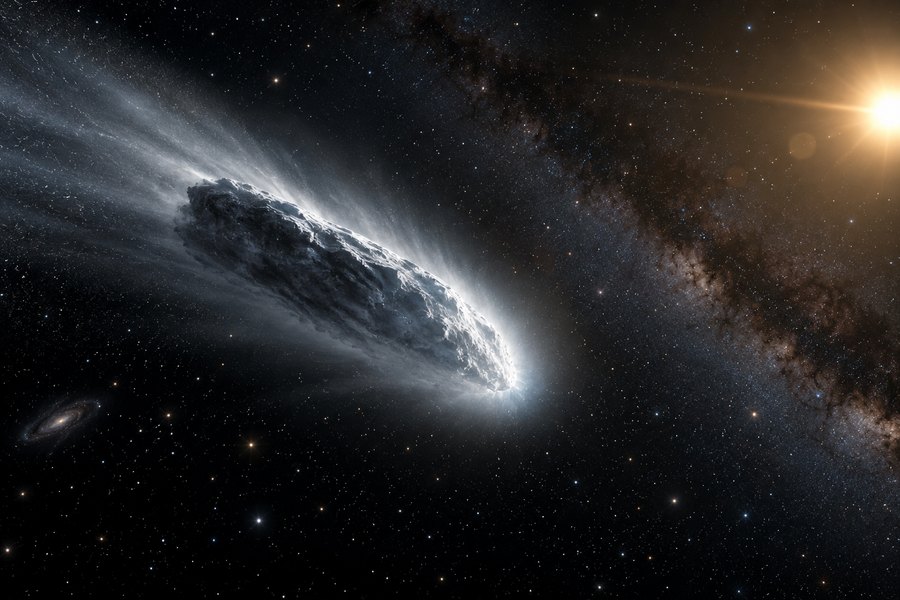
Something entered our Solar System from interstellar space, passed around the Sun and continued back towards the darkness between the stars.
Its name is 3I/ATLAS.
That alone makes it extraordinary.
Only three confirmed interstellar objects have ever been observed passing through our Solar System. Yet 3I/ATLAS quickly became interesting for another reason: online speculation that it might be something more than a comet.
Could it be artificial?
Could an extraterrestrial civilisation have sent it?
Or are astronomers simply looking at a particularly unusual comet formed around another star?
Recent observations are beginning to provide much better answers.
What Is 3I/ATLAS?
3I/ATLAS is the third confirmed interstellar object detected passing through our Solar System.
It was first reported on 1 July 2025 by the NASA-funded ATLAS survey telescope in Rio Hurtado, Chile.
Astronomers determined that its trajectory is hyperbolic. In simple terms, it is not gravitationally bound to the Sun and originated outside our Solar System.
That makes 3I/ATLAS fundamentally different from the familiar comets that repeatedly orbit our star.
It is material from another planetary system passing briefly through our neighbourhood.
For astronomers, that is an exceptionally rare opportunity.
Why Did the Alien Spacecraft Theory Begin?
The arrival of an object from another star naturally attracts attention.
That happened before with ʻOumuamua, the first recognised interstellar object, whose unusual properties generated years of scientific discussion and public speculation about possible artificial origins.
3I/ATLAS entered a world already familiar with that debate.
Its interstellar origin, unusual chemistry and limited observation window provided fertile ground for theories suggesting it could be technological rather than natural.
The idea is fascinating.
But an interesting hypothesis and evidence for that hypothesis are not the same thing.
Scientists therefore began doing exactly what should happen with an unusual object: observing it using different instruments and testing competing explanations.
The distinction is similar to the one surrounding UFOs and UAPs. An object can initially be unidentified without that automatically making it extraterrestrial. We examine that problem in Are UFOs Real? What the Evidence Actually Says.
What Has NASA Observed?
NASA classifies 3I/ATLAS as an interstellar comet.
Observations have shown a coma — the cloud of gas and dust produced as volatile material leaves a cometary nucleus — surrounding the object.
NASA's Hubble Space Telescope also observed the comet during its journey through the Solar System.
Its trajectory itself is not mysterious in the sense sometimes suggested online.
Interstellar objects are expected to pass through planetary systems occasionally. The difficulty is detecting them.
The fact that only three have been confirmed tells us more about the challenge of finding small, fast-moving interstellar visitors than it does about whether such objects should exist.
New Research Has Revealed Something Stranger
The scientific story became particularly interesting in September 2026.
Researchers using the WEAVE instrument on the William Herschel Telescope reported new clues suggesting that 3I/ATLAS formed under extremely cold conditions, far from its original star.
Its chemistry therefore provides astronomers with information about an environment outside our own Solar System.
Separate observations using the Atacama Compact Array also revealed an unusually high abundance of methanol relative to hydrogen cyanide.
Researchers found that tiny icy grains surrounding the comet were releasing methanol, effectively behaving like miniature comets themselves.
This is unusual.
But unusual chemistry is not evidence of engineering.
Instead, it may tell astronomers something about how chemically diverse planetary systems elsewhere in the Milky Way can be.
Did SETI Detect Anything Artificial?
This is one of the most important questions surrounding the 3I/ATLAS alien theory.
Scientists at the SETI Institute used the Allen Telescope Array to search the object for possible radio technosignatures.
More than seven hours of observations covered radio frequencies between 1 and 9 GHz.
The search initially produced millions of signal detections. After filtering and analysis, the remaining candidates were traced to human-made radio interference.
The result was straightforward:
no evidence of extraterrestrial technology was detected.
That does not mathematically prove that no conceivable technology could be associated with the object.
It does mean that a targeted search for the type of radio emission the experiment could detect found nothing artificial.
That distinction is important.
Why Did the IAU Respond to the Rumours?
The level of speculation became significant enough for the International Astronomical Union to launch an information campaign addressing misinformation surrounding 3I/ATLAS.
According to the IAU, thousands of observations submitted to the Minor Planet Center confirmed the object's trajectory and showed that it posed no danger to Earth.
The organisation also stressed the scientific value of studying a visitor formed in another planetary system.
This is a useful example of what happens when genuine scientific uncertainty meets social media.
Astronomers may say, “We are still investigating this object's properties.”
Online, that can quickly become, “Scientists cannot explain the object.”
Those sentences sound similar.
They mean very different things.
Could 3I/ATLAS Still Be Artificial?
Science rarely works by declaring every imaginable possibility impossible.
Instead, explanations compete against the available evidence.
If 3I/ATLAS were artificial, researchers would want observations difficult to explain through known cometary processes: convincing technological emissions, controlled manoeuvres, manufactured materials or another measurable signature pointing towards engineering.
So far, observations have instead revealed characteristics consistent with a natural interstellar comet.
Its gas, dust, icy grains and chemical composition are scientifically interesting precisely because they allow researchers to compare material formed elsewhere in the Galaxy with comets from our own Solar System.
No verified observation currently demonstrates that 3I/ATLAS is an alien spacecraft.
What Would Count as Evidence of Alien Technology?
This question matters far beyond 3I/ATLAS.
A strange trajectory alone would not necessarily be enough.
Neither would an unusual photograph or unexpected chemical composition.
A convincing case would ideally involve several independent forms of evidence that consistently point towards technology rather than natural processes.
For example, a structured artificial radio transmission associated directly with the object would dramatically change the discussion.
So would clearly controlled acceleration that could not reasonably be explained through outgassing or gravity.
This is the same evidential problem faced by modern UAP research.
Our guide What Evidence Would Scientists Need to Confirm an Extraordinary UAP? looks more closely at how extraordinary observations can be tested.
Why 3I/ATLAS Matters Even If It Is Just a Comet
The phrase “just a comet” does 3I/ATLAS a disservice.
Every piece of this object formed somewhere beyond our Solar System.
Its ice and dust preserve information about another planetary environment.
By examining its chemistry, astronomers are effectively analysing a physical sample from another star system without sending a spacecraft there.
That is remarkable.
And because only three interstellar objects have been confirmed so far, scientists do not yet know how representative any one of them is.
Future discoveries may reveal that interstellar comets are remarkably diverse.
Or they may reveal patterns that astronomers have not yet recognised.
Either result would teach us something new about our Galaxy.
The More Interesting Mystery
The most compelling question surrounding 3I/ATLAS may not be whether it is an alien spacecraft.
It may be where it formed, what its chemistry tells us about another planetary system and how many similar objects are travelling unnoticed through interstellar space.
Current observations support the interpretation of 3I/ATLAS as a natural interstellar comet.
No verified evidence has demonstrated extraterrestrial technology associated with it.
That conclusion does not remove the mystery.
It changes the mystery from “Is this an alien spacecraft?” to something arguably larger:
What are the worlds beyond our Solar System actually made of?
For readers following the wider search for non-human technology, continue with Could UFOs Already Be on Earth? The Cryptoterrestrial Hypothesis Explained.
Sources and Further Reading
- NASA Science — Comet 3I/ATLAS
- International Astronomical Union — IAU Combats Misinformation on Interstellar Object Comet 3I/ATLAS
- SETI Institute — SETI Institute Looks for Signs of Technology in Interstellar Visitor 3I/ATLAS
- Isaac Newton Group of Telescopes — WEAVE Reveals Secrets of Interstellar Comet 3I/ATLAS
- The Astrophysical Journal Letters — 3I/ATLAS Methanol and HCN Study