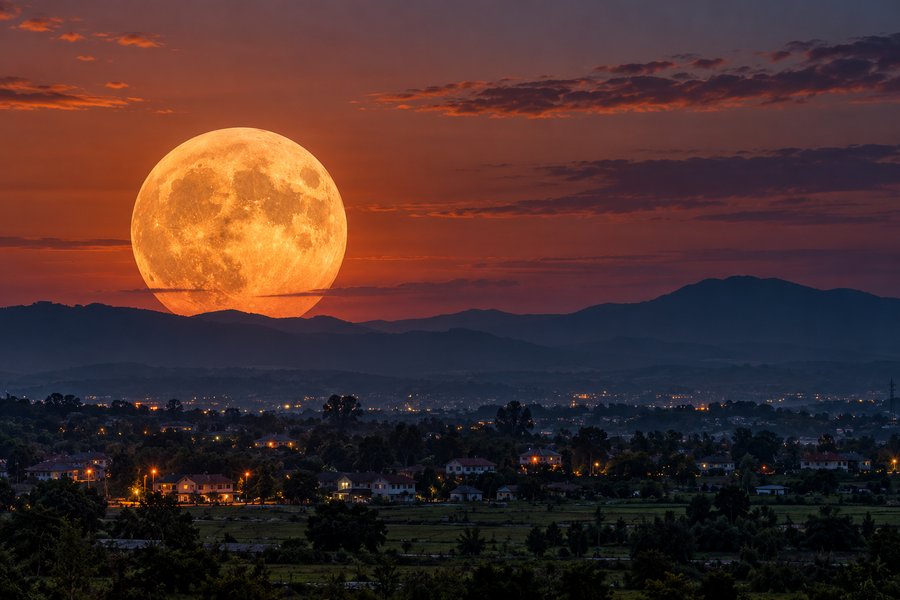
The Moon rises above a distant line of trees, looking unusually large against the evening sky. A few hours later, the same Moon appears smaller as it climbs overhead. It is a familiar sight, yet the explanation is more surprising than many people expect.
The Moon has not suddenly changed its size. Instead, our visual system is interpreting the same object differently depending on its position and surroundings.
This phenomenon is known as the Moon illusion. Scientists have studied it for centuries, and although several explanations have been proposed, the precise combination of factors responsible for the effect remains a subject of research.
Does the Moon Really Get Bigger Near the Horizon?
The short answer is no. The Moon does not physically expand when it approaches the horizon.
With a diameter of approximately 3,474 kilometres, Earth's natural satellite maintains essentially the same physical size throughout its orbit.
Its distance from Earth does vary because its orbit is elliptical. This causes genuine changes in its apparent angular diameter over time, but those changes are not responsible for the dramatic difference people notice between a rising Moon and one high overhead during the same evening.
In fact, the Moon is generally slightly farther from an observer when it is near the horizon than when it is directly overhead.
That makes the illusion particularly interesting. An object that is slightly farther away can appear considerably larger.
The difference is not caused by the Moon itself, but by the way we perceive it.
For readers interested in the Moon's physical environment, our article on lunar caves and lava tubes explores how volcanic activity helped shape the lunar surface.
What Is the Moon Illusion?
The Moon illusion is a visual phenomenon in which the Moon appears larger near the horizon than it does higher in the sky, despite having nearly the same measurable angular size.
The effect is especially noticeable when the Moon rises above mountains, buildings, forests or distant hills.
These familiar objects provide visual references that may influence how the brain judges the Moon's size and distance.
When the Moon moves higher, those references disappear. Against a largely empty sky, it can seem smaller.
Scientists distinguish between an object's angular size and its perceived size. Angular size describes how much of our field of view an object occupies. Perceived size describes how large that object appears to us.
The Moon illusion demonstrates that these two measurements do not always agree.
Why Does the Horizon Affect Our Perception?
One major explanation involves the relationship between perceived distance and apparent size.
The human brain does not process visual information like a camera. It interprets what we see using surrounding objects, depth cues and previous experience.
For some observers, the sky near the horizon may appear farther away than the sky directly overhead.
If the brain interprets the horizon Moon as more distant while its angular size remains nearly unchanged, it may perceive the Moon as physically larger.
This idea is connected to a psychological principle known as size constancy.
In everyday life, size constancy helps us recognise that an approaching car is not physically growing, even though its image becomes larger in our field of vision.
However, the Moon illusion is not explained completely by a single theory.
Researchers have also investigated relative-size effects, the perceived shape of the sky and differences in visual context.
The strength of the illusion can vary between observers and viewing conditions.
Is the Earth's Atmosphere Magnifying the Moon?
A common explanation suggests that the atmosphere acts like a magnifying glass, enlarging the Moon as its light travels through thicker layers of air.
This sounds plausible, but it does not explain the Moon illusion.
When the Moon is near the horizon, its light passes through more atmosphere than when it is overhead.
Atmospheric scattering can make the Moon appear yellow, orange or red, particularly when particles and aerosols affect the light travelling toward an observer.
Atmospheric refraction can also distort the Moon's shape. Near the horizon, the lower edge may be refracted differently from the upper edge, making the lunar disc appear slightly flattened.
These are genuine physical effects.
However, they do not produce the dramatic magnification people often perceive.
The atmosphere can change the Moon's colour and shape, but the impression of a much larger Moon is primarily perceptual.
How Can You Test the Moon Illusion Yourself?
One of the most appealing aspects of the Moon illusion is that anyone can investigate it without expensive equipment.
Choose an evening when the Moon is visible close to the horizon. Ideally, observe it near buildings, trees or distant hills.
First, extend your arm and compare the Moon's width with your little finger. The Moon typically spans about half a degree of the sky, although its precise angular diameter varies with its distance from Earth.
Remember approximately how much of your finger the Moon covers.
Later, when the Moon has climbed higher, repeat the comparison with your arm extended in the same way.
You may notice that the Moon looks smaller, even though its measured angular width has barely changed.
Another useful experiment involves photography.
Take one photograph near the horizon and another later in the evening, keeping the same camera, focal length and zoom setting.
Compare the number of pixels occupied by the lunar disc rather than judging its size relative to the surrounding landscape.
The results often reveal a striking difference between what we perceive and what can be measured.
Why Does the Moon Look Huge in Some Photographs?
Photographs showing an enormous Moon behind a city skyline or mountain range regularly attract attention online.
Although some images are digitally altered, many dramatic Moon photographs are created using ordinary photographic techniques.
Photographers often position themselves a considerable distance from a foreground subject and use a telephoto lens.
This allows a distant Moon to occupy a substantial portion of the image while appearing close to buildings, trees or people.
The effect is sometimes described as perspective compression.
Strictly speaking, the apparent relationship between foreground and background is determined by the camera's position, while the long focal length provides a narrow field of view and makes distant details occupy more of the frame.
The result can be spectacular without requiring digital manipulation.
However, such photographs should not be interpreted as evidence that the Moon has physically increased in size.
Is the Moon Illusion the Same as a Supermoon?
The Moon illusion and a supermoon are different phenomena, although they can occur together.
A supermoon generally refers to a full Moon that occurs relatively close to Earth in its elliptical orbit.
Because the Moon is nearer, its angular diameter can be somewhat larger than that of a full Moon occurring near the more distant part of its orbit.
This is a measurable physical difference.
The Moon illusion, by contrast, depends on human perception and viewing context.
An ordinary full Moon can appear enormous near the horizon, while a supermoon high overhead may seem comparatively small.
When a supermoon rises above a familiar landscape, the real difference in angular size and the perceptual illusion can combine to create a particularly memorable sight.
Understanding the distinction helps explain why dramatic descriptions of unusually large Moons are not always supported by equally dramatic physical measurements.
Why Are Scientists Still Interested in the Moon Illusion?
The Moon illusion is not simply an astronomical curiosity. It provides an opportunity to investigate how human perception works.
Our brains constantly interpret incomplete visual information.
They estimate distance, recognise objects and maintain a relatively stable understanding of the surrounding world.
Usually, these processes are remarkably effective.
But the Moon illusion demonstrates that perception can sometimes differ from direct physical measurement.
Researchers studying the illusion have explored how the brain combines visual context, apparent distance and angular size.
The findings are relevant to broader questions in psychology and visual science.
They also offer an important lesson for astronomy: unusual appearances should be investigated carefully before conclusions are drawn.
Other observations, including transient lunar phenomena, illustrate why separating what is observed from how it is interpreted matters when studying the Moon.
What the Moon Illusion Teaches Us About the Night Sky
The next time you see a huge Moon rising above the horizon, try looking at it differently.
Notice the buildings, trees or mountains surrounding it. Compare its appearance with the same Moon later in the evening.
The physical object has changed very little, but your experience of it may be dramatically different.
That difference reveals something important about human vision.
We do not simply record the world as it exists. Our brains construct a meaningful picture from the information available.
The Moon illusion is a reminder that even the most familiar sights can reveal unexpected scientific questions.
Sometimes, understanding the universe begins not with a powerful telescope, but with asking why an ordinary object looks the way it does.
Sources and Further Reading
NASA Science — The Moon Illusion
https://science.nasa.gov/moon/moon-illusion/
NASA Science — Earth's Moon
https://science.nasa.gov/moon/
Encyclopaedia Britannica — Moon
https://www.britannica.com/place/Moon