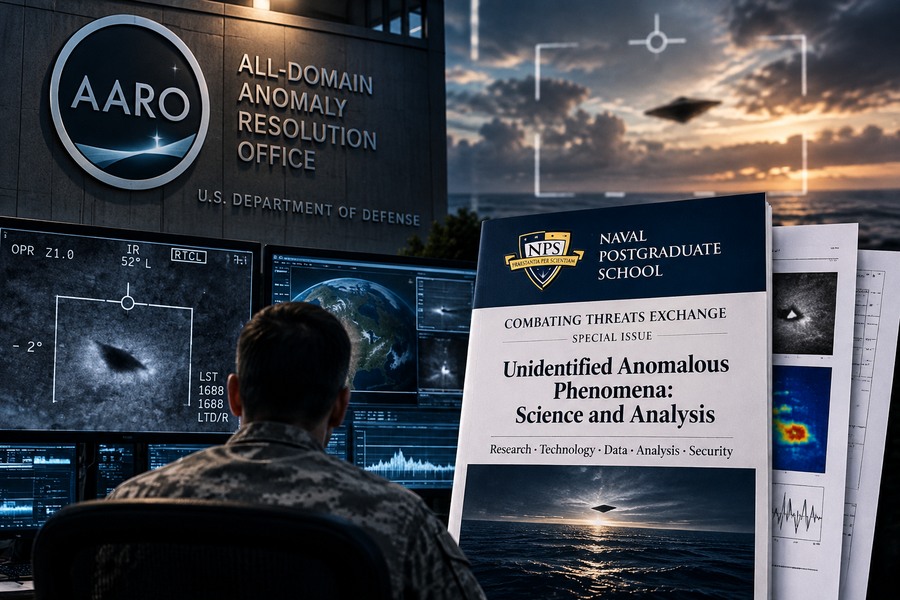
For decades, the UFO debate has been dominated by extraordinary stories, blurry photographs and videos that appear mysterious but often contain too little information for scientists to reach firm conclusions.
A new publication connected with the Pentagon's All-domain Anomaly Resolution Office, or AARO, focuses on a much less sensational question: how can researchers collect better evidence?
The Naval Postgraduate School has published a special issue of its Combating Threats Exchange journal titled Unidentified Anomalous Phenomena: Science and Analysis. The project was developed through the Naval Postgraduate School and in partnership with AARO, with the publication concentrating on data collection, sensing technology and methods for analysing UAP observations. Naval Postgraduate School
Rather than presenting evidence that UFOs are extraterrestrial spacecraft, the publication highlights a fundamental obstacle facing modern UAP research.
Scientists frequently do not have enough high-quality information to determine what an unusual observation actually represents.
That may sound less dramatic than claims about recovered spacecraft or non-human intelligence.
Scientifically, however, it could be far more important.
What Is the New AARO UAP Science Publication?
The special issue contains an introduction, a foreword, an interview with AARO director Dr Jon Kosloski and four technical or practical articles.
Those articles examine data vetting and accessibility, event-based sensing technology, Ukrainian military observations of aerospace objects and methods ordinary observers can use to photograph UAP more effectively. Naval Postgraduate School
The subjects reveal the publication's central theme.
The problem is not simply finding more UFO videos.
It is obtaining observations containing enough information to be scientifically useful.
AARO director Jon Kosloski made the problem particularly clear in his interview for the issue.
He described AARO's biggest challenge as the lack of high-quality data. UAP Global
That single problem explains why so many apparently impressive UFO cases remain difficult to resolve.
Why Is UAP Data Often So Poor?
Modern life is surrounded by cameras.
Smartphones record high-resolution video.
Aircraft carry sophisticated sensors.
Satellites continuously observe Earth.
Military systems can detect objects across enormous distances.
It might therefore seem surprising that unidentified objects are still captured as vague dots, glowing shapes or indistinct blobs.
But image resolution is only one part of the problem.
To analyse an unknown object properly, researchers may need its distance from the sensor, altitude, viewing angle, exact time, sensor settings, camera movement and environmental conditions.
Without those measurements, even a clear-looking video can be surprisingly difficult to interpret.
Imagine watching a small object move rapidly across a video frame.
If researchers do not know its distance, they may not know its physical size.
Without size and distance, calculating its true velocity becomes difficult.
The object could be small and relatively close.
It could be much larger and farther away.
Perspective can make both appear similar.
This is why the difference between an interesting UFO video and scientifically useful UAP data can be enormous.
Why More UFO Videos Do Not Necessarily Mean Better Evidence
Hundreds of UFO videos can provide less scientific information than one carefully recorded event.
A short clip uploaded to social media may contain almost no metadata.
The original file may have been compressed.
The recording may have been cropped.
The person filming may not remember the exact direction in which the camera was pointed.
There may be no information about distance or altitude.
Researchers can enhance the image, stabilise it and examine individual frames.
But they cannot reliably reconstruct information that was never recorded.
This is a crucial limitation.
Artificial intelligence cannot magically recover the physical distance of an object if the original observation contained no information from which that distance can be calculated.
More sophisticated analysis therefore cannot completely compensate for poor data collection.
What Is Event-Based Sensing?
One of the most interesting subjects in the Naval Postgraduate School issue is event-based sensing.
Traditional cameras generally capture complete images at regular intervals.
Event cameras work differently.
Individual pixels respond when they detect changes in brightness.
Instead of repeatedly recording an entire scene, the system can concentrate on changes occurring within it.
This technology can provide extremely high temporal resolution while generating data differently from conventional video.
For UAP research, that could be useful when tracking objects that appear suddenly or move rapidly.
The special issue includes a dedicated article examining event-based sensing for UAP detection, tracking and characterisation. Naval Postgraduate School
That represents an important shift in approach.
Rather than waiting for somebody to notice something unusual and pull out a smartphone, researchers can design instruments specifically to collect useful measurements when anomalous events occur.
Why Multiple Sensors Matter
A single camera recording rarely provides enough information to determine an object's true size, distance or speed. Combining optical observations with radar, infrared measurements and other independent sources can help investigators test competing explanations.
For AARO, the challenge is not simply collecting more sightings, but obtaining reliable measurements that scientists can analyse and reproduce.
For a closer look at the standards involved, read our guide to what evidence scientists would need to confirm an extraordinary UAP.
What Can Scientists Learn From Ukraine?
Another article in the special issue examines Ukrainian military observations and analysis of aerospace objects during the country's defence against Russia. Naval Postgraduate School
This is particularly relevant because modern conflict zones contain an extraordinary variety of objects in the sky.
Aircraft, missiles, drones, satellites, balloons, electronic warfare systems and other technologies can all generate observations that may initially appear unusual.
For UAP researchers, such environments provide an important lesson.
An unidentified observation does not exist in a vacuum.
Researchers must understand the technological and operational environment surrounding it.
A strange object recorded in restricted military airspace may have a very different range of possible explanations from an unusual light recorded above a remote rural location.
Context is therefore part of the evidence.
Can Ordinary People Collect Better UFO Evidence?
Yes — and the special issue specifically addresses this problem.
One article is a practical photography guide designed to help everyday observers capture UAP events more effectively. Naval Postgraduate School
This may seem surprisingly basic compared with military sensors and advanced camera technology.
But civilian observations represent a significant portion of UFO reports.
Simple changes can make those observations considerably more useful.
Keeping the original file matters.
Recording the exact time matters.
Knowing the location matters.
Including stationary objects in the frame can provide useful reference points.
Recording for longer rather than capturing a few seconds can reveal how an object behaves.
Photographing the same event from another position can be even more valuable.
Good scientific evidence does not always require an expensive sensor.
It requires information that allows observations to be tested.
Why Metadata Could Be More Important Than the UFO Image
An unusual image can attract attention, but its scientific value depends heavily on the information recorded alongside it. Timestamps, camera settings, viewing angles and location data can help researchers understand what the equipment actually observed.
Without that context, even striking footage may remain impossible to evaluate confidently. Improving how such information is collected is therefore an important part of making UAP investigations more rigorous.
What Has AARO Previously Said About UFO Evidence?
AARO has previously taken a cautious position regarding extraordinary interpretations of UAP.
Its historical review reported that US government investigations had not found evidence establishing that a UAP represented off-world technology. It also stated that AARO had found no evidence supporting claims that the US government and private companies were secretly reverse-engineering extraterrestrial technology. AARO
The report also identified persistent poor-quality data as one of the factors complicating historical UAP investigations. AARO
This does not mean every UAP has been explained.
Some observations remain unresolved.
The distinction is important.
A case can remain unidentified because the available information is insufficient without providing evidence that the object has an extraterrestrial origin.
BriefGlo's explanation of what AARO is provides additional background on the organisation and its role in modern UAP investigations.
Could Better Sensors Finally Solve UFO Cases?
Better sensors could help investigators identify more ordinary objects and reduce uncertainty in future UAP reports. They may also produce stronger evidence in cases that remain unexplained.
However, improved technology does not guarantee that every observation will receive a definitive answer. The real progress lies in replacing speculation with measurements that can be independently examined.
What About the Pentagon's Released UAP Videos?
This data problem has already appeared in analysis of government UAP footage.
In August 2026, researchers Jacob Haqq-Misra and Ravi Kopparapu analysed 112 videos released through the government's PURSUE programme.
Their preprint analysis highlighted limitations created by missing or redacted sensor information, particularly when attempting to determine whether objects displayed genuinely anomalous velocities. The work had not yet undergone peer review when it was reported. The Debrief
The problem is straightforward.
Watching an object cross a video frame does not automatically reveal its physical speed.
Researchers need information about range, viewing geometry and sensor movement.
Without it, apparently extraordinary movement may be impossible to quantify reliably.
The Pentagon can therefore release an authentic military UFO video while independent scientists still lack enough information to determine what it shows.
Authenticity and scientific completeness are different questions.
Is AARO Trying to Prove Aliens Exist?
That is not what the Naval Postgraduate School publication establishes.
Its focus is improving how UAP observations are collected, analysed and understood.
The original call for contributions described areas including sensing technology, data analysis, theoretical frameworks, historical research and citizen science. Naval Postgraduate School
Those methods could potentially discover something unexpected.
They could also explain observations that currently appear mysterious.
Science must allow both outcomes.
Starting with the conclusion that every UAP has an ordinary explanation would bias the investigation.
Starting with the conclusion that unexplained UAP represent extraterrestrial spacecraft would do exactly the same thing.
The useful question is simpler:
What does the evidence allow researchers to conclude?
Why Scientific UFO Research Is Changing
For much of modern UFO history, researchers have worked backwards.
Something strange was observed.
Investigators then attempted to reconstruct what happened using whatever photographs, memories or records happened to survive.
A scientific approach can reverse that process.
Researchers can decide in advance what information they need.
They can build sensor systems capable of collecting it.
They can establish standards for metadata.
They can preserve original observations.
They can define analytical methods before extraordinary claims are made.
Most importantly, they can quantify uncertainty.
That may not produce spectacular conclusions immediately.
But it provides something UFO research has often lacked: reproducibility.
Could Better Data Make UFOs Less Mysterious?
Probably in many cases.
Improved observations may reveal aircraft, drones, balloons, satellites, atmospheric phenomena or sensor artefacts that previously could not be identified.
That would not make the research unsuccessful.
Explaining an unidentified object is exactly what a successful investigation should do.
Other cases may remain unresolved.
And it is possible that better instruments could eventually record phenomena that do not fit existing explanations.
If that happens, researchers would finally possess the type of evidence needed to demonstrate why those observations are genuinely unusual.
Either outcome represents progress.
Why AARO's Science Approach Matters
The most important development in modern UFO research may not be another dramatic video.
It may be the gradual improvement of the evidence itself.
The Naval Postgraduate School special issue demonstrates that UAP research is increasingly being framed around familiar scientific problems: sensor quality, metadata, measurement, reproducibility and uncertainty. Naval Postgraduate School
Those concepts are less exciting than claims about alien spacecraft.
They are also much more useful for discovering what unidentified objects actually are.
A blurry object can remain mysterious indefinitely.
A calibrated observation containing distance, trajectory, sensor information and independent measurements can be tested.
That is the difference between collecting UFO stories and studying UAP scientifically.
If the next generation of observations contains better data, researchers may finally be able to resolve more cases.
And if something genuinely extraordinary remains after conventional explanations have been tested, scientists will have something far more valuable than speculation.
They will have measurements.
Sources and Further Reading
Naval Postgraduate School — UAP Special CTX Issue: Unidentified Anomalous Phenomena: Science and Analysis
Naval Postgraduate School — Special Edition Journal: Unidentified Anomalous Phenomena
All-domain Anomaly Resolution Office — Official Website
AARO — Historical Record Report, Volume 1
DefenseScoop — New Science Advisory Council Forms to Help US Government Resolve the UAP Mystery
The Debrief — Scientists Analyse More Than 100 Pentagon PURSUE UAP Videos