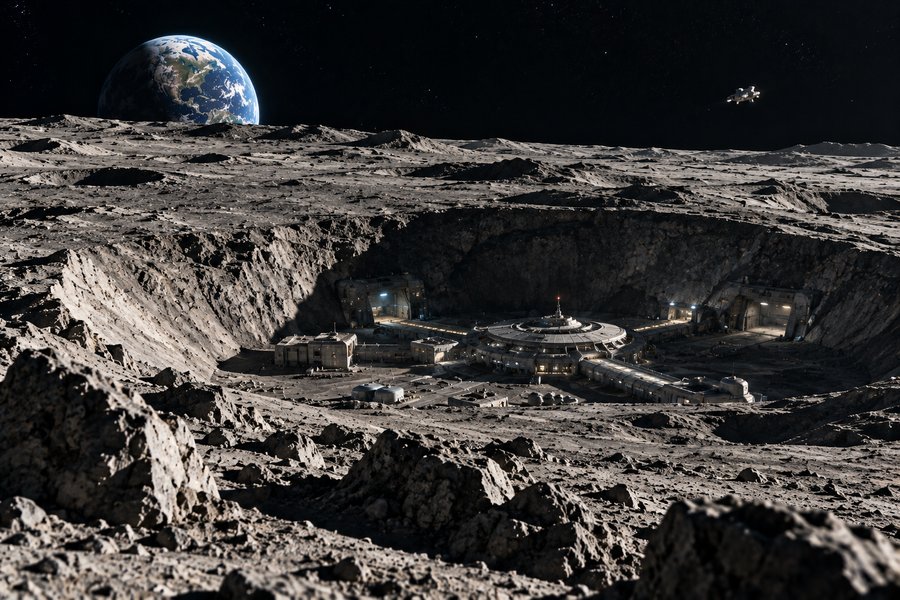
Few places in UFO mythology have attracted as much speculation as the Moon.
For decades, books, documentaries and online communities have claimed that unusual structures, mysterious lights and strange objects photographed during lunar missions could point to something extraordinary: a hidden alien base on the Moon.
Some versions place the alleged installation on the far side, permanently out of direct view from Earth. Others imagine enormous underground complexes hidden inside craters or lunar lava tubes.
It is a compelling story.
It is also a story for which no verified evidence of an extraterrestrial installation has been established.
That does not make every lunar anomaly uninteresting. Lunar exploration continues to reveal complex geology, possible resources and environments that remain scientifically important.
The more useful question, therefore, is not whether an alien base sounds possible.
It is where the idea came from — and whether the evidence normally presented for it actually supports the conclusion.
Why Would Aliens Build a Base on the Moon?
As a thought experiment, the Moon has several attractive characteristics.
It is close to Earth.
It has no oceans, forests or cities covering its surface.
Its geological environment changes far more slowly than Earth's.
And because one hemisphere normally faces away from our planet, the lunar far side can sound like an obvious location for something attempting to avoid observation from Earth.
But there is an immediate problem.
The far side is hidden from observers standing on Earth, not from spacecraft.
Modern missions have extensively photographed and mapped the Moon. NASA's Lunar Reconnaissance Orbiter, for example, has produced detailed maps and measurements of the lunar surface.
A hypothetical civilisation might still construct something underground.
But that moves the discussion from observable evidence into speculation.
Why Is the Far Side Central to the Theory?
The far side remained genuinely mysterious for most of human history.
Because the Moon is tidally locked to Earth, we cannot normally see most of the opposite hemisphere from the ground.
That naturally created a blank space for speculation.
Once spacecraft began photographing it, however, the mystery changed.
The far side turned out to be dominated by heavily cratered terrain and highlands rather than the large dark volcanic plains familiar on the near side.
Today, the idea that nobody knows what exists there is incorrect.
The far side is scientifically fascinating, but it is not an unphotographed hidden world.
The difference between those two ideas is important when examining claims of a secret lunar installation. The wider far side of the Moon UFO mystery shows how genuine lunar geography became intertwined with claims about hidden spacecraft and extraterrestrial installations.
The wider far side of the Moon UFO mystery shows how genuine lunar geography became intertwined with claims about hidden spacecraft and extraterrestrial installations.
Did Apollo Astronauts See UFOs Near the Moon?
Apollo material is another major ingredient in the Moon-base story.
Astronaut transcripts contain descriptions of lights, flashes and unidentified objects. Apollo photographs also contain unusual features that have been interpreted in dramatically different ways.
One case receiving renewed attention involves three bright features associated with Apollo 17 photography. The Apollo 17 UFO case examines those mysterious features more closely, including what the original imagery can and cannot establish.
The existence of an unexplained feature does not establish an alien base.
It establishes an anomaly that may deserve further analysis.
Possible explanations for unusual objects observed during space missions include spacecraft debris, reflections, ice particles, photographic effects and objects whose distance cannot easily be judged against the black background of space.
The distinction matters because UFO mythology often compresses several separate steps into one:
Something appears unusual.
Therefore it is an unidentified craft.
Therefore it is extraterrestrial.
Therefore extraterrestrials are operating from the Moon.
Each step requires additional evidence.
Why Do Apollo Photographs Produce So Many “Structures”?
The lunar surface can be visually deceptive.
There is effectively no atmospheric haze to soften distant features.
Sunlight can illuminate one side of a formation while leaving the neighbouring terrain extremely dark.
Low-angle illumination creates long shadows.
Craters overlap.
Ridges intersect.
Rock formations can appear surprisingly geometric.
Then the image itself introduces another layer.
Older photographs may be scanned, compressed, enlarged, sharpened and copied repeatedly before reaching social media.
Every processing step can change how a small feature appears.
Eventually, a handful of pixels may begin to resemble a tower, entrance, spacecraft or building.
That does not mean the observer is deliberately inventing something.
Human perception naturally searches for recognisable patterns.
What About Towers and Buildings on the Moon?
Claims of enormous lunar towers and artificial structures have circulated for decades.
Usually, the evidence consists of a photograph containing an unusual shape.
The difficulty is scale.
Without reliable information about distance and terrain, a relatively ordinary geological feature can appear enormous.
Shadows create another problem.
A dark region beside a bright ridge may resemble an entrance.
A crater wall illuminated from one direction may resemble a constructed surface.
And digital enhancement can make the problem worse.
Sharpening does not recover unlimited hidden information.
At some point, software begins emphasising noise and interpolation rather than revealing genuine physical detail.
A blurry rectangular feature can therefore begin as geology and end up online labelled as a “Moon building”.
A convincing artificial structure would need to remain artificial-looking across multiple observations, lighting conditions and viewing angles.
That standard has not been met by the famous Moon-base photographs.
Could an Alien Base Be Underground?
This version of the theory is harder to dismiss simply by looking at surface photographs.
The Moon genuinely contains subsurface environments.
Research based on lunar observations has supported the existence of pits and cave-like structures associated with volcanic terrain. Such environments are scientifically interesting partly because natural underground shelters could eventually protect human explorers from radiation, micrometeorites and extreme surface conditions.
That gives the underground-base theory an interesting twist.
A technologically advanced civilisation could theoretically recognise the same advantages.
But this is where possibility and evidence must remain separate.
Natural caves exist.
That does not demonstrate that anyone occupies them.
A cave is evidence of lunar geology, not evidence of extraterrestrial engineering.
Could Something Have Been Left on the Moon Millions of Years Ago?
This is a more scientifically interesting version of the question.
Imagine that a technological civilisation explored the Solar System long before humans developed civilisation.
Where might traces survive?
Earth is not ideal.
Weather erodes surfaces.
Oceans move sediments.
Plate tectonics recycles crust.
Biological activity changes environments.
The Moon is different.
Its surface can preserve ancient material for extremely long periods.
That means the idea of searching the Moon for hypothetical technological artefacts can be considered without first assuming aliens are currently operating a secret base.
The logic is similar to archaeology.
Researchers would not begin by declaring that an artefact exists.
They would ask what signature an artificial object might produce and then search for it.
That is a fundamentally different approach from examining random photographs until something looks artificial. A more recent scientific proposal explores whether microscopic traces of alien technology could survive in Moon dust. Unlike claims about hidden lunar bases, this approach focuses on potential material evidence that could be tested in a laboratory.
What About Strange Lights on the Moon?
Unusual lunar lights have a long history.
Observers have occasionally reported temporary brightening, colour changes or flashes associated with particular lunar regions.
Historically these have often been grouped under the term transient lunar phenomena.
Several natural mechanisms can produce temporary visual events.
Meteor impacts are one example.
Lighting geometry can also dramatically alter the appearance of lunar terrain.
Instrumental and atmospheric effects can complicate Earth-based observations.
A flash therefore becomes scientifically useful only when researchers can establish where it occurred, how long it lasted and whether independent instruments recorded it.
Without that information, a strange light remains a strange light.
It does not automatically become a spacecraft leaving an underground base.
Why Doesn't NASA Simply Photograph Every Suspected Site?
In many cases, it already has.
Modern lunar missions have generated enormous quantities of imagery and scientific data.
NASA's Lunar Reconnaissance Orbiter continues to provide detailed information about lunar terrain, composition and potential resources.
The problem is that conspiracy claims can move faster than evidence.
When one alleged structure is identified as geology, another photograph can replace it.
When higher-resolution imagery fails to reveal a base, the theory can shift underground.
When the near side produces nothing convincing, attention moves to the far side.
A hypothesis that continually changes to avoid contradictory observations becomes increasingly difficult to test.
That does not prove the hypothesis false.
But it does reduce its scientific usefulness.
Would Governments Be Able to Hide a Moon Base?
This question has changed considerably since the Apollo era.
Lunar exploration is no longer controlled by a single country.
Space agencies, universities, private organisations and amateur astronomers all contribute observations.
Different nations operate lunar spacecraft.
Scientists routinely publish and analyse lunar data.
Hiding an enormous surface installation would therefore require more than altering one NASA photograph.
Independent observations would also need to fail to reveal it.
The smaller and deeper underground a hypothetical installation becomes, the harder it would be to detect.
But notice what happens to the claim.
It also becomes harder to verify.
What Evidence Would Actually Change the Debate?
A genuine discovery would need evidence far stronger than an unusual photograph.
Multiple independent spacecraft could photograph the same structure.
Radar might identify geometry inconsistent with natural geology.
Spectroscopy could reveal unusual manufactured materials.
Thermal observations might detect unexplained energy.
Repeated activity could establish movement.
A future mission might eventually inspect the location directly.
Physical material would be stronger still.
The key would be convergence. The same principle applies when evaluating UAP evidence, where multiple independent measurements are far more valuable than a single ambiguous photograph.
Different forms of evidence would point towards the same conclusion.
One blurry image would no longer carry the entire argument.
That is the standard required for an extraordinary claim.
Could Future Moon Missions Find Something Unexpected?
Certainly.
The Moon is not fully explored simply because it has been extensively photographed.
Scientists continue to investigate its interior, polar regions, water resources, geological history and subsurface environments.
Future astronauts and robotic missions will examine environments that humans have never physically visited.
Unexpected discoveries are almost inevitable.
But “unexpected” should not be confused with “extraterrestrial”.
A newly discovered cave would be extraordinary lunar geology.
An unusual mineral deposit could reshape theories of lunar history.
An unexplained object would require investigation.
Only evidence demonstrating technological manufacture by a non-human civilisation would justify moving to the alien conclusion.
Why Does the Alien Moon Base Theory Survive?
Because it combines several powerful ideas.
A world we can see but cannot easily visit.
A hemisphere hidden from direct Earth-based observation.
Secretive Cold War space programmes.
Astronaut stories.
Strange photographs.
UFOs.
And the possibility that humanity is not alone.
The theory also benefits from an asymmetry.
Evidence against one alleged structure does not eliminate every possible hiding place on the Moon.
There is always another crater.
Another photograph.
Another cave.
Another shadow.
That makes the story difficult to kill — but it does not make it stronger scientifically.
So Is There an Alien Base on the Moon?
There is currently no verified evidence demonstrating that an extraterrestrial civilisation operates, or once operated, a base on the Moon.
There are genuine lunar mysteries.
There are unusual photographs.
There are caves and pits.
There are historical reports of strange lights.
There are unresolved questions about some observations made during spaceflight.
Those facts can justify investigation. This distinction also matters when asking whether UFOs are real, because a genuinely unexplained observation does not automatically identify the intelligence or technology behind it.
They do not collectively become proof of an alien installation simply because they are placed next to one another.
The strongest version of the Moon-base question is therefore not:
“Where is NASA hiding the alien base?”
It is:
“What evidence would allow us to distinguish an artificial extraterrestrial structure from ordinary lunar geology?”
That question is testable.
And if humanity ever does discover something artificial on the Moon that was not built by us, the evidence required to establish it will almost certainly be much stronger than a strange shadow in an old photograph.
Sources and Further Reading
NASA Science — Earth's Moon
NASA — Lunar Reconnaissance Orbiter
NASA Science — Earth's Moon
NASA — Lunar Reconnaissance Orbiter
NASA — Moon Caves and Lunar Pits