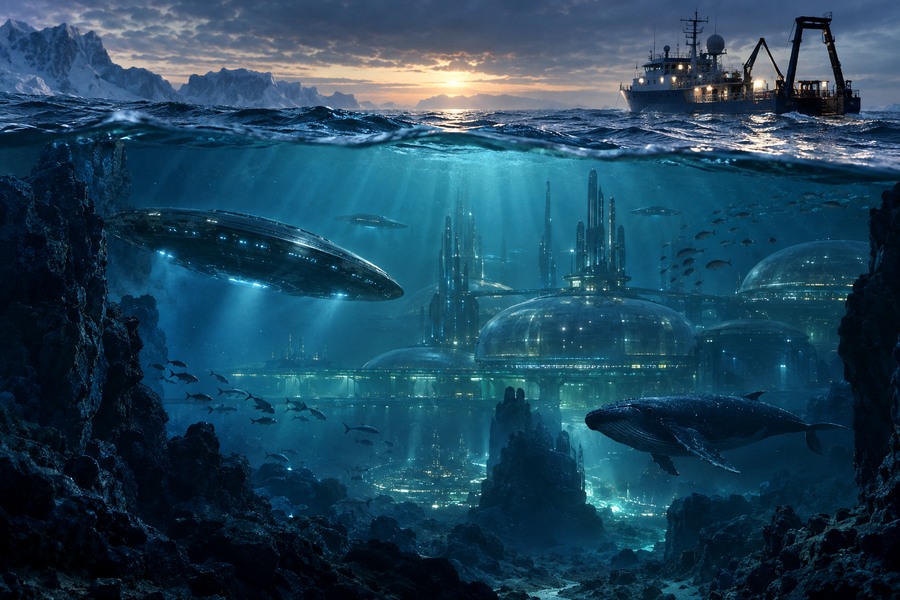
For decades, the search for extraterrestrial intelligence has looked towards the stars. Radio telescopes scan distant systems, astronomers study potentially habitable planets, and spacecraft investigate worlds that may contain the ingredients for life.
But a more unusual question has increasingly entered discussions about UFOs and unidentified anomalous phenomena: what if an unknown intelligence is not arriving from distant space at all?
What if it is already here — beneath the ocean?
Stories of unidentified objects entering or leaving the sea have helped create the idea of an underwater intelligence: a technologically advanced presence supposedly capable of operating within Earth’s oceans while remaining largely hidden from humanity.
It is an intriguing hypothesis. It is also one for which there is currently no verified evidence.
Yet the question becomes more interesting when we consider just how little of the deep ocean humans have directly observed.
Why the Ocean Creates the Perfect Mystery
Earth may feel thoroughly explored, but its oceans tell a different story.
The ocean covers roughly 70 per cent of the planet’s surface and has an average depth of about 3,682 metres. The deepest known point, Challenger Deep in the Mariana Trench, reaches approximately 10,935 metres.
More importantly, direct observation of the deep-ocean floor remains extremely limited.
According to NOAA Ocean Exploration, as of April 2026 around 28.7 per cent of the global seafloor had been mapped using modern high-resolution technology. But mapping is not the same as physically observing an environment.
NOAA estimates that humans have directly observed less than 0.001 per cent of the deep-ocean seafloor.
That enormous observational gap naturally creates room for speculation.
It does not demonstrate that an unknown civilisation exists underwater. It simply means that large parts of the deep ocean remain poorly observed compared with Earth’s surface.
From UFOs to USOs
Most people are familiar with UFOs and UAPs. Less familiar is the term USO — Unidentified Submerged Object.
The expression is commonly used in UFO literature for unusual objects reportedly observed beneath the water, entering the ocean or emerging from it.
This overlaps with another idea frequently discussed in modern UAP circles: so-called transmedium objects, meaning objects reported as apparently moving between environments such as air and water.
Reports of this kind have contributed to speculation that some unusual objects seen near coastlines or military operations might have an underwater origin.
However, there is an important distinction.
Unidentified does not mean extraterrestrial.
An observation may remain unidentified because information is incomplete, sensor data are limited, the object was observed briefly, or investigators cannot confidently distinguish between conventional explanations.
For a closer examination of reported underwater objects and the evidence behind them, read our article on whether UFOs are coming from the ocean.
The Underwater Intelligence Hypothesis
The more speculative version of the idea goes beyond individual unidentified objects.
It proposes that an advanced intelligence could maintain a permanent presence somewhere within Earth’s oceans.
Different versions suggest different origins.
One possibility imagines extraterrestrial visitors establishing underwater facilities because the ocean provides natural concealment.
Another proposes something considerably stranger: an intelligent civilisation that developed on Earth independently of humanity and has remained hidden.
This overlaps with the broader cryptoterrestrial hypothesis, which explores the possibility that an unknown technologically advanced population could exist on or near Earth rather than arriving from another star system.
At present, neither scenario has been demonstrated by scientific evidence.
Could a Civilisation Actually Hide in the Deep Ocean?
The sheer size of the ocean makes the question tempting.
But hiding an entire technologically advanced civilisation would be considerably harder than hiding an undiscovered species.
Advanced technology requires energy. Large settlements would potentially produce heat, waste, chemical changes, sound or physical infrastructure.
Modern oceans are also monitored using satellites, sonar, research vessels, autonomous vehicles, underwater cables and military systems.
This does not mean every cubic kilometre of ocean is continuously watched. Far from it.
But a large industrial civilisation operating over long periods would plausibly leave multiple detectable signatures.
So far, no publicly verified discovery has demonstrated the existence of such a civilisation.
The fact that much of the ocean remains unexplored therefore cannot itself be treated as evidence that something technologically advanced is hiding there.
Deep-Sea Life Shows Why Scientists Keep Looking
There is another reason the idea of life in extreme underwater environments remains fascinating — one grounded firmly in science.
Life survives in places once considered extraordinarily hostile.
Deep-sea ecosystems can exist without sunlight. Around hydrothermal vents, organisms survive using chemical energy associated with interactions between seawater and rock.
These environments have become important to astrobiology because they demonstrate that sunlight is not necessarily required for an ecosystem.
That discovery changes how scientists think about life elsewhere.
If life can thrive around Earth’s deep-ocean hydrothermal systems, perhaps organisms could survive beneath the ice of distant worlds.
NASA Is Looking at Oceans Too — Just Not for Underwater Aliens
Some online discussions connect NASA with claims of hidden discoveries beneath Earth’s oceans.
The reality is more interesting scientifically, although less sensational.
NASA studies extreme environments on Earth partly because they can help scientists understand potentially habitable environments elsewhere.
Europa, a moon of Jupiter, is believed to contain a global ocean beneath its icy surface. NASA considers Europa an important target for studying whether environments beyond Earth could support life.
Saturn’s moon Enceladus is another extraordinary example.
Evidence indicates that Enceladus contains a global saltwater ocean beneath its icy crust. Material from that ocean escapes through plumes into space, allowing spacecraft to investigate its chemistry.
NASA research has also found evidence consistent with hydrothermal activity and chemical energy sources that could potentially support microbial ecosystems.
The contrast is important. NASA is investigating whether ocean worlds such as Europa and Enceladus could provide environments suitable for life, particularly microbial life. This is different from investigating claims of advanced alien civilisations beneath Earth's oceans.
NASA's Europa Clipper mission, launched in October 2024, is designed to assess Europa's habitability, not to confirm that life has already been discovered there.
Could Underwater Aliens Avoid Detection?
An unknown underwater civilisation would be difficult to investigate if every missing piece of evidence were explained by assuming that its technology could evade detection.
A scientifically useful hypothesis must produce predictions that researchers can test. Evidence might include independently verified artificial structures, unusual materials, persistent energy signatures or repeatable sensor observations.
Until such evidence is available, the unexplored ocean cannot be treated as proof of a hidden technological civilisation.
What About Underwater Alien Bases?
Claims about secret underwater alien bases have circulated for decades, often connected with particular coastlines, unusual sonar readings or UFO sightings over water.
Such claims should be separated into three categories:
Documented observation: Something unusual was genuinely recorded or reported.
Unresolved observation: Available information does not provide enough evidence for a confident explanation.
Extraordinary interpretation: The unexplained observation is attributed to aliens, non-human intelligence or a hidden underwater base.
Only the first two can sometimes be established from available evidence.
Moving from “we cannot identify this object” to “this is an alien craft operating from an underwater base” requires additional evidence.
This distinction is central to evaluating credible UAP evidence: an unexplained observation can be genuine without proving that an extraterrestrial explanation is correct.
Could the Ocean Hide Something We Have Never Seen?
Almost certainly.
Scientists continue to discover new marine species and previously unknown geological features.
NOAA estimates that a substantial proportion of ocean species may remain undiscovered or formally undescribed.
The deep ocean therefore remains one of Earth’s greatest scientific frontiers.
But there is a vast difference between discovering an unfamiliar organism and discovering a technologically advanced non-human civilisation.
The first happens regularly.
The second has never been verified.
So, Could Aliens Be Living in Earth’s Oceans?
As a hypothetical possibility, it cannot be completely excluded simply because humanity has not explored every part of the ocean.
As a claim supported by current evidence, however, the situation is very different.
There is presently no verified scientific evidence demonstrating that extraterrestrials, non-human intelligence or an advanced hidden civilisation lives beneath Earth’s oceans.
Reports of unusual objects around water remain interesting when supported by credible observations or sensor data, but “unidentified” should remain unidentified until stronger evidence allows a more specific conclusion.
Perhaps the most fascinating part of the underwater intelligence hypothesis is therefore not what it proves, but what it reveals about two genuine scientific mysteries.
We still have an enormous amount to learn about our own ocean.
And elsewhere in the Solar System, hidden oceans beneath kilometres of ice may genuinely be among the most promising places to search for life beyond Earth.
The ocean mystery is real.
Whether anyone else is living in it remains an unanswered — and so far unsupported — question.
Sources and Further Reading
NASA — Europa Clipper Mission Science
NOAA Ocean Exploration — How Much of the Ocean Has Been Explored?
NOAA Ocean Exploration — How Deep Is the Ocean?
NASA — Europa Clipper Mission
NASA — Why Europa? Ingredients for Life