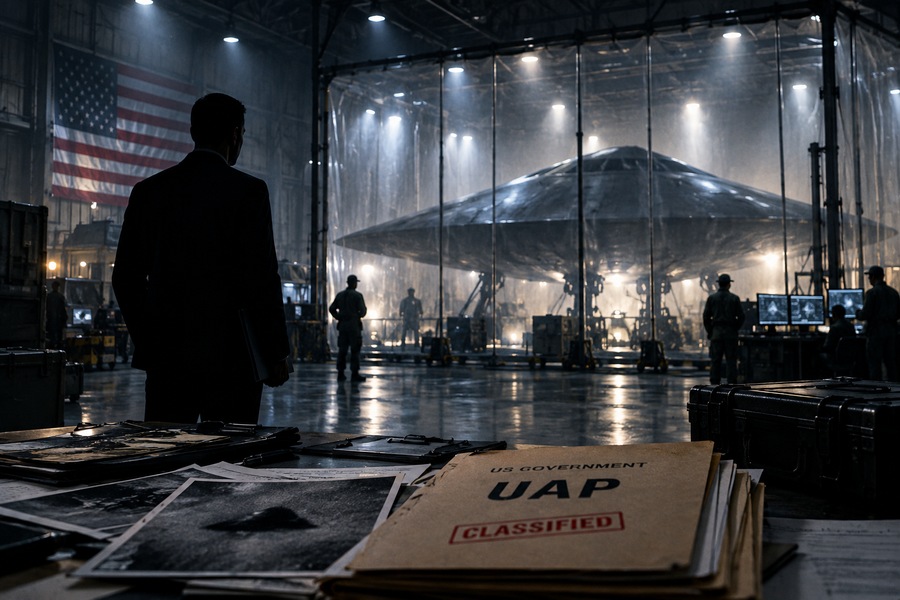
A remarkably direct UFO claim has pushed UAP whistleblower Dylan Borland back into the spotlight.
During an appearance on the Hang Out with Sean Hannity podcast, Borland was asked whether the US government possesses recovered craft.
His answer was unequivocal.
When Hannity followed by asking whether Borland knew this “for a fact”, Borland answered yes.
The exchange quickly travelled beyond the podcast, producing another wave of discussion around UFO disclosure and alleged government crash-retrieval programmes.
But there is an important distinction between the significance of the statement and the strength of the publicly available evidence.
Borland made a clear claim.
He did not publicly provide a recovered object, laboratory analysis, photographs or documents capable of independently establishing that the alleged craft exists — or that it has a non-human origin.
That leaves us with a familiar problem in modern UAP research:
How much evidential weight should be given to whistleblower testimony when the underlying material remains unavailable to the public?
Who Is Dylan Borland?
Borland is not simply an anonymous UFO witness appearing online.
He has identified himself as a former US Air Force geospatial intelligence specialist and subsequently entered official UAP whistleblower channels.
In written testimony submitted to the US House Oversight Committee for its 9 September 2025 hearing, Borland identified himself as a former Air Force 1N1 geospatial intelligence specialist who served from 2010 to 2013. He also described later work analysing imagery and radar data for defence contractors. These details are documented in his congressional statement, although the statement itself does not independently verify his extraordinary UAP allegations.
Borland has also said he supplied information to government bodies including the Intelligence Community Inspector General and the All-domain Anomaly Resolution Office.
That background makes his statements relevant to the disclosure debate.
It does not independently prove them.
This distinction is essential.
Someone's professional background can help establish whether they plausibly occupied a position to encounter particular information.
It cannot, by itself, establish that every conclusion or allegation they subsequently make is correct.
What Did Dylan Borland Actually Say?
The latest controversy comes from a straightforward exchange.
Hannity asked whether the government possesses recovered craft.
Borland answered that it does.
Hannity then asked whether he knew that “for a fact”.
Borland answered yes.
That wording naturally produced headlines.
But several questions remain unanswered publicly.
What craft is Borland referring to?
Where was it recovered?
Where is it currently stored?
What evidence establishes its origin?
Has Borland personally examined it?
Has its material been independently analysed?
Could it represent classified human technology rather than something non-human?
The publicly available exchange does not answer those questions.
That does not establish that Borland's claim is false.
It means the claim cannot currently be independently verified from the evidence released alongside it.
“Recovered Craft” Does Not Automatically Mean Alien Craft
This distinction is easy to lose in UFO coverage.
An unidentified craft is not necessarily an extraterrestrial craft.
Military and intelligence organisations encounter technology belonging to other countries, experimental systems, drones, surveillance platforms and objects whose origins may initially be uncertain.
For a recovered object to become convincing evidence of non-human technology, investigators would need considerably more than testimony that a craft exists.
Ideally, researchers would want physical material accompanied by a documented chain of custody.
That material could then be examined by independent laboratories.
Researchers could study isotopic composition, manufacturing techniques, microscopic structure and other physical characteristics.
Even highly unusual material would require careful interpretation.
“Unfamiliar” and “extraterrestrial” are not synonyms.
Has Borland Released Physical Evidence?
Not publicly in connection with this claim.
Reports covering the new interview do not identify documents, photographs or physical samples released by Borland that independently demonstrate the existence of the alleged recovered craft.
Nor does the exchange publicly identify the craft's location or origin.
This is currently the central evidential limitation.
The public can assess what Borland said.
It cannot independently inspect the object he says exists.
For BriefGlo's purposes, that places the statement in the category of an important attributable whistleblower claim rather than verified physical evidence.
Understanding the difference between testimony, sensor data and physical material is central to evaluating UAP evidence. A claim may justify further investigation without independently establishing that a recovered non-human craft exists.
The Claim Conflicts With AARO's Public Position
Borland's statement becomes more interesting when compared with the US government's published UAP assessment.
AARO has publicly stated that its investigations have not established verifiable evidence that the US government or private companies possess extraterrestrial technology. Our guide to what AARO does explains the agency's investigative role and how its published findings differ from individual whistleblower allegations.
The positions therefore differ substantially.
Borland says recovered craft exist.
AARO says its investigations have not verified evidence establishing possession of extraterrestrial craft.
Neither statement should simply be transformed into proof of the opposite position.
A government conclusion does not logically demonstrate that every whistleblower allegation is false.
Likewise, a whistleblower allegation does not become verified merely because someone believes the government could conceal information.
The useful question is what independently testable evidence each side can provide.
Why Whistleblowers Matter to the UAP Debate
UAP whistleblowers have become increasingly important because many allegations involve classified programmes.
That creates an unusual evidential problem.
A person may claim to know something but simultaneously say that classification rules prevent them from showing the underlying information publicly.
For outsiders, this creates a difficult situation.
The allegation can potentially be investigated through authorised government channels, but the general public may still be unable to evaluate the evidence.
This is one reason recent changes to government reporting procedures matter.
BriefGlo previously examined how new reporting mechanisms affect UAP whistleblowers.
A protected reporting route can make it easier for authorised investigators to receive sensitive information.
It does not automatically make every allegation true.
The Pentagon Is Releasing More UFO Records
Borland's comments also arrive during a period of increased public attention around official UAP records.
Government archives have released documents, reports and other material connected with historical and modern UFO investigations.
Some cases remain unresolved in publicly available records.
But an unidentified object is not automatically evidence of extraterrestrial technology.
This is why the growing collection of Pentagon UFO files should be separated from the much stronger claim that the government physically possesses non-human craft.
Those are different evidential questions.
Borland Is Not the First Whistleblower to Make Such Claims
The recovered-craft allegation has appeared before.
Former intelligence officer David Grusch became internationally known after alleging that the US government possessed recovered craft connected with a long-running retrieval programme.
Former intelligence officer David Grusch became internationally known after alleging that the US government possessed recovered craft connected with a long-running retrieval programme.
Those claims generated significant congressional and public interest.
Yet the central public-evidence problem remains.
The most extraordinary underlying material has not been released in a form that allows independent scientific testing.
Borland's statement therefore does not emerge in isolation.
It adds another named whistleblower to a broader dispute over whether extraordinary evidence exists behind classified barriers.
What Evidence Would Change the Debate?
A recovered non-human craft would potentially be one of the most important discoveries in human history.
The evidential standard should reflect that.
The strongest case would involve several independent forms of evidence converging.
A physical object with documented provenance would be important.
Material samples available to multiple independent laboratories would allow scientific testing.
Researchers could examine whether manufacturing characteristics or material properties can be explained by known technology.
Reliable records showing where and when an object was recovered would provide provenance.
Associated sensor data could provide another independent source of information.
Multiple witnesses whose accounts can be corroborated would strengthen the evidential chain further.
No single element would necessarily establish extraterrestrial origin.
The strength would come from independent evidence consistently pointing towards the same explanation.
Could the Government Really Keep Something This Large Secret?
This question appears whenever crash-retrieval allegations emerge.
Governments unquestionably maintain classified programmes.
The existence of classified aerospace and intelligence projects is not controversial.
But secrecy becomes progressively more complicated as the number of participants, facilities, contractors and years involved increases.
A decades-long programme involving recovered non-human spacecraft would presumably require specialists in materials science, engineering, intelligence, security, logistics and administration.
That does not make secrecy impossible.
It does mean a strong public case would eventually require evidence beyond testimony.
Documents, physical samples, authenticated imagery or independently corroborated records would substantially change the debate.
Until then, the public is being asked to evaluate claims about evidence it cannot inspect.
So, Has the US Government Recovered a UFO?
The most accurate answer remains:
There is an explicit whistleblower claim that it has, but publicly available evidence has not established that claim as fact.
Dylan Borland says recovered craft exist.
His intelligence background and participation in official whistleblower processes make the statement relevant.
But relevance is not verification.
No publicly available physical craft, independently tested material or documentary evidence released alongside the recent claim currently allows outside researchers to confirm that the alleged object exists or that it has a non-human origin.
The dispute also returns to the broader question of whether UFO reports have yet produced evidence strong enough to establish a genuinely unknown technology.
That leaves the central question unresolved.
If Borland or other whistleblowers eventually produce independently testable material, the evidential landscape could change dramatically.
Until then, this remains a consequential claim in the modern UFO disclosure debate — and still a claim awaiting publicly verifiable proof.
Sources and Further Reading
U.S. Government Publishing Office — Official Congressional Hearing Transcript
U.S. House Oversight Committee — Dylan Borland's Written Testimony
U.S. House Oversight Committee — UAP Transparency and Whistleblower Protection Hearing