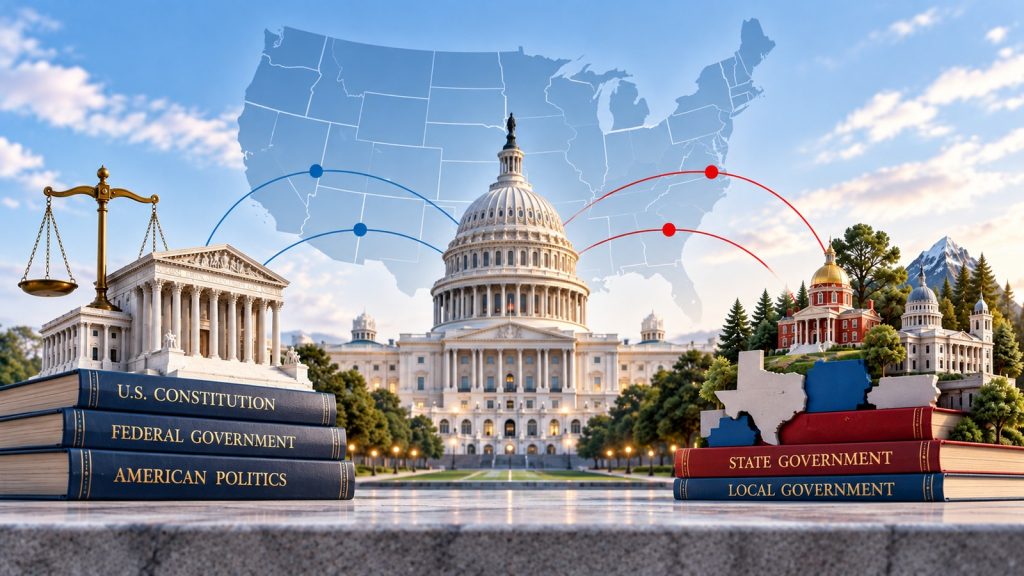
Federal vs. State Government: Who Has More Power in the United States?
The United States has one federal government, 50 state governments and thousands of local authorities. Each has responsibilities that affect how Americans live, work, pay taxes and access public services.
For people unfamiliar with the American political system, this arrangement can seem confusing.
Why can driving rules differ between states? Why does the federal government control immigration while states make many decisions about schools? And what happens when a state law conflicts with a federal law?
The answers lie in a constitutional principle known as federalism.
Rather than giving all political authority to one national government, the United States divides power between the federal government and the states.
Understanding that division is essential to understanding how American government works.
What Is the Difference Between Federal and State Government?
The federal government exercises authority across the United States in areas assigned to it by the Constitution.
State governments exercise authority within their respective states, subject to the U.S. Constitution and applicable federal law.
Both levels of government can make laws, collect taxes and operate public institutions.
However, their responsibilities are not identical.
| Federal government | State government |
|---|---|
| Exercises authority nationwide within constitutional limits | Exercises authority within a particular state |
| Handles national defence and foreign relations | Oversees many state and local public services |
| Regulates interstate and foreign commerce | Regulates many activities within the state |
| Establishes federal immigration law | Administers state laws and institutions |
| Collects federal taxes | Collects state taxes where applicable |
| Operates federal courts | Operates state court systems |
This division is not absolute.
Many policy areas involve both levels of government, and disputes can arise over where one government's authority ends and another's begins.
What Is Federalism?
Federalism is a system in which governmental authority is divided between a national government and regional governments.
In the United States, those regional governments are the states.
The Constitution establishes the federal government's powers while recognising the continuing authority of the states.
The Tenth Amendment states that powers not delegated to the United States by the Constitution, nor prohibited to the states, are reserved to the states or the people.
This does not mean the federal government has authority only when the Constitution names an activity in everyday language.
Congress also possesses certain implied powers necessary and proper for carrying out its enumerated responsibilities.
The balance between national and state authority has developed through legislation, constitutional amendments and court decisions.
For a broader explanation, read our guide to the U.S. Constitution.
Why Did the United States Create Two Levels of Government?
The division of authority reflects the country's early history.
After independence, the original states operated under the Articles of Confederation.
That arrangement left the national government with limited powers, creating difficulties in taxation, trade and collective decision-making.
The Constitutional Convention of 1787 sought to establish a more effective national government.
However, many delegates also feared concentrating too much authority in a distant central institution.
The resulting Constitution created a federal system.
The national government received significant powers, while states retained substantial responsibilities.
This compromise helped establish a functioning union without completely replacing the states as political institutions.
The precise balance has remained a subject of debate throughout American history.
What Powers Does the Federal Government Have?
The Constitution grants the federal government important responsibilities affecting the country as a whole.
National Defence and Foreign Relations
The federal government manages diplomatic relations with other countries and maintains the armed forces.
Congress has the power to declare war, while the president serves as commander in chief.
The federal government also negotiates treaties and conducts foreign policy through constitutionally established procedures.
Individual states cannot independently conduct national foreign policy.
Immigration and Citizenship
Federal law governs immigration and naturalisation.
Federal agencies administer visa systems, immigration enforcement and citizenship procedures.
States may have responsibilities that interact with immigration policy, but they cannot establish an independent national immigration system.
Interstate and International Commerce
Congress has constitutional authority to regulate commerce among the states and with foreign nations.
This power supports federal legislation affecting industries, transport, labour and commercial activities that cross state boundaries.
The scope of the commerce power has been interpreted and limited through Supreme Court decisions.
Federal Taxation and Spending
Congress can levy federal taxes and authorise spending within constitutional limits.
Federal revenue supports national programmes, defence, infrastructure and other government activities.
The federal government may also provide grants to states, sometimes with conditions attached.
What Powers Do State Governments Have?
State governments exercise extensive authority over matters affecting people within their borders.
Education
States play a central role in organising and funding public education.
They establish educational standards, regulate school systems and oversee many aspects of teacher qualifications.
Local school districts often manage day-to-day operations.
The federal government also influences education through civil rights laws, funding programmes and other legal requirements.
Education is therefore largely state-administered, but not exclusively a state concern.
Public Safety
States establish many criminal laws and maintain law enforcement institutions.
They also regulate various public safety activities.
Local governments operate police departments and emergency services under state law.
Federal authorities enforce federal criminal laws and may cooperate with state agencies.
The existence of both systems means some conduct can fall within state and federal jurisdiction.
Driving and Transport Rules
States generally issue driving licences and establish many road traffic laws.
Speed limits, vehicle registration procedures and certain licensing requirements can differ between states.
Federal standards and funding requirements also influence transport policy.
This is one reason driving regulations are not completely uniform across America.
State Taxes and Public Services
States may collect income taxes, sales taxes and other forms of revenue.
The types and rates vary considerably.
Some states do not impose a broad individual income tax, while others rely heavily on it.
State budgets help finance schools, transport networks, healthcare services and other programmes.
What Powers Do Federal and State Governments Share?
Some powers are exercised by both levels of government.
These are often described as concurrent powers.
Both federal and state governments may collect taxes, establish courts and enact laws within their respective authority.
They can also cooperate on infrastructure, public health and emergency management.
For example, a major highway project may involve federal funding, state planning and local construction decisions.
Healthcare provides another example.
Federal laws and programmes operate alongside state licensing requirements, insurance regulations and public health systems.
Shared responsibilities can make public services more flexible.
They can also produce disagreements over funding, legal obligations and administrative control.
What Happens When Federal and State Laws Conflict?
Article VI of the Constitution contains the Supremacy Clause.
It establishes that the Constitution, federal laws made pursuant to it and treaties made under U.S. authority form the supreme law of the land.
When a valid federal law conflicts with a state law, federal law generally prevails to the extent of the conflict.
This principle is known as federal preemption.
However, not every difference between federal and state law creates a legal conflict.
States may sometimes establish additional rules where federal law permits them.
Courts examine the relevant constitutional provisions, statutory language and legal context to determine whether preemption applies.
Federal supremacy also does not mean the federal government can exercise any power it wishes.
Federal actions must themselves comply with the Constitution.
Can a State Refuse to Follow Federal Law?
A state cannot make a valid federal law disappear simply by declaring it invalid.
However, an important distinction exists between complying with federal law and being required to administer federal programmes.
Under the anti-commandeering principle, the federal government generally cannot require state legislatures or executive officials to carry out federal regulatory programmes.
The Supreme Court has addressed this principle in cases including New York v. United States, Printz v. United States and Murphy v. NCAA.
For example, the federal government may enforce a valid federal law using federal authorities.
But it cannot automatically require state officials to implement that programme on its behalf.
The legal outcome depends on the specific law and constitutional issue.
This distinction is often overlooked in public debates about federal and state power.
How Does Federalism Affect Elections?
States have substantial responsibilities for administering American elections.
They establish many procedures involving voter registration, polling places, ballots and vote counting.
However, those procedures must comply with the Constitution and applicable federal legislation.
Congress also has authority over certain aspects of federal elections.
The federal government establishes important protections against discrimination in voting.
This combination explains why voting procedures can vary between states even during the same presidential election.
For a detailed explanation, see our article on how U.S. elections work.
Does Every State Have Its Own Constitution?
Yes. Each of the 50 states has its own constitution.
State constitutions establish the structure of state government and provide legal rules for state institutions.
They may also protect rights beyond those required by the federal Constitution.
However, state constitutions cannot override the U.S. Constitution.
Most state governments have legislative, executive and judicial branches, although their institutional details differ.
For example, state legislatures vary in size, and the procedures for selecting judges are not uniform nationwide.
This reflects the ability of states to organise their internal governments within federal constitutional limits.
What Is the Role of Local Government?
Local governments include counties, cities, towns and other administrative bodies.
They may provide services such as waste collection, local roads, public transport, planning and emergency response.
Unlike the federal government and states, local governments do not possess the same independent constitutional status under the U.S. federal system.
Their powers generally come from state constitutions and state laws.
Some cities and counties have substantial home-rule authority, allowing them to manage local matters.
Others operate under more restrictive arrangements.
This is why local government powers can vary considerably from one state to another.
Federal vs. State Government: Real-Life Examples
The division of authority becomes easier to understand through everyday situations.
| Situation | Main responsibility |
|---|---|
| Applying for a U.S. passport | Federal government |
| Obtaining a driving licence | State government |
| Joining the U.S. military | Federal government |
| Attending a public school | Primarily state and local government |
| Paying federal income tax | Federal government |
| Paying applicable state income tax | State government |
| Registering to vote | State and local election authorities, subject to federal law |
| Resolving a federal constitutional dispute | Courts with appropriate jurisdiction |
These are general examples.
Some services involve several levels of government, and responsibility may differ depending on the legal circumstances.
Who Has More Power: Federal or State Government?
There is no single answer covering every area of government.
The federal government has supreme authority when acting within its constitutional powers and where valid federal law controls.
States retain broad powers over many domestic matters.
For example, the federal government controls national defence, but state and local institutions make many decisions affecting public education.
Congress may establish nationwide legal requirements in areas within its authority, while states administer many public programmes.
The balance also changes as courts interpret constitutional provisions and Congress enacts new legislation.
Federalism is therefore not simply a hierarchy in which the federal government controls every state decision.
It is a division of authority governed by the Constitution.
How Do the Three Branches Fit Into Federalism?
Federalism and separation of powers are different constitutional principles.
Federalism divides authority between the national government and the states.
Separation of powers divides federal authority among Congress, the president and the federal courts.
The two arrangements operate together.
For example, Congress may pass a federal law affecting state governments.
The executive branch may implement that law, while federal courts may decide whether it is constitutional.
State governments may also challenge federal actions in court when they have a legally recognised basis to do so.
Our article on why the U.S. government has three branches explains this second division of power.
Why Does Federalism Still Matter Today?
Federalism affects debates over education, healthcare, environmental regulation, elections and public safety.
Supporters of decentralised government argue that states can respond to local needs and experiment with different policies.
Supporters of stronger national standards argue that some problems require consistent protections and coordination across state borders.
Both perspectives reflect genuine features of the American system.
State flexibility can encourage innovation, but it can also produce significant differences in public services and legal protections.
National rules can promote consistency, but they may reduce local discretion.
The Constitution establishes the framework within which these disagreements are resolved.
The outcome depends on the relevant constitutional powers, legislation and judicial decisions.
Frequently Asked Questions
What is the main difference between federal and state government?
The federal government exercises nationwide powers granted by the Constitution. State governments exercise authority within their states, subject to federal constitutional and legal limits.
Does federal law always override state law?
Valid federal law takes priority when there is a legally recognised conflict. However, federal authority is limited by the Constitution, and not every difference between state and federal rules creates preemption.
Who controls public education in the United States?
State and local governments have primary responsibility, while the federal government influences education through legislation, funding and civil rights protections.
Can states make their own laws?
Yes. States can enact laws within their constitutional authority, provided those laws do not violate the U.S. Constitution or controlling federal law.
Do all states have the same taxes?
No. State tax systems differ, including income tax, sales tax and other revenue arrangements.
Is local government part of the federal government?
Generally, no. Local governments derive their authority primarily from state law.
Final Thoughts
The difference between federal and state government is one of the foundations of the American political system.
The federal government handles matters requiring national authority, while states retain extensive responsibilities over public services, regulation and local institutions.
Both levels can exercise certain powers, and their responsibilities often overlap.
The Constitution establishes the legal framework for resolving disputes, including the Supremacy Clause and the Tenth Amendment.
Federalism can make government more complex, but it also allows authority to be distributed across different institutions and communities.
Understanding this arrangement explains why American laws and public services can vary between states while remaining part of one constitutional system.
Sources and Further Reading
Congress.gov — Constitution Annotated
Official analysis of federalism, the Tenth Amendment, the Supremacy Clause and constitutional powers.
National Archives — The Constitution of the United States
Original constitutional text, including Articles I, VI and the amendment framework.
National Archives — The Bill of Rights
Official information about the first ten amendments, including the Tenth Amendment.
USAGov — Branches of the U.S. Government
Official overview of the federal government's institutional structure.
U.S. Supreme Court — Opinions of the Court
Official source for Supreme Court decisions, including constitutional disputes over government authority.
USAGov — Voting and Elections
Federal guidance explaining voting procedures and the role of state election authorities.