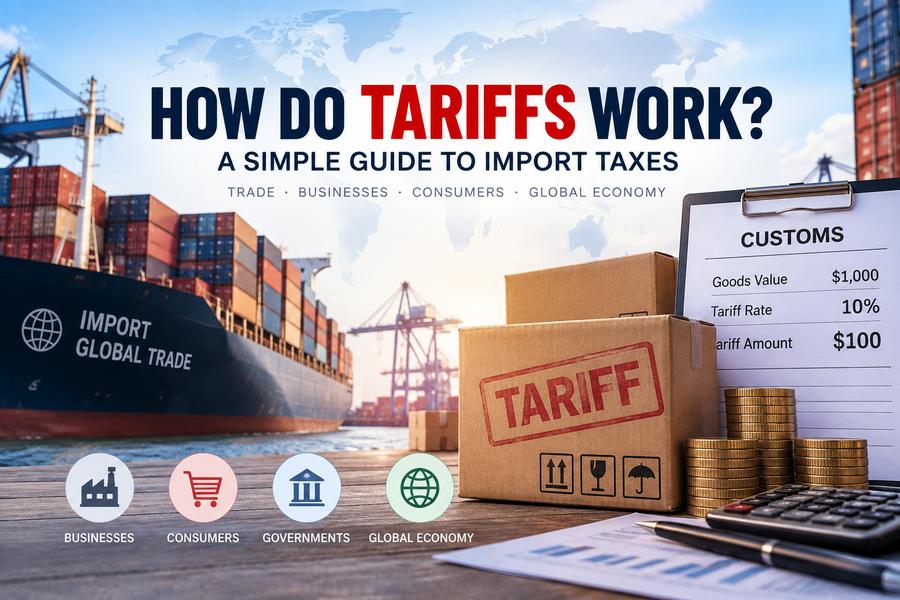
How Do Tariffs Work? Who Pays Them and Why They Matter
Tariffs are one of the oldest tools in international trade. Governments use them to protect domestic industries, raise revenue and influence economic relationships with other countries.
Yet tariffs are often misunderstood, particularly when politicians discuss who pays them.
A tariff may be imposed on goods from another country, but that does not mean the foreign government sends the payment. In most cases, the importer pays the duty when the goods enter the destination country.
What happens afterwards is more complicated.
The importer may absorb the cost, negotiate a lower price with its supplier or charge customers more.
Understanding how tariffs work is therefore essential for making sense of trade disputes, consumer prices and economic policy.
What Is a Tariff?
A tariff is a tax imposed on goods imported from another country.
For example, the United States may charge a tariff on certain imported vehicles, machinery or industrial materials.
The duty is collected through the customs system when the goods enter the country.
Governments use tariffs for several reasons. Some are intended to protect domestic producers from foreign competition. Others respond to trade practices considered unfair or aim to raise government revenue.
Tariffs can also be used as leverage in international negotiations.
Although tariffs are usually discussed in connection with imports, they affect more than international shipments.
They can influence production costs, retail prices, investment decisions and the availability of products.
Their economic effects depend on the tariff rate, the goods covered and how businesses respond.
How Do Tariffs Work? A Simple Example
Imagine an American company importing a coffee machine from another country.
The customs value of the machine is $100.
If the applicable import tariff is 20%, the importer generally owes an additional $20 in customs duty.
| Item | Amount |
|---|---|
| Customs value of imported machine | $100 |
| Import tariff rate | 20% |
| Tariff payable | $20 |
| Value plus tariff | $120 |
This is a simplified illustration. It excludes shipping, insurance, other customs fees, taxes and retailer margins.
The importer pays the tariff to the US government through the customs process.
The foreign manufacturer does not automatically pay that $20.
However, the importer may ask its supplier to reduce the original selling price.
Alternatively, it may accept a lower profit margin or increase the price charged to retailers.
If the machine eventually costs more in a shop, the consumer may end up bearing part of the tariff's economic burden.
The example shows why the person legally responsible for paying a tariff is not necessarily the person who ultimately bears its cost.
Who Actually Pays Tariffs?
In the United States, the importer of record is generally responsible for paying customs duties.
The importer may be a retailer, manufacturer, distributor or another business bringing goods into the country.
The payment is made to US Customs and Border Protection, not to the country where the product was manufactured.
But the financial impact can be divided among several groups.
Importers may accept lower profits.
Foreign suppliers may reduce prices to retain customers.
Retailers may raise their selling prices.
Consumers may purchase fewer products or switch to cheaper alternatives.
The balance depends on competition, demand, exchange rates and how easily businesses can change suppliers.
Research has repeatedly found that US importers and consumers bear a substantial share of tariff costs, although the precise distribution changes over time.
This distinction between the legal payment and the wider economic burden is one of the most important concepts in trade policy.
Why Do Governments Impose Tariffs?
Governments generally use tariffs to pursue economic or strategic objectives.
Protecting Domestic Industries
A tariff makes selected imported products more expensive.
That can help domestic manufacturers compete with foreign businesses selling similar goods.
For example, a tariff on imported steel may support local steel producers by reducing price competition.
However, American manufacturers that use steel may face higher input costs.
Raising Government Revenue
Tariffs generate revenue for the government collecting them.
Before modern income taxes became widespread, customs duties were an important source of public funding in many countries.
They remain a source of government revenue today, although their importance varies.
Responding to Trade Practices
Governments may impose tariffs following investigations into subsidies, dumping or other trade practices.
Such measures can be designed to address specific industries rather than all imports from a country.
Strengthening Negotiating Positions
Tariffs can also be used to encourage trading partners to change policies or negotiate agreements.
Whether this strategy succeeds depends on how the affected countries respond and the economic costs involved.
What Are the Main Types of Tariffs?
Not all tariffs are calculated in the same way.
| Tariff type | How it works | Example |
|---|---|---|
| Ad valorem | Percentage of the customs value | 10% of a $200 item = $20 |
| Specific | Fixed amount per unit | $5 per imported item |
| Compound | Combination of percentage and fixed amount | 5% of value plus $2 per item |
An ad valorem tariff is commonly used in explanations because it is straightforward to calculate.
Specific tariffs are based on quantities such as weight, volume or number of units.
Compound tariffs combine both approaches.
Actual customs calculations can be more complicated because countries may apply different classifications, exemptions and additional duties.
In the United States, importers use the Harmonized Tariff Schedule to identify the classification and applicable rates for goods.
The country of origin can also affect the duties payable.
How Do Tariffs Affect Consumer Prices?
Tariffs can increase the cost of imported products.
If a business pays more to bring goods into a country, it may pass some of that cost to its customers.
The effect can also extend to products manufactured domestically.
An American factory may rely on imported machinery, electronics or raw materials.
Higher duties on those inputs can increase production costs, even when the finished product is labelled as made in America.
Domestic competitors may also have more room to raise prices when imported alternatives become expensive.
However, prices do not always rise immediately or by the full tariff amount.
Businesses may have existing inventories, long-term supplier contracts or enough profit margin to absorb part of the increase.
The effect also depends on how sensitive customers are to price changes.
For a closer look at the evidence, read our analysis of how Trump's tariffs affect consumer prices.
Do Tariffs Help or Hurt the Economy?
Tariffs can create benefits for some businesses while imposing costs on others.
A domestic manufacturer competing with imports may gain customers when foreign products become more expensive.
This could support production or employment in that particular industry.
However, companies relying on imported materials may face higher costs.
Retailers may struggle to maintain sales if customers reduce spending.
Exporters can also be affected when other countries respond with tariffs of their own.
Economic research generally finds that broad tariffs create trade-offs rather than benefits shared equally across the economy.
The Congressional Budget Office has previously estimated that trade barriers can reduce real household income and economic output, even while generating government revenue.
The overall outcome depends on which industries are affected, the scale of the duties and how businesses adapt.
A tariff that benefits one factory may create difficulties for another business further along the supply chain.
Can Tariffs Protect American Jobs?
Tariffs may support employment in industries facing competition from imported goods.
For example, a manufacturer might retain customers if imported alternatives become more expensive.
But job effects are not limited to the protected industry.
A company using imported components may face higher costs and reduce investment or hiring.
Other businesses may lose export sales if trading partners retaliate.
Employment outcomes also depend on productivity, consumer demand and how quickly production can expand.
Building a domestic factory or replacing an international supplier can take years.
For these reasons, tariffs do not automatically create more jobs across the economy.
Their impact should be assessed across both the industries receiving protection and those bearing additional costs.
What Happens When Countries Retaliate?
A country affected by tariffs may respond by imposing duties on imports from the country that introduced them.
For example, if the United States raises tariffs on certain foreign goods, the affected trading partner may impose additional duties on American exports.
These measures can make products more expensive in both markets.
They can also reduce sales for exporters, disrupt supply chains and create uncertainty for businesses.
When restrictions escalate repeatedly, the dispute may develop into a trade war.
Governments sometimes resolve disagreements through negotiations, exemptions or revised trade agreements.
However, prolonged disputes can discourage investment and complicate international production.
Our guide to what a trade war is explains how these conflicts develop and why their effects can spread beyond the countries directly involved.
How Are Tariffs Different From Trade Sanctions?
Tariffs and trade sanctions can both restrict international commerce, but they operate differently.
A tariff usually allows a product to enter a country after the applicable duty has been paid.
A trade sanction may prohibit particular transactions, restrict access to financial services or ban trade with specified individuals, businesses or countries.
Sanctions are often associated with foreign-policy and national-security objectives.
Tariffs are more commonly used as instruments of trade and industrial policy, although they can also serve strategic goals.
The legal authority and compliance requirements differ.
Businesses therefore need to understand the specific rules rather than assume that all trade restrictions work in the same way.
Why Are Tariffs Important in US–EU Trade?
The United States and European Union exchange large volumes of goods and services.
Many businesses depend on suppliers and customers on both sides of the Atlantic.
Tariffs on machinery, vehicles or industrial materials can affect production costs and investment decisions.
Even companies that do not directly import goods may be affected through suppliers.
Political disagreements over tariffs can therefore influence a much wider economic relationship.
Our analysis of US–EU trade explains why transatlantic commerce matters to both economies.
For a closer examination of tariff disputes, see Donald Trump vs the EU and the risk of a trade war.
Understanding the basic mechanics of tariffs makes these debates easier to evaluate without relying on political claims alone.
Are Tariffs Always Bad?
No. Tariffs can serve legitimate policy objectives, including protecting selected industries, responding to unfair trade practices and addressing strategic supply-chain concerns.
However, they also create costs and unintended consequences.
Whether a particular tariff is beneficial depends on its purpose, design, duration and economic effects.
A narrowly targeted measure addressing a specific market problem is different from a broad tariff affecting many products.
The important question is not simply whether tariffs are good or bad.
It is whether their benefits outweigh the costs for the economy and the people affected.
How Do Tariffs Work? The Bottom Line
A tariff is a tax collected on imported goods.
In the United States, the importer generally pays the duty to the government when the goods enter the country.
The economic cost may then be shared among importers, foreign suppliers, businesses and consumers.
Tariffs can protect some domestic industries and generate revenue, but they may also raise prices, increase production costs and provoke retaliation.
Their effects vary across products, countries and industries.
Understanding who pays the duty, how businesses respond and what happens to consumer prices provides a clearer picture of trade policy than any single political argument.
Tariffs are powerful economic tools, but their consequences rarely stop at the border.
Frequently Asked Questions
Who pays tariffs in the United States?
The importer of record generally pays customs duties to US Customs and Border Protection. Businesses and consumers may ultimately bear part of the cost.
Are tariffs paid by foreign governments?
No. Foreign governments do not normally pay US import tariffs directly. Foreign exporters may absorb part of the economic cost by lowering their prices.
Do tariffs always increase prices?
Not necessarily for every product. Businesses may absorb costs or change suppliers, but tariffs can raise consumer prices and production costs overall.
What is the difference between a tariff and a tax?
A tariff is a specific type of tax applied to international trade, usually imports. Other taxes may apply to income, sales, property or domestic transactions.
Sources and Further Reading
U.S. Customs and Border Protection — Basic Importing and Exporting
Official guidance on importing goods and customs procedures.
U.S. International Trade Commission — Harmonized Tariff Schedule
The official US tariff classification system and duty rates.
Council on Foreign Relations — What Are Tariffs?
An explanation of tariff policy, economic effects and trade disputes.
Council on Foreign Relations — Who Pays Trump's Tariffs?
Analysis of how tariff costs are distributed among importers, exporters and consumers.
Congressional Budget Office — The Effects of Tariffs and Trade Barriers in CBO's Projections
Economic analysis of trade barriers, household income and output.
Federal Reserve Board — Paying More and Buying Less: 2025 Tariffs and U.S. Household Spending
Research on tariff-related consumer prices and spending behaviour.