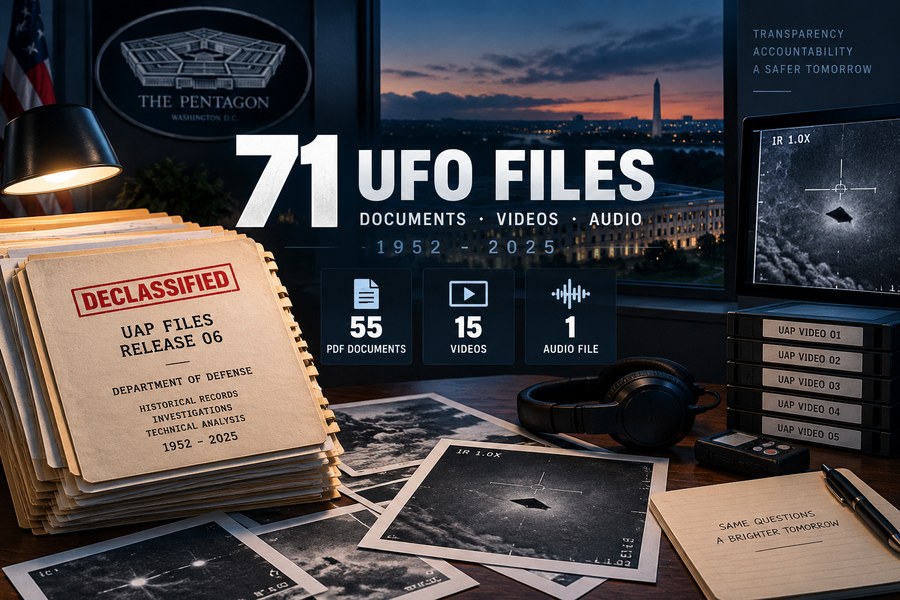
The number sounds impressive: 71 UFO files released at once, covering more than seven decades of reports, research and unexplained observations.
But the number alone tells us surprisingly little.
The Pentagon’s sixth UAP release, published on 18 September 2026, contains 55 PDF documents, 15 videos and one audio recording. Sixty-seven files came from the Department of Defense, while four were supplied by local law enforcement in Colorado.
The material dates from 1952 to 2025, bringing together Cold War-era UFO investigations, speculative aerospace research and much more recent military sensor footage.
Most of the collection is also partially redacted: 64 of the 71 files contain redactions.
So what is actually inside the archive?
71 Files Do Not Mean 71 UFO Encounters
The first distinction is an important one.
Seventy-one files should not be interpreted as 71 separate unexplained UFO sightings.
Some documents concern research programmes rather than individual encounters. Multiple files can relate to similar subjects, while other documents examine theoretical technologies without documenting a UFO observation at all.
The collection breaks down into:
55 PDF documents
15 video files
1 audio recording
This makes the PDFs by far the largest part of the release, accounting for roughly three quarters of the archive.
Anyone expecting 71 dramatic UFO videos will therefore find something quite different: a mixed historical and technical record.
The 55 PDFs: The Largest Part of the Release
The documents are arguably the most complicated part of Release 06.
A significant group consists of 37 Defense Intelligence Reference Documents connected to the Advanced Aerospace Weapon System Applications Program, commonly known as AAWSAP.
Established by the Defense Intelligence Agency in 2008, AAWSAP examined potential aerospace threats and technologies that might become relevant decades into the future.
The subjects covered in these papers can sound extraordinary.
They include discussions of warp drives, traversable wormholes, antigravity concepts, negative mass propulsion, invisibility and other advanced theoretical ideas.
But there is an essential caveat.
The existence of a government document discussing a theoretical technology is not evidence that the technology has been built — or even that it is physically achievable.
The department has specifically cautioned against interpreting these reference documents as present-day validation of the concepts they discuss.
That difference between “the government studied it” and “the government proved it” is critical when evaluating declassified UFO material.
One Document Examines Reported Biological Effects
Among the more unusual AAWSAP-related material is research examining alleged biological effects associated with anomalous aerospace events.
The subject naturally attracts attention because descriptions can include injuries or symptoms attributed by researchers to unusual electromagnetic or aerospace environments.
Yet this material needs particularly careful treatment.
A report recording or analysing an alleged association does not automatically establish what caused an injury, nor does it demonstrate the involvement of extraterrestrial technology.
Without complete independent data, alternative explanations and reproducible evidence, the material remains part of an investigative record rather than proof of an extraordinary conclusion.
The same principle applies across the wider body of UAP evidence.
The 15 Videos: The Most Visually Compelling Material
For most readers, the 15 videos will probably be the most immediately interesting part of the release.
Some contain military infrared or sensor footage of objects that investigators were unable to identify confidently from the available information.
One reported case involves several small spherical objects observed during a military operation in the Middle East. Other footage comes from operational regions in Asia.
Several cases remain unresolved in the public record.
But “unresolved” requires context.
Infrared footage can make an object appear very different from how it would look to the naked eye. Apparent speed can be affected by the movement of the observing aircraft, sensor tracking, viewing angle and uncertainty about the object's distance.
Without complete telemetry and contextual information, a bright dot moving across a display may be genuinely difficult to identify.
That does not make the footage meaningless. It simply limits the conclusions that can responsibly be drawn from it.
This problem has appeared repeatedly in previously released Pentagon UFO videos.
Four Videos Came From Colorado Law Enforcement
Not everything in the collection originated from military sensors.
Four files were supplied by local law-enforcement authorities in Colorado and relate to observations recorded in 2023.
That is significant because it demonstrates how broad the modern UAP archive has become.
UAP reports are no longer restricted to military pilots or intelligence personnel. Material can enter the investigative system from other government and law-enforcement sources as well.
However, cellphone footage presents its own limitations.
Autofocus, digital zoom, image stabilisation, compression and low-light conditions can produce visual effects that are difficult to interpret after the event.
A video may therefore document something genuinely unidentified without providing enough information to determine what that object was.
The Single Audio File Takes Us Back to 1952
Perhaps the most historically interesting item is not a video at all.
The release contains an audio recording associated with US Air Force Captain Edward J. Ruppelt, one of the most important figures in the early history of official American UFO investigations.
Ruppelt became closely associated with Project Blue Book, the Air Force programme that investigated thousands of UFO reports during the Cold War.
The recording dates to 1952 — the earliest year represented in this release.
Its presence alongside material from 2025 creates an unusual historical bridge.
The terminology has changed from “flying saucers” and UFOs to UAP, while sensors, aircraft and investigative methods have become dramatically more sophisticated.
Yet the fundamental problem remains familiar: observers sometimes encounter something they cannot identify with the information available to them.
For readers new to the terminology, our explainer on what a UAP is examines why unidentified does not mean extraterrestrial.
From 1952 to 2025: Why the Time Span Matters
The 73-year span of the archive is one of its most interesting characteristics.
A UFO observation recorded in 1952 exists in a very different technological environment from an infrared military observation recorded in 2025.
Radar improved.
Cameras improved.
Satellites became commonplace.
Infrared sensors became far more capable.
Drones introduced an entirely new category of objects into controlled airspace.
Computer analysis transformed the way sensor information could be examined.
This makes comparisons across decades difficult.
An unexplained observation from the early 1950s cannot simply be evaluated according to the same evidential standards as a modern multi-sensor military event.
At the same time, historical records can show how official attitudes towards unidentified phenomena evolved.
Why Are 64 of the 71 Files Redacted?
Another striking number is 64.
That is how many files contain some form of redaction.
Redaction can immediately create suspicion around UFO documents, but there are many ordinary reasons governments remove information before publication.
Military locations, intelligence capabilities, operational procedures and personal information may all require protection.
A blacked-out paragraph therefore does not itself indicate that extraordinary evidence is being concealed.
However, extensive redactions create a genuine analytical limitation.
Researchers outside government cannot evaluate information they cannot see.
The correct conclusion is therefore neither “the redactions hide aliens” nor “the missing information is irrelevant”.
It is simply that the public dataset is incomplete.
What Is Actually New?
Another complication is that not everything in a newly released archive is necessarily new information.
Some AAWSAP research has circulated publicly before.
Historical UFO material has also appeared through previous government releases and archives.
The significance of Release 06 is therefore partly organisational.
Documents from different periods and investigative contexts are being brought together within the PURSUE disclosure system, giving researchers a clearer route into the government record.
That may ultimately prove more useful than any single sensational document.
What the 71 Files Do — and Do Not — Establish
Taken together, the collection establishes that the US government accumulated a large and diverse body of material concerning unidentified observations and unconventional aerospace research.
It also contains cases that remain unresolved in the information released publicly.
What it does not establish is equally important.
The 71 files do not collectively prove the existence of extraterrestrial spacecraft.
They do not demonstrate that theoretical propulsion systems discussed in research papers have been successfully developed.
And they do not mean that every unidentified object represents the same phenomenon.
The archive contains different decades, sensors, witnesses, agencies, research programmes and evidential standards.
Treating all 71 files as a single body of “alien evidence” would therefore obscure rather than clarify what was actually released.
The Most Important Part May Be What Comes Next
Release 06 should probably be viewed as another layer in a growing public archive rather than a final disclosure event.
PURSUE is designed around continuing releases, meaning additional documents may provide context for cases that currently appear incomplete.
That makes careful cataloguing important.
The real value of these releases will depend not simply on how many files become public, but on whether researchers eventually receive enough contextual and sensor information to evaluate the strongest cases properly.
For now, the Pentagon’s 71 UFO files offer something less dramatic than definitive proof — but more useful than another viral UFO claim.
They provide documents that can actually be examined.
And that is where serious investigation begins.
Sources and Further Reading
CBS News — Pentagon Releases More UFO Files, Including Documents on Secretive Military Program
Detailed reporting on Release 06, including the breakdown of 71 files, AAWSAP material, videos and historical records.
U.S. Department of War — UFO/UAP Records
U.S. Department of War — Department Publishes Sixth Release of Unidentified Anomalous Phenomena Files
Official announcement confirming the sixth release of historical and declassified UAP records.
CBS News — Watch: Pentagon Releases 15 New UFO Videos
Collection of the 15 video files included in the sixth release.