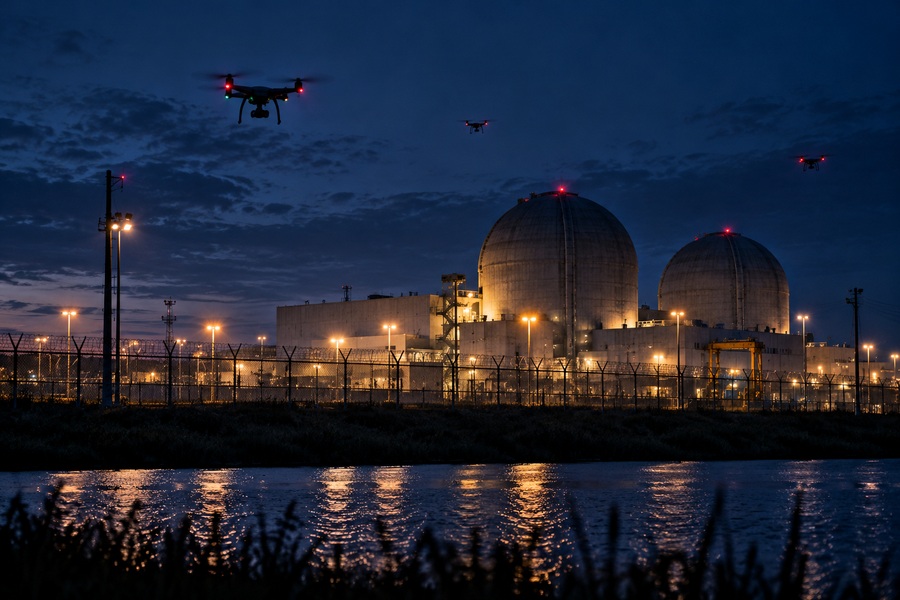
A nuclear power station is not somewhere security teams expect unidentified aircraft to linger. Yet newly publicised records describe several drone sightings around Virginia's Surry Nuclear Power Plant, including activity reported near protected areas and reactor buildings. The incidents themselves are not new. They occurred in December 2024. What brought them back into public discussion was an investigation published by Liberation Times on 7 October 2026, based on drone-related reports obtained from the US Nuclear Regulatory Commission (NRC). The publication says it reviewed 67 reports covering 28 nuclear sites across 17 states, with incidents recorded between February 2024 and March 2026. Some accounts describe unusual flight patterns, multiple aircraft and difficulties identifying operators. Those details deserve scrutiny. But there is an important distinction between an aircraft whose operator remains unknown and an aircraft that cannot be explained by conventional technology. The Surry reports raise legitimate questions about airspace security. They do not, by themselves, demonstrate the presence of extraterrestrial vehicles.
What Happened at Surry Nuclear Power Plant?
Surry Power Station is an operating nuclear facility in Virginia, near the James River. It contains two pressurised-water reactors and is regulated by the NRC. According to the records described by Liberation Times, security personnel reported multiple drones around the facility on 3 December 2024. The reported activity continued during the evening and involved aircraft passing over areas of the property, including its protected zone. Security measures were reportedly heightened, and outside authorities were contacted. A further account dated 10 December describes aircraft near security enclosures, an administration building and other parts of the site. One object reportedly hovered above a security enclosure before its lights disappeared from view. Another was described as a larger aircraft displaying red, green and white lights. The significance of these accounts lies partly in their location. Nuclear power stations operate under strict security requirements, and unidentified aircraft near sensitive infrastructure create concerns even when their purpose is unknown.
What Was Unusual About the Reported Aircraft?
One of the more striking descriptions concerns an aircraft that a security officer reportedly characterised as triangular in appearance. Other reported observations involved smaller aircraft moving around a larger object. According to the published account, two smaller aircraft appeared to move in opposing zigzag patterns near the larger one. Descriptions like these naturally attract attention within UFO and UAP discussions. However, witness descriptions are not the same as technical identification. Aircraft viewed at night can be difficult to judge accurately. Distance, speed, shape and size may be uncertain, particularly when observers are relying on lights against a dark background. Several conventional drones operating together can also create complicated visual patterns. The published descriptions do not provide enough publicly verifiable technical information to determine the exact aircraft types involved. That uncertainty should remain part of the story rather than being replaced by a more dramatic conclusion.
Why Were the Incidents Reported to Federal Authorities?
Drone activity around nuclear facilities is a security matter, regardless of whether the aircraft appear unusual. The NRC updated its reporting requirements in 2024, directing nuclear power plant operators to report drone sightings. According to the regulator, reports are shared with the NRC, the Federal Aviation Administration, the Federal Bureau of Investigation and local law enforcement. This reporting framework reflects the increasing availability of commercially operated unmanned aircraft. Small drones can be used for photography, surveying and many legitimate activities, but unauthorised flights around sensitive infrastructure may raise concerns about surveillance or other security risks. The purpose of reporting is to help authorities understand potential threats and assess whether existing protections remain adequate. It is not an indication that regulators believe every unidentified aircraft is an extraordinary phenomenon.
What Do the Newly Published NRC Records Actually Establish?
The records obtained by Liberation Times describe 67 drone-related reports involving 28 nuclear sites across 17 US states between February 2024 and March 2026.
Five entries concern Surry Nuclear Power Plant, documenting reported aircraft movements, security responses and observations near sensitive areas. Some accounts describe unusual lighting patterns or multiple aircraft, while another refers to radar confirmation reported by personnel at nearby Fort Eustis.
The released entries are marked “Closed Unresolved”. This administrative status does not establish that the aircraft displayed extraordinary capabilities or that every possible conventional explanation was eliminated.
The records also provide limited information about subsequent investigations. As a result, the available material cannot reliably establish the operators, intentions or precise types of all the reported aircraft.
For a broader explanation of these evidentiary limits, see our guide to what scientists need to confirm extraordinary UAP evidence.
Does an Unidentified Drone Count as a UFO or UAP?
Does an Unidentified Drone Count as a UFO or UAP?
An aircraft can remain unidentified because its operator, model or flight purpose is unknown. That does not mean it possesses extraordinary technology.
The term UAP is used for observations that have not been adequately identified or explained, but it does not automatically imply an extraterrestrial origin.
Our guide to what a UAP is explains the distinction.
At Surry, the primary concern is the presence of unauthorised or unidentified aircraft near critical infrastructure. The available records do not demonstrate flight characteristics beyond conventional aviation capabilities.
Why Are Nuclear Facilities Particularly Sensitive?
Nuclear power stations are part of a country's critical infrastructure. They generate electricity, contain specialised equipment and operate under strict safety and security regulations. Unauthorised aircraft may create concerns about reconnaissance, interference with operations or attempts to test security responses. Those concerns exist even if the aircraft are commercially available drones. The NRC states that nuclear power plants are designed with substantial physical protections and are required to maintain security systems appropriate to their regulatory obligations. The regulator also explains that plant security forces generally do not possess independent authority to shoot down or otherwise intercept aircraft. That creates a practical challenge. Security personnel may detect or report an aircraft without being legally authorised to bring it down. Effective responses therefore depend on coordination between plant operators, aviation authorities and law enforcement. The Surry reports illustrate why identifying aircraft and understanding their movements can matter even when no direct attack or damage has been established.
Have Similar Incidents Occurred at Other Nuclear Plants?
Yes. The Surry accounts form part of a broader reporting issue rather than an isolated event. In its January 2025 fact sheet, the NRC acknowledged numerous reports of drone sightings over critical infrastructure, including nuclear power plants. An NRC Office of Inspector General report later described a review of unauthorised unmanned aerial vehicle activity at regulated facilities. According to that report, operators submitted 34 relevant reports between 10 August 2024 and 11 January 2025. The review focused on regulatory oversight, reporting procedures and security-related coordination. It also noted that some details of the regulator's activities involved sensitive information. These official findings support the conclusion that drone incursions are a genuine security and oversight issue. They do not establish that the incidents share one operator, one motive or one unusual technological explanation. Different sightings may involve entirely different circumstances.
Why Do Some People Connect These Reports to UFO History?
Reports involving unidentified aircraft and nuclear facilities have appeared in UFO discussions for decades. Historical accounts involving military installations, nuclear weapons and other sensitive sites have contributed to the belief that unusual aerial phenomena show particular interest in nuclear technology. The Jay Stratton UFO claims are part of this wider debate, although statements about unexplained activity near nuclear facilities must still be assessed against independently verifiable evidence. Some witnesses and former officials have made claims supporting that interpretation. However, a historical pattern cannot be established simply by collecting accounts that sound similar. Investigators must consider how incidents were recorded, whether comparable events occurred at other locations and whether reporting practices changed over time. Nuclear facilities already receive heightened surveillance, which may make unusual aircraft more likely to be noticed and documented. Modern drone availability also complicates comparisons with older cases. The recent Surry reports should therefore be assessed on their own evidence rather than treated as confirmation of decades-old theories.
What Evidence Would Help Identify the Aircraft?
The most useful evidence would come from independently verifiable technical records. Radar data, if available, could help establish flight paths and approximate movement. Time-stamped video from multiple positions might clarify apparent shapes, distances and relative speeds. Information about aircraft registration, communications or known drone operations could also help identify conventional activity. Witness statements remain important, especially when several observers report the same event. The work of AARO provides a useful example of how investigators approach unidentified aerial reports through evidence collection, analysis and attempts to establish conventional explanations. But they are strongest when supported by measurements that allow investigators to test competing explanations. A triangular appearance, for example, might reflect an aircraft's actual structure or the arrangement of its visible lights. Without additional evidence, it is difficult to distinguish between those possibilities. The publicly reported Surry material leaves important questions unanswered, including who operated the aircraft and whether all the observations involved the same group.
Did the Drone Sightings Threaten Reactor Safety?
The available reports raise security questions, but they should not be confused with evidence of a reactor safety emergency. A drone passing near a nuclear facility does not automatically mean its reactors were damaged or their safety systems compromised. The NRC's published guidance emphasises that commercial nuclear power plants have substantial protective structures and security arrangements. Assessing an actual threat would require information about the aircraft, their capabilities, proximity, behaviour and any effects on plant operations. The material described in the October investigation does not establish that the reported flights caused reactor damage or a radiological release. That distinction matters for readers living near nuclear facilities. Security incidents deserve investigation, but reporting should not imply a public health emergency without evidence.
What the Surry Reports Tell Us
The Surry incidents highlight a genuine security concern: unidentified aircraft were reported near sensitive nuclear infrastructure, yet the publicly released records do not fully establish who operated them or why they were present.
The next step is to determine whether additional investigation records, radar data or official findings can clarify the incidents. Further document releases may help distinguish cases that remain genuinely unresolved from those whose conclusions were simply not included in the published material.
Nothing in the available evidence demonstrates extraterrestrial technology or a reactor safety emergency.
The most important question is therefore not whether alien spacecraft visited Surry, but how effectively authorities can identify and respond to unauthorised aircraft operating near critical infrastructure.
Sources and Further Reading
Liberation Times — New Records Reveal Repeated Drone Flights Over U.S. Nuclear Sites, Including Reactors Near Langley Air Force Base
U.S. Nuclear Regulatory Commission — Drones and Nuclear Power Plant Security
NRC Office of Inspector General — Semiannual Report to Congress, April–September 2025
U.S. Nuclear Regulatory Commission — Surry Power Station, Unit 1
U.S. Nuclear Regulatory Commission — Surry Power Station 2025 Annual Assessment Meeting
UFO, Aliens & News — Nuclear-Site Drone Reports: What Five Surry Records Actually Show