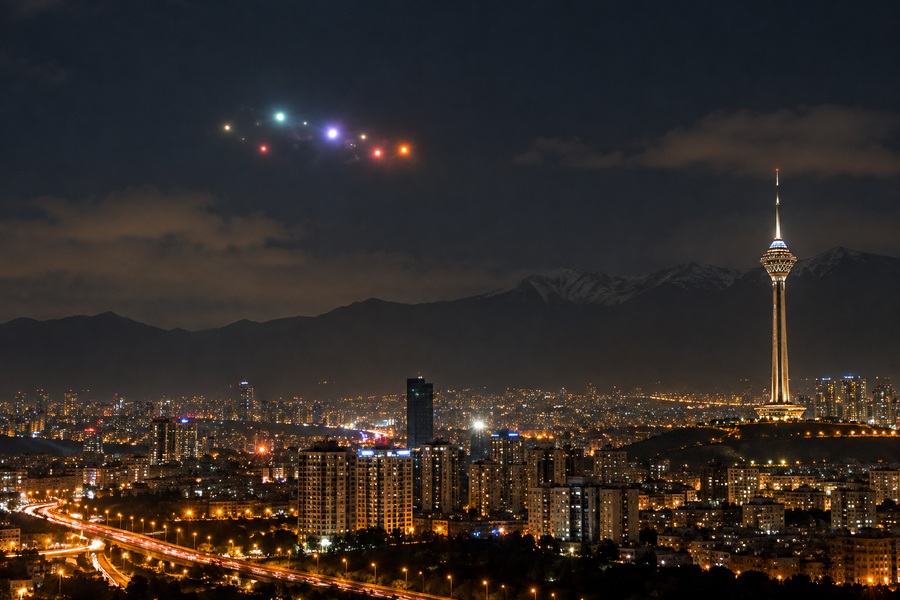
On 20 September 2026, a short video showing a strange arrangement of coloured lights above Tehran began attracting attention online. The footage appeared almost exactly 50 years after one of Iran's most widely discussed UFO incidents, when military pilots reported an unusual aerial encounter over the capital in September 1976.
The timing was striking. So was the footage itself. A curved formation of bright lights appeared against the evening sky, changing colours while seemingly remaining in roughly the same area.
Within days, the video was being discussed as another possible UFO sighting over Tehran. Some viewers suggested drones or illuminated aircraft. Others pointed towards more extraordinary explanations.
But what was actually recorded, and is there any meaningful connection between the two incidents?
What Happened Over Tehran in September 2026?
The reported sighting took place on the evening of 20 September, near Tehran's Azadegan Expressway.
A video attributed to a local witness showed several bright points of light arranged in a curved formation. The lights appeared in different colours, including green, blue, white and red, creating an unusual display against the darkening sky.
The recording was reportedly made at approximately 7:30 pm local time.
The footage subsequently circulated across social media and attracted international coverage. Reuters Connect distributed material supplied through the video agency Spectee, while making clear that Reuters had not independently verified the footage.
That distinction matters. A video can document something unusual without establishing what the object was, how far away it was or whether the accompanying description is entirely accurate.
As of October 2026, no publicly available technical investigation has conclusively identified the lights.
What Does the Tehran UFO Video Actually Show?
The most noticeable feature is the arrangement of the lights.
Rather than a single glowing object, the footage appears to show several separate illuminated points forming a shallow arc. Their colours change during the recording, giving the impression of a structured object or lighting display.
However, the camera was moving, and the image contains considerable blur. These limitations make it difficult to establish whether the lights were attached to one object or belonged to several separate sources.
The video also lacks reliable distance measurements.
A small object flying relatively close to the camera can appear surprisingly large against an empty sky. Similarly, apparent movement can be misleading when the observer is inside a moving vehicle.
Without independent footage from another location, investigators cannot reliably calculate the object's physical size, altitude or speed.
The recording is therefore interesting, but it does not demonstrate extraordinary flight performance.
Could the Lights Have Come From a Model Aircraft?
One of the more plausible explanations involves an illuminated model aircraft.
Aviation commentators have suggested that a radio-controlled glider fitted with programmable LED lights could produce an appearance similar to the Tehran footage.
One model mentioned in online discussions is the E-flite Night Radian, a powered glider equipped with lights that can display different colours and patterns.
Viewed from certain angles, such an aircraft might appear as a curved row of lights rather than a recognisable aeroplane.
Other conventional possibilities include illuminated kites, drones or equipment carrying decorative lighting.
These explanations are worth examining because they involve technology that already exists and can be tested.
Nevertheless, resemblance alone is not proof. No publicly documented demonstration has conclusively matched a specific model aircraft, kite or drone to the object recorded over Tehran.
The lights remain unidentified in the available footage, even though an ordinary explanation remains entirely possible.
Did Iranian Authorities Identify the Object?
Some reports suggested that aviation authorities had been unable to associate the sighting with a known flight.
However, such reporting should not be confused with a published military radar investigation.
There is an important difference between failing to identify a corresponding civil aircraft and proving that an object was invisible to radar.
Small drones, model aircraft and other low-altitude objects may not appear as identifiable commercial flights.
At the time of writing, no publicly released technical report has established the object's identity or demonstrated unusual capabilities.
Claims that the lights evaded military detection or performed impossible manoeuvres therefore go beyond the available evidence.
Why Did the Video Revive the 1976 Tehran UFO Incident?
The timing made the new footage particularly compelling to UFO enthusiasts.
On the night of 18–19 September 1976, residents of Tehran reported a bright, unusual object in the sky. Iranian military aircraft were subsequently sent to investigate.
Accounts from the incident described an aerial object that appeared to behave unusually, along with reported problems affecting aircraft instruments and communications.
The event attracted attention from American intelligence officials, and documents describing the encounter later became publicly available.
Those records helped establish the 1976 incident as one of the best-known military UFO cases of its era.
The September 2026 footage appeared almost exactly half a century later, in the same city.
It is an intriguing historical coincidence, but there is no verified evidence connecting the two events.
What Really Happened During the 1976 Tehran Encounter?
The historical case involved considerably more than a short civilian video.
According to intelligence reporting from the period, witnesses contacted authorities after observing an unusual light over Tehran. Iranian Air Force F-4 Phantom jets were dispatched to investigate.
The reports described radar observations and temporary instrument or communication problems experienced by the crews.
Some accounts also referred to smaller lights appearing to separate from the principal object.
These details made the incident notable, particularly because it involved military personnel and generated official documentation.
However, an intelligence report recording a witness account does not independently establish the physical cause of every reported observation.
The documents show that the incident was investigated and taken seriously. They do not provide conclusive scientific proof that extraterrestrial technology was involved.
That distinction is essential when examining historical UFO cases.
Are the 1976 and 2026 Sightings Connected?
There is no demonstrated connection between them.
The 1976 case involved military witness accounts, aircraft activity and government records. The September 2026 sighting is primarily known through a short recording circulated online.
The two events differ in the type and quality of evidence available.
They also occurred in different political, technological and aviation environments.
Tehran's appearance in both stories may explain why the comparison became popular, but sharing a location does not establish a shared cause.
Likewise, the 50-year anniversary is historically interesting without being evidence of a recurring phenomenon.
A meaningful connection would require independent information linking the objects, their characteristics or their origins. No such evidence has been publicly established.
What Would Investigators Need to Identify the Lights?
A reliable investigation would begin with the original, unedited recording.
Investigators would need to establish the precise filming location, camera direction and time. Additional footage from independent observers would be particularly valuable.
Weather conditions, cloud height, aircraft activity and any available radar records could then be compared with the visual evidence.
The shape and colour sequence of the lights could also be tested against known illuminated model aircraft and kites.
Such comparisons would be more useful than relying on visual resemblance alone.
This is why credible UAP evidence depends on independently verifiable observations rather than a single unusual-looking video.
A sighting can remain unresolved simply because too little information was recorded.
An unidentified object is not automatically an extraordinary object.
Does the Tehran UFO Video Show Alien Technology?
Nothing in the publicly available evidence establishes an extraterrestrial origin.
The footage shows unusual lights, but it does not demonstrate that the object travelled at impossible speeds, defied gravity or possessed technology beyond human capabilities.
Suggestions involving secret aircraft or alleged experimental craft are similarly unsupported without identifiable technical evidence.
It is reasonable to investigate unusual observations, especially when the original material can be examined.
It is not reasonable to treat the absence of an immediate explanation as proof of a particular extraordinary theory.
For readers interested in the broader question, our guide to whether UFOs are real explains why confirmed observations and confirmed extraterrestrial technology are very different claims.
Why Do Unexplained Lights Continue to Attract Attention?
Night-time sightings are especially difficult to interpret.
Distance is hard to judge without visible landmarks, and bright lights can obscure the shape of the object carrying them.
Modern cameras can introduce additional complications, including digital zoom artefacts, motion blur and automatic exposure changes.
Meanwhile, drones, illuminated kites and remotely controlled aircraft have become increasingly accessible.
These technologies can produce displays that would have seemed extraordinary to observers only a few decades ago.
Social media adds another dimension. A short recording can reach millions of people before investigators have established the basic circumstances.
Once a video becomes associated with a famous historical mystery, speculation can spread faster than the evidence.
Conclusion: What Do We Actually Know About the Tehran UFO of 2026?
The September 2026 Tehran sighting remains an interesting example of how unusual aerial footage can revive a much older mystery.
A witness recorded a curved arrangement of changing coloured lights, reportedly near the Azadegan Expressway. The footage attracted widespread attention because it appeared close to the 50th anniversary of the famous 1976 Tehran UFO encounter.
Conventional explanations, particularly illuminated model aircraft or kites, deserve consideration. Yet the available material does not establish a definitive identification.
Equally, there is no credible public evidence that the lights represented an extraterrestrial spacecraft or were connected to the historical incident.
The most useful conclusion is a limited one: something unusual was recorded, but the available evidence is insufficient to determine exactly what it was.
That uncertainty is a reason for careful investigation, not for certainty about an extraordinary explanation.
Sources and Further Reading
- Reuters Connect — Unidentified Object Hovers Over Tehran Night Sky
- Factnameh — Fact-Checking Claims About Unidentified Lights in Tehran and Mashhad
- UAP Globe — Multicoloured Lights Over Tehran's Azadegan Expressway
- NSA Declassified Documents — Government and UFOs
- U.S. Department of Defense Archive — UFOs and Defense: What Should We Prepare For?