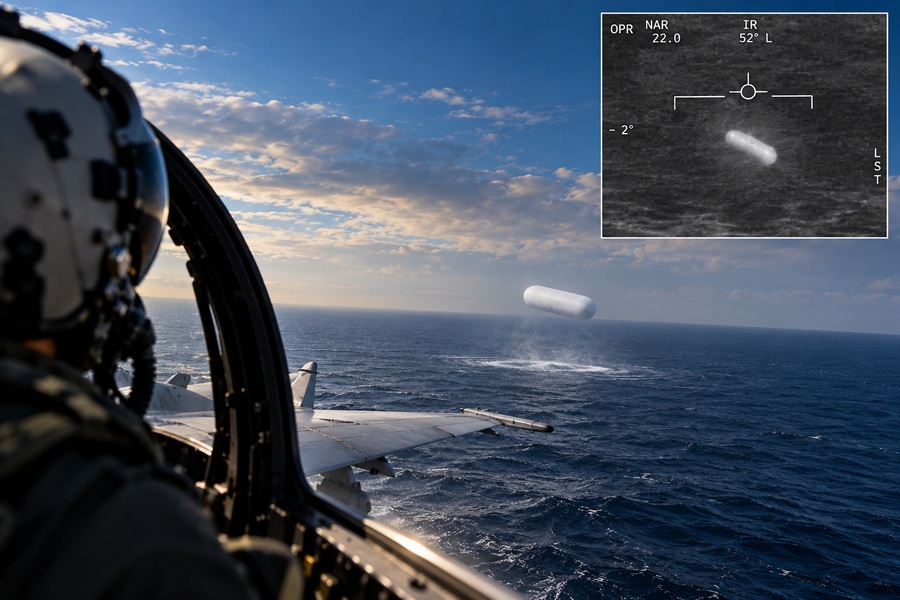
More than two decades after it occurred, the Tic Tac UFO encounter remains one of the most discussed incidents in modern UFO history.
The case began in November 2004 during US Navy training operations off Southern California involving the USS Nimitz Carrier Strike Group.
Navy personnel reported unusual radar contacts. Fighter pilots were subsequently directed towards one of the locations, where Commander David Fravor and Lieutenant Commander Alex Dietrich described seeing a white object above an area of disturbed ocean.
Another Navy aviator, Chad Underwood, later recorded infrared footage associated with the incident.
That recording became known as FLIR1.
The Pentagon eventually confirmed that the video was genuine Navy footage and formally released it in 2020.
Yet the most important question remains unresolved in the public record.
What was the object?
Recent interviews have brought the case back into discussion. In September 2026, Navy veteran Jimmy Hernandez III gave what Podcast UFO described as his first live public interview about his experience aboard the Nimitz during the incident. His account included claims about radio communications, recordings being removed and a nondisclosure agreement. Those claims are his testimony and should not be treated as independently verified documentation. Apple Podcasts
The renewed attention makes this a useful moment to separate what is documented from what remains disputed.
What Was the Tic Tac UFO?
The name came from the object's reported appearance.
Witnesses described a smooth, white, elongated object resembling a Tic Tac sweet, without obvious wings or conventional control surfaces.
Fravor and Dietrich encountered the object visually during a training mission on 14 November 2004.
According to accounts associated with the incident, personnel aboard the USS Princeton had also been detecting unusual radar contacts before the intercept.
The pilots were redirected to investigate.
When they arrived, they reported seeing disturbed water below and an unusual white object moving above it.
Fravor attempted to approach.
The object then departed from the immediate area.
Those observations became the foundation of the Nimitz UFO case.
But they were not the only evidence associated with it.
Who Recorded the Famous Tic Tac UFO Video?
Chad Underwood recorded the infrared footage later known as FLIR1.
Underwood was flying another F/A-18 and used an Advanced Targeting Forward Looking Infrared system — ATFLIR — during the mission.
Unlike Fravor and Dietrich, Underwood did not report visually seeing the object with his own eyes.
His encounter was sensor-based.
That distinction matters.
The famous video therefore should not simply be treated as a recording of exactly what Fravor had visually observed earlier.
Rather, it is another piece of evidence associated with the wider sequence of events.
Underwood has publicly discussed difficulties identifying the object from its infrared appearance and has described unusual aspects of the sensor encounter. Probed
What Does the FLIR1 Video Actually Show?
The FLIR1 recording shows an infrared target tracked by an F/A-18's ATFLIR system. The footage is authentic US Navy material, but the publicly available clip does not contain everything needed to reconstruct the object's physical behaviour.
Distance, camera orientation, aircraft movement and sensor settings all influence how an object appears on screen. Apparent acceleration or changes in direction cannot be reliably converted into physical performance without appropriate measurements.
The footage must also be considered separately from the visual observations reported by David Fravor and Alex Dietrich. Researchers would need original sensor records to establish how confidently the different observations can be connected.
Our guide to UAP evidence explains why video, testimony and technical measurements must be assessed together.
Did the Tic Tac Jam Chad Underwood's Radar?
This is one of the more interesting aspects of Underwood's account.
He has described radar indications that he interpreted as possible active jamming.
That claim has received renewed attention in September 2026 as clips of Underwood discussing the encounter circulated again. Probed
If confirmed with original sensor records, such information could potentially be significant.
But there is an important limitation.
The complete underlying sensor dataset needed for independent analysis has not been made publicly available.
That means outside researchers cannot simply reconstruct every aspect of the encounter from the short FLIR1 video.
The distinction between a witness's interpretation and independently accessible technical data is crucial.
Underwood's experience operating the equipment gives his account relevance.
It does not eliminate the need for the original data.
Why Is the Nimitz Encounter Considered Important?
Many UFO reports consist of a single witness observing a distant light.
The Nimitz case is more complicated.
It involves multiple Navy personnel and different forms of reported observation.
There were visual accounts from pilots.
There were radar-related reports.
There was infrared footage.
Those elements make the case considerably more interesting than an isolated smartphone recording.
But multiple sources do not automatically establish an extraordinary explanation.
Investigators still need to determine whether different observations correspond to the same object, whether sensor readings were interpreted correctly and what information may be missing from the public record.
This is precisely why the case remains controversial.
A New Nimitz Witness Has Spoken Publicly
Interest in the case increased again in September 2026 when Navy veteran Jimmy Hernandez III appeared on Podcast UFO.
According to the programme, Hernandez served aboard USS Nimitz and worked in Primary Flight Control during the period of the 2004 encounter.
In his interview, Hernandez described hearing radio communications associated with Fravor's encounter.
He also claimed that individuals later removed recordings and that he signed a nondisclosure agreement.
Podcast UFO describes the appearance as his first live public interview about the case. Apple Podcasts
These claims add another witness account to the history surrounding the Nimitz incident.
They do not, however, independently establish what the Tic Tac object was.
Publicly accessible documentation would be required to verify claims concerning specific recordings, their removal and what those recordings contained.
What Happened to the Missing Nimitz Data?
Several people associated with the Nimitz encounter have described radar tracks, recordings and other information that are not publicly available for independent examination.
Original radar data, aircraft telemetry and complete targeting-pod recordings could help researchers reconstruct the incident more accurately, provided those records still exist and can be authenticated.
Their absence from the public record does not establish that evidence was deliberately concealed or that the missing material contains extraordinary discoveries.
It means that important aspects of the encounter cannot currently be independently verified.
Could the Tic Tac Have Been Secret US Technology?
Secret military technology is frequently proposed as an explanation for unexplained military encounters.
In principle, advanced aircraft or electronic-warfare systems could produce observations unfamiliar to ordinary personnel.
But the hypothesis needs evidence.
Simply labelling an unidentified object a secret aircraft does not identify it.
There would also be practical questions about why experimental technology would apparently be operated in a way that interfered with a major Navy training exercise.
Those questions do not rule the hypothesis out.
They demonstrate why it cannot be accepted without supporting information.
Did the Pentagon Confirm the Tic Tac UFO?
On 27 April 2020, the US Department of Defense authorised the release of three historical Navy videos, including one recorded in November 2004.
The department confirmed that the footage circulating publicly was genuine Navy material and stated that the aerial phenomena remained classified as unidentified.
That confirmation did not establish the objects' origins or endorse an extraterrestrial explanation.
The distinction is central to our examination of whether UFOs are real: a genuine recording can document an unidentified observation without proving that the object was an alien spacecraft.
Does the Tic Tac UFO Break the Laws of Physics?
Claims about extraordinary speed, acceleration and manoeuvrability are among the reasons the Nimitz case has remained famous.
But determining physical performance requires measurements.
If researchers know an object's distance, position and movement over time, they can estimate velocity and acceleration.
Without reliable values, apparent movement in footage cannot provide the same certainty.
Some published analyses have attempted to estimate the object's performance using witness accounts and available information.
Other researchers dispute assumptions required by those calculations.
The most valuable evidence would therefore be original, calibrated sensor data capable of constraining those variables directly.
Until such information is publicly available, claims about the object's exact performance should be treated cautiously.
Was the Tic Tac an Alien Spacecraft?
There is currently no publicly available evidence that establishes an extraterrestrial origin for the Nimitz object.
That does not make the encounter uninteresting.
Quite the opposite.
A well-documented unidentified event involving trained military personnel deserves careful investigation precisely because its identity remains uncertain.
But “unidentified” and “extraterrestrial” are different conclusions.
Our explanation of what a UAP actually means explores that distinction.
Possible explanations range from misinterpretation and sensor effects to classified technology or a genuinely unusual physical phenomenon.
Evidence must distinguish between those possibilities.
Why the Tic Tac UFO Still Matters in 2026
The Nimitz incident has survived more than twenty years of UFO debate because the basic question has never received a publicly demonstrated answer.
Recent interviews have added more testimony.
They have not solved the case.
In some ways, that illustrates the central problem facing modern UAP research.
Witness testimony can tell investigators where to look.
Video can preserve part of an observation.
Radar can potentially provide quantitative measurements.
But the strongest conclusions require those sources to be preserved, compared and independently analysed.
The Tic Tac UFO therefore remains important not because it proves alien visitation, but because it demonstrates exactly what investigators need if they want to move beyond speculation.
Original sensor data.
Reliable provenance.
Multiple independent observations.
And enough information for other researchers to test the conclusions.
Until that standard is met, the Nimitz encounter remains one of the most compelling unresolved cases in the public UFO record — but unresolved is still the correct word.
Sources and Further Reading
U.S. Department of Defense — Statement on the Release of Historical Navy Videos
U.S. House Committee on Oversight and Accountability — Unidentified Anomalous Phenomena Hearing
All-domain Anomaly Resolution Office (AARO) — Official Website
Podcast UFO — Navy Veteran Jimmy Hernandez III and Filmmaker David Beaty
HISTORY — The USS Nimitz Tic Tac UFO Encounter
U.S. House Committee on Oversight — David Fravor's Written Statement on the USS Nimitz Encounter