If life exists elsewhere in the universe, it may not always remain microscopic. Given enough time, life on another world could conceivably develop technology — just as humans have built radio transmitters, satellites, cities and spacecraft on Earth.
If that happened, some of that technology might leave traces visible across interstellar distances.
Scientists call these potential clues technosignatures.
As we explored in our guide to biosignatures, researchers can search for chemical or physical evidence that might indicate biological activity. Technosignatures take the idea one step further: instead of looking simply for life, scientists look for signs that technology may exist — or once existed — somewhere beyond Earth.
What Is a Technosignature?
A technosignature is an observable signal or characteristic that could potentially indicate the presence of technology.
The best-known example is an artificial radio signal.
Earth has been producing radio transmissions for little more than a century. Some of those signals have travelled beyond our Solar System, although detecting ordinary terrestrial broadcasts from great distances would be extremely difficult.
Scientists therefore consider whether another civilisation might produce stronger or more distinctive signals that could be recognised as artificial.
But radio is only one possibility.
Scientists Are Looking Beyond Radio Signals
Modern searches for technosignatures consider a much wider range of possibilities.
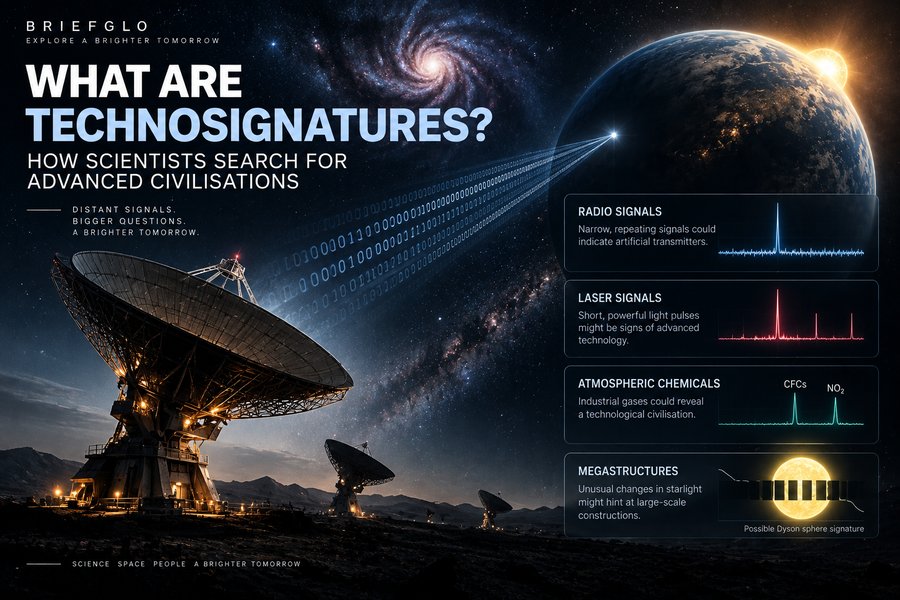
Researchers have discussed unusually narrow radio transmissions, powerful laser pulses, artificial chemicals in an exoplanet's atmosphere, unusual infrared heat and even enormous structures that might alter the light arriving from a distant star.
Some ideas are more speculative than others.
For example, scientists have considered whether a sufficiently advanced civilisation might build structures capable of collecting enormous quantities of energy from its star. Such hypothetical constructions are often associated with the idea of a Dyson sphere.
Nobody has discovered one. Even an unusual excess of infrared radiation would not, by itself, establish the existence of such a structure. Natural sources, including surrounding dust, can also produce infrared emissions. Any proposed detection would require careful modelling and independent observations before a technological explanation could be considered.
The point is not that such structures necessarily exist, but that astronomy can ask whether certain observations would be difficult to explain through known natural processes.
Could Pollution Reveal an Alien Civilisation?
Perhaps surprisingly, pollution could potentially become a technosignature.
Human civilisation has changed Earth's atmosphere by producing chemicals associated with industry. If something similar happened on another planet, sufficiently powerful future telescopes might be able to detect unusual atmospheric chemistry.
NASA researchers have studied whether compounds associated with industrial activity could, under certain circumstances, be detectable on distant worlds.
This connects technosignature research directly with the study of an exoplanet atmosphere, where scientists analyse how different gases absorb and transmit light.
However, detecting an unusual chemical would not automatically prove that somebody manufactured it. Scientists would first need to investigate natural chemical and geological explanations.
What About Radio and Laser Signals?
Radio remains one of the most familiar ways of searching for technological life.
Radio telescopes can scan the sky for signals with characteristics that might distinguish them from natural astronomical sources. Researchers have also considered short pulses of laser light as another possible form of detectable technology.
The difficulty is enormous.
The universe is full of natural radio emissions, energetic events and unusual signals. Human technology also creates interference.
A strange signal therefore needs to survive repeated observations and careful investigation before scientists can seriously consider an artificial origin.
An unexplained signal is not automatically an alien message.
Have We Detected a Technosignature?
No confirmed extraterrestrial technosignature has been discovered. One useful example is BLC1, a narrow-band radio signal identified in observations of Proxima Centauri made in 2019. Its unusual characteristics initially attracted attention from researchers working with the Breakthrough Listen project. However, a detailed investigation found evidence consistent with interference from human technology rather than an extraterrestrial transmitter. The case illustrates why an intriguing signal is only the beginning of a scientific investigation, not confirmation of alien intelligence. For a closer look at how astronomers distinguish unusual observations from interference, read How Do Scientists Search for Signals From Space?.
There have been intriguing signals and astronomical observations over the years, but none has provided accepted evidence of an advanced civilisation beyond Earth.
That distinction is particularly important because stories involving possible alien signals can easily become exaggerated.
Scientists generally need to determine whether a signal repeats, where it comes from and whether natural phenomena or human technology can explain it.
Extraordinary interpretations come much later.
Biosignatures vs Technosignatures
The difference is fairly simple.
A biosignature could indicate life.
A technosignature could indicate technology.
Microorganisms changing the chemistry of a planet's atmosphere might create a biosignature. A clearly artificial transmission from that planet could potentially be a technosignature.
This also means that a planet could contain life without producing any detectable technology.
Earth illustrates the problem rather well. Life has existed here for billions of years, while technology capable of producing signals detectable across astronomical distances appeared only extremely recently by comparison.
Searching for biosignatures therefore covers a much broader range of possible life.
What Would Convincing Evidence Look Like?
A convincing technosignature would need to be difficult to explain naturally and supported by strong observations.
A repeating narrow-band signal from a particular planetary system, for example, would deserve considerable attention if researchers could rule out terrestrial interference and known astronomical sources.
Likewise, unusual atmospheric chemicals or infrared emissions would need to be examined against natural alternatives.
Scientists would also want independent teams and observatories to verify an important detection.
For now, technosignatures remain exactly what the name suggests: signatures to search for, not evidence that advanced extraterrestrial civilisations have already been found.
Yet the search raises an interesting question in the opposite direction.
The question also works in reverse. If scientists can search distant worlds for signs of technology, could another civilisation detect our own planet? Explore the possibilities in Could an Alien Civilisation Detect Earth?.
Sources and Further Reading
NASA Science — Searching for Signs of Intelligent Life: Technosignatures
NASA's overview of how scientists search for potential technological evidence, including radio signals, lasers, atmospheric chemicals and hypothetical large-scale structures.
NASA Science — UAP FAQs: What Are Technosignatures?
NASA's explanation of technosignatures and how they differ from broader biosignatures.
NASA Science — Finding Life Beyond Earth: What Comes Next?
An overview of potential searches involving artificial chemicals, city lights, large structures and infrared waste heat.
NASA — NASA Is Taking a New Look at Searching for Life Beyond Earth
Background on the scientific study of technosignatures and the expansion of SETI beyond traditional radio searches.
Nature Astronomy — Analysis of the Breakthrough Listen Signal of Interest BLC1