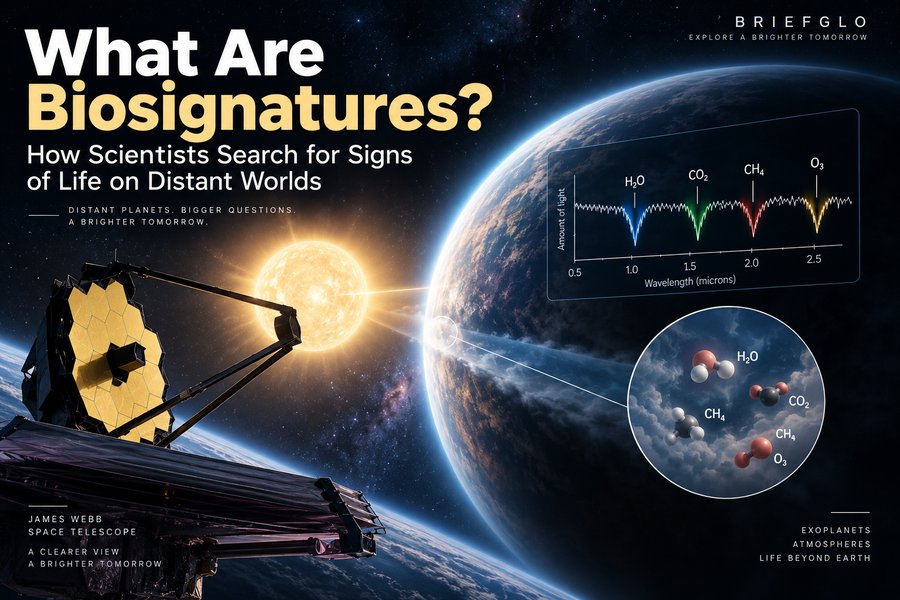
Finding a distant planet is one thing. Finding evidence that something might be living there is considerably harder.
Scientists cannot travel to an exoplanet, collect a rock or examine a drop of water. Instead, they have to search for indirect clues — changes in an atmosphere, unusual chemistry or other features that could have been influenced by life.
These clues are known as biosignatures.
As explored in our guide to how scientists study an exoplanet atmosphere, telescopes can separate incoming light into different wavelengths and reveal some of the gases surrounding a distant world. The next challenge is deciding what those gases actually mean.
What Is a Biosignature?
A biosignature is a substance, structure, pattern or characteristic that could provide evidence of past or present life.
On Earth, living organisms have transformed the planet for billions of years. Plants and microorganisms, for example, have played a major role in shaping the chemistry of our atmosphere.
Scientists therefore ask a fascinating question: if life changed another planet in a similar way, could we detect the result from Earth?
For distant exoplanets, atmospheric gases are among the most promising places to look. Biosignatures are not limited to atmospheric gases. Scientists also investigate chemical patterns preserved in rocks, possible fossil structures and the distribution of particular molecules. On Earth, ancient microbial communities have left traces in sedimentary deposits. Similar observations on another world could be scientifically important, although geological processes would still need to be ruled out before claiming a biological origin.
Which Gases Could Be Signs of Life?
Oxygen is perhaps the best-known example.
Much of the oxygen in Earth's atmosphere exists because photosynthetic organisms continually produce it. Finding substantial oxygen on another planet would therefore attract enormous scientific interest.
Researchers are also interested in gases such as methane and combinations of atmospheric chemicals that might be difficult to maintain without a continuous source.
But there is an important problem.
A potentially interesting gas is not proof of life.
Methane can be produced by geological processes. Under some planetary conditions, oxygen can also accumulate without biology.
That means scientists cannot simply detect one molecule and announce that they have discovered life.
Why One Gas Is Not Enough
Imagine astronomers detected oxygen in the atmosphere of a rocky exoplanet.
The discovery would be exciting, but the investigation would only be beginning.
Researchers would want to understand the planet's star, temperature, atmospheric composition and geological environment. They would also search for other molecules that could help explain where the oxygen came from.
This wider context is essential because nature can produce what researchers call false positives — signals that resemble biological activity but actually have a non-biological explanation.
NASA-supported research into exoplanet biosignatures therefore emphasises multiple lines of evidence rather than relying on a single molecule. Scientists also examine whether an atmosphere contains gases that would normally react with one another and disappear unless they were continually replenished. Such chemical disequilibrium can be interesting, but it is not automatically biological. Researchers must model the planet's atmosphere, geological activity and incoming radiation to determine whether non-living processes could maintain the same combination of gases.
How Would Scientists Detect a Biosignature?
The process begins with light.
When an exoplanet passes in front of its star, some starlight can travel through the planet's atmosphere. Molecules absorb particular wavelengths, leaving patterns in the spectrum recorded by a telescope.
This technique can reveal information about atmospheric chemistry across enormous distances.
The James Webb Space Telescope is already helping astronomers investigate exoplanet atmospheres, although detecting a genuine biosignature on a small rocky world remains extremely challenging. NASA notes that convincing identification would require extensive observations, follow-up work and several converging lines of evidence.
It is one of the reasons the search for extraterrestrial life is likely to be a gradual scientific process rather than a single dramatic discovery.
Does a Habitable Planet Automatically Have Biosignatures?
No.
A planet within the habitable zone may have conditions that allow liquid water on its surface, provided its atmosphere and other environmental factors are suitable. However, this does not tell us whether life actually developed there.
Likewise, an apparently Earth-sized planet is not necessarily another Earth.
Its atmosphere could be completely different. It might have lost its water billions of years ago, experience intense radiation from its star or possess environmental conditions hostile to biology.
Habitability and inhabited are two very different ideas.
Have Scientists Found a Confirmed Biosignature Beyond Earth?
Not yet.
Scientists have discovered environments and chemical signals that are interesting enough to investigate further, but no observation has established the existence of extraterrestrial life.
NASA describes a potential biosignature as something that might have a biological origin but requires more evidence before scientists can determine whether life is responsible.
That distinction matters.
A strange molecule is evidence to investigate, not a conclusion.
What Would Convincing Evidence Look Like?
The strongest case would probably not depend on one spectacular measurement.
Scientists would look for several observations that support each other: atmospheric chemistry consistent with biological activity, suitable environmental conditions and the absence of convincing geological or chemical explanations for the same signals.
Researchers would then need independent observations and further analysis.
This may sound cautious, but the consequences of discovering life beyond Earth would be enormous. The evidence would need to be correspondingly strong.
For now, biosignatures give scientists something extremely valuable: a way to turn the question “Could there be life out there?” into something that can actually be tested.
And biology is not the only possible signal.
If an advanced civilisation existed on a distant world, it might leave behind evidence of technology rather than biology alone. Our guide to technosignatures explains how scientists investigate possible radio transmissions, artificial atmospheric chemicals and other technological clues.