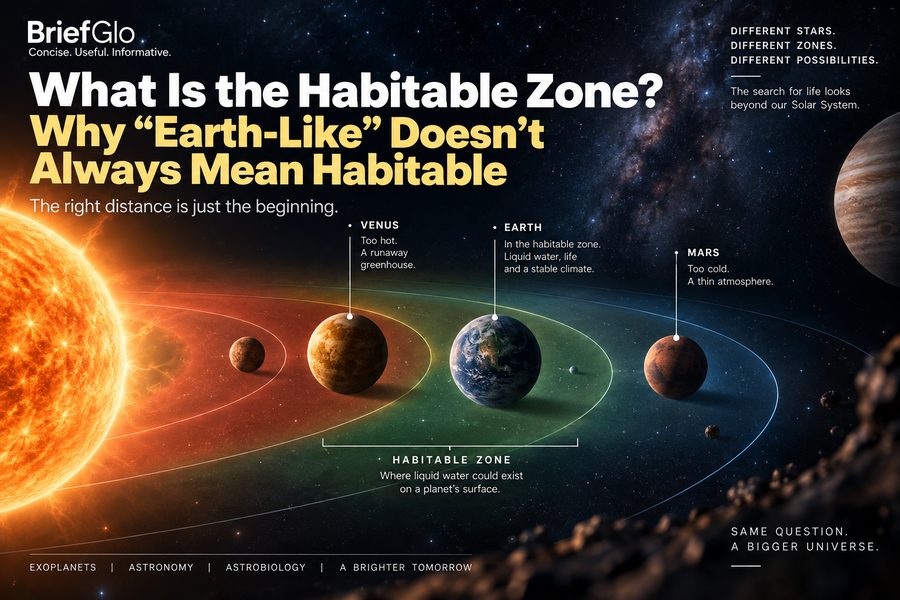
When astronomers discover a planet that might resemble Earth, one of the first questions is whether it lies in the habitable zone of its star. Headlines sometimes describe such worlds as potentially habitable, raising the possibility of oceans, familiar landscapes or even life.
But there is an important distinction between a planet being the right distance from its star and actually being capable of supporting living organisms.
A world can sit comfortably within the habitable zone and still be completely hostile to life. Another may orbit far outside it yet contain liquid water beneath an icy surface.
The habitable zone is therefore a useful starting point, not a guarantee of habitability.
What Is the Habitable Zone?
The habitable zone is the region around a star where a planet with suitable atmospheric conditions could maintain liquid water on its surface.
It is sometimes called the Goldilocks zone, borrowing the idea of conditions being neither too hot nor too cold.
A planet orbiting too close to its star may receive enough energy to lose its surface water through evaporation and atmospheric processes. Farther away, temperatures may become too low for surface oceans to remain liquid without sufficient greenhouse warming.
Between these extremes lies a range of orbital distances where surface liquid water may be possible.
The precise boundaries depend on the star and on assumptions about the planet's atmosphere.
For hotter, more luminous stars, the habitable zone generally lies farther out. Around smaller, cooler stars, it can be much closer.
Scientists use this concept to identify promising targets among the many exoplanets discovered beyond our Solar System.
However, orbital distance alone tells us surprisingly little about a planet's actual surface.
Why Liquid Water Matters
Every known form of life on Earth depends on liquid water.
Water acts as a medium for chemical reactions, transports substances within organisms and helps support the complex processes associated with biology.
That makes it a practical focus when searching for life elsewhere.
Yet liquid water is only one requirement.
Life as we understand it also needs suitable chemistry, access to energy and environmental conditions that allow biological processes to continue.
A planet could have water but lack other essential ingredients. It might also experience extreme radiation, unstable temperatures or atmospheric conditions that make its surface unsuitable for known organisms.
The habitable zone helps astronomers identify where one important condition might exist. It does not establish that all the others are present.
Earth, Venus and Mars: Three Very Different Outcomes
Our own Solar System illustrates why distance from a star cannot explain everything.
Earth lies within the Sun's habitable zone and has maintained liquid water on its surface for billions of years.
Its atmosphere helps regulate temperature, while geological and chemical processes influence the long-term climate.
Venus tells a very different story.
Although it is similar to Earth in size, Venus has an extremely dense atmosphere dominated by carbon dioxide. Its powerful greenhouse effect produces surface temperatures hot enough to melt lead.
Mars presents another contrast.
Its atmosphere is thin, and its surface is generally cold and dry. Nevertheless, geological evidence indicates that liquid water once flowed across parts of the planet.
The history of ancient water and possible life on Mars remains an important area of planetary research.
These three worlds demonstrate that atmospheric evolution, geological history and the availability of water matter at least as much as a planet's present orbital distance.
Why Atmospheres Can Change Everything
An atmosphere is more than a layer of gas surrounding a planet.
It influences surface pressure, temperature, weather and the movement of energy around the globe.
Greenhouse gases can help maintain temperatures suitable for liquid water. Without enough warming, even a planet in the habitable zone might become frozen.
Too much greenhouse warming, however, can produce conditions resembling Venus.
Atmospheric pressure is equally important because it affects whether water can remain liquid at the surface.
A planet's atmosphere can also change over time.
Volcanic activity may release gases, while radiation and particles from the host star can gradually remove atmospheric material.
Some planets may lose substantial amounts of water during their early histories, leaving them dry even if their later orbits appear favourable.
Understanding habitability therefore requires scientists to study both the present atmosphere and the processes that shaped it.
The Challenges of Red Dwarf Stars
Many potentially interesting exoplanets orbit red dwarfs, stars that are smaller and cooler than the Sun.
Because these stars emit less energy, their habitable zones lie relatively close to them.
That proximity creates several complications.
Some red dwarfs produce powerful flares and high-energy radiation that can affect nearby planetary atmospheres.
Planets in close orbits may also become tidally locked, meaning the same side continually faces the star while the opposite side remains in darkness.
This does not automatically make a planet uninhabitable.
A sufficiently substantial atmosphere or ocean might transport heat between the illuminated and dark hemispheres, reducing extreme temperature differences.
But whether that happens depends on conditions scientists cannot always measure directly.
A planet around a red dwarf may therefore be an attractive observational target while still presenting major uncertainties about its environment.
TRAPPIST-1: Seven Worlds, Many Questions
The TRAPPIST-1 system, approximately 40 light-years from Earth, has become one of the most important laboratories for studying rocky exoplanets.
It contains seven roughly Earth-sized planets orbiting a small, cool star.
Three of them — TRAPPIST-1 e, f and g — lie within the star's commonly defined habitable zone.
Their locations make them scientifically interesting, but they do not establish that any of these planets has oceans or life.
Observations with the James Webb Space Telescope have begun narrowing down possible atmospheric conditions across the system.
Studies have found little evidence of thick atmospheres around the innermost planets, while the atmospheres of other worlds remain more difficult to characterise.
For TRAPPIST-1 e, observations reported in 2025 could not establish whether the planet has an atmosphere, although some atmospheric scenarios were constrained.
Activity from the host star makes the analysis especially challenging.
The system offers a useful reminder that even when astronomers know a planet's size, mass and orbit, its actual environment may remain uncertain.
Could Life Exist Outside the Habitable Zone?
The traditional habitable zone focuses on liquid water at a planet's surface.
But some of the most intriguing environments in our Solar System are hidden beneath ice.
Europa, one of Jupiter's moons, is thought to contain a global ocean beneath its frozen exterior.
Its internal ocean may remain liquid partly because of heat generated by tidal forces as Jupiter's gravity repeatedly flexes the moon.
That makes Europa's hidden ocean an important target in the search for potentially habitable environments.
Saturn's moon Enceladus offers another example.
It releases plumes containing water vapour and ice particles from fractures near its south pole. Spacecraft observations have provided evidence of an ocean beneath its icy shell.
The possibility of life in Enceladus's ocean is still unproven, but the moon demonstrates that liquid water does not always require warmth from a nearby star.
These worlds expand the scientific discussion beyond the familiar Goldilocks zone.
A planet or moon can be outside the conventional habitable zone while still possessing an environment worth investigating.
Does Earth-Like Mean Habitable?
When astronomers describe an exoplanet as Earth-like, they may be referring to only a few measurable characteristics.
It might have a similar radius, comparable mass or an orbit receiving roughly the same amount of energy that Earth receives from the Sun.
Those similarities are valuable, but they are not enough to establish that the planet resembles Earth in every meaningful way.
Two planets of similar size can have very different atmospheres, surface temperatures and geological histories.
An Earth-sized planet might be covered in ice, dominated by volcanic activity or stripped of most of its atmosphere.
Even the term potentially habitable should be understood carefully.
It means that available evidence has not ruled out certain conditions compatible with life, rather than that those conditions have been demonstrated.
A genuinely Earth-like environment would require much more information than planetary size and orbital distance.
How Can Scientists Tell Whether a Planet Is Habitable?
Astronomers combine several kinds of evidence to assess distant worlds.
A planet's orbit helps estimate how much energy it receives from its star.
Its size and mass can provide clues about whether it is likely to be rocky or rich in gas.
The host star's age, brightness and activity also matter.
One of the most promising areas of research involves studying planetary atmospheres.
When a planet passes in front of its star, some starlight may filter through its atmosphere. By examining the wavelengths absorbed, scientists can search for evidence of particular gases.
Our guide to how scientists study exoplanet atmospheres explains this method and why the James Webb Space Telescope is important to the field.
Researchers are also interested in possible biosignatures, chemical indicators that might be associated with biological activity.
However, individual gases can have non-biological origins.
No atmospheric measurement should be treated as proof of life without carefully considering alternative explanations.
Why the Habitable Zone Still Matters
Despite its limitations, the habitable zone remains one of astronomy's most useful tools.
Scientists cannot examine every planet in equal detail. Telescopes have limited observing time, and many distant worlds are extremely difficult to study.
The habitable zone helps researchers prioritise planets where surface liquid water might be possible.
It also provides a consistent framework for comparing planetary systems around different stars.
But the next stage of exoplanet research is moving beyond simple measurements of distance.
Astronomers want to understand atmospheric composition, climate, geological processes and the history of individual worlds.
A planet's position in the habitable zone is an invitation to investigate, not a final answer.
The larger scientific question is not merely whether another Earth-sized planet exists, but whether any distant world has maintained the complex conditions that could allow life to emerge and survive.
For now, Earth remains the only planet known to support life.
Discovering another potentially habitable world would be exciting. Demonstrating that it is truly habitable would be a much greater achievement.
Sources and Further Reading
NASA Science — The Habitable Zone
An introduction to the Goldilocks zone and its role in the search for potentially habitable planets.
NASA Science — What Is the Habitable Zone?
An explanation of how orbital distance and atmospheric conditions affect the possibility of surface liquid water.
NASA Science — What Is Webb Revealing About the TRAPPIST-1 System?
A summary of Webb's atmospheric observations and the scientific uncertainties surrounding the TRAPPIST-1 planets.
NASA Science — NASA Webb Looks at Earth-Sized, Habitable-Zone Exoplanet TRAPPIST-1 e
Research findings on one of the most closely studied potentially habitable exoplanets.
NASA Science — What Determines If a Planet Can Have Life?
An overview of the environmental factors involved in planetary habitability.