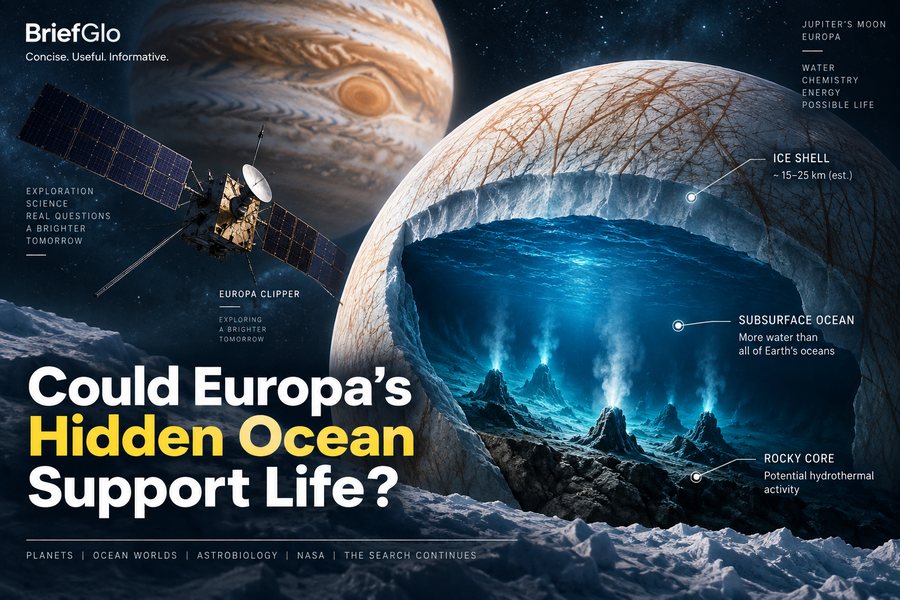
From a distance, Europa looks like a frozen world with little chance of supporting life. Its surface is covered in ice, sunlight is weak, and temperatures are far below freezing.
Yet beneath that icy exterior, scientists believe one of the Solar System's most intriguing environments may exist: a vast ocean of liquid water.
Europa, one of Jupiter's largest moons, has become a major target in the search for extraterrestrial life. Evidence suggests that its ocean could contain more water than all of Earth's oceans combined.
But water is only part of the story.
For life to survive, an environment also needs suitable chemistry, an accessible energy source and conditions that remain stable over time.
NASA's Europa Clipper spacecraft is now travelling towards Jupiter to investigate whether Europa could provide those conditions.
The mission is not designed to discover living organisms directly. Instead, it aims to answer a question that comes first: could this distant moon support life at all?
What Is Europa?
Europa is one of Jupiter's four large Galilean moons, discovered in 1610.
It is slightly smaller than Earth's Moon and orbits Jupiter at a distance of approximately 671,000 kilometres.
Its surface is one of the smoothest in the Solar System, although it is crossed by long cracks, ridges and reddish-brown markings.
These features suggest that Europa's icy exterior has experienced extensive geological activity.
The moon is also exposed to intense radiation from Jupiter's magnetic environment, making its surface extremely hostile to life as we know it.
However, the conditions beneath the ice could be very different.
Scientists believe Europa has a rocky interior, a layer of liquid water and an outer shell of ice.
That combination makes it fundamentally different from a completely frozen, inactive world.
Is There Really an Ocean Beneath Europa?
The strongest evidence for Europa's hidden ocean comes from several independent observations.
Images from NASA's Voyager and Galileo missions revealed a fractured surface with relatively few large impact craters.
This suggested that Europa's exterior has been reshaped by geological processes.
More importantly, measurements from the Galileo spacecraft detected magnetic signals consistent with an electrically conductive layer beneath the ice.
A global ocean containing dissolved salts provides a plausible explanation for those observations.
Scientists therefore consider a subsurface ocean highly likely, although important details about its depth, composition and circulation remain uncertain.
Some estimates suggest that Europa's ocean could contain roughly twice as much liquid water as Earth's oceans.
Unlike Earth's oceans, however, Europa's water would be hidden beneath an icy shell potentially many kilometres thick.
Understanding that shell is one of the main challenges for future exploration.
Why Doesn't Europa's Ocean Freeze Completely?
Europa is far beyond the region where sunlight can keep surface water liquid under Earth-like conditions.
So how could an ocean remain beneath its ice?
The answer involves Jupiter's gravity.
Europa follows a slightly elliptical orbit around the giant planet. As its distance from Jupiter changes, powerful gravitational forces repeatedly stretch and compress its interior.
This process is called tidal heating.
Gravitational interactions with neighbouring moons help maintain Europa's orbital eccentricity, allowing this internal flexing to continue.
The resulting energy may help keep water liquid beneath the frozen surface.
Europa therefore illustrates an important limitation of the traditional habitable zone.
A world does not necessarily need strong sunlight to maintain liquid water if another source of heat is available.
That possibility expands the range of environments scientists consider when searching for life.
Could Europa's Ocean Support Life?
Scientists often examine three broad requirements when assessing whether an environment could support life as we know it: liquid water, useful chemical ingredients and an energy source.
Europa appears to have the first requirement.
Its ocean may also contain dissolved minerals and other substances that could participate in important chemical reactions.
The greatest uncertainty concerns how energy and chemical materials move through the moon.
On Earth, microorganisms can survive in environments without sunlight by obtaining energy from chemical reactions.
If similar reactions occur inside Europa, they might provide opportunities for microbial life.
However, scientists do not yet know whether the necessary chemicals are available in the right concentrations or whether they can be transported efficiently through the ocean.
A potentially habitable environment is not necessarily an inhabited one.
No spacecraft has detected living organisms on Europa, and scientists have not confirmed that life ever developed there.
Could Hydrothermal Vents Exist on Europa?
One possibility involves interactions between Europa's ocean and its rocky interior.
On Earth, hydrothermal vents form where heated water circulates through rocks beneath the ocean floor.
These environments support ecosystems that do not depend directly on sunlight.
Some microorganisms use chemical energy released through water-rock reactions.
Researchers are interested in whether comparable processes could occur at the bottom of Europa's ocean.
If liquid water reaches warm rock, chemical reactions might release substances that microorganisms could potentially use.
Europa's internal heating and rocky interior make this possibility scientifically plausible.
But there is an important distinction between a plausible process and an observed feature.
Scientists have not directly photographed hydrothermal vents beneath Europa's ice.
Their possible existence remains a hypothesis that future observations and modelling may help evaluate.
Could Chemicals From the Surface Reach the Ocean?
Europa's surface is continually exposed to radiation from Jupiter's powerful magnetic environment.
That radiation can alter water ice and other surface materials, producing chemically reactive substances.
Some of these compounds could be useful to hypothetical organisms if they eventually reached the ocean.
The challenge is transport.
Europa's icy shell separates the surface from the liquid water below.
Scientists are investigating whether cracks, shifting ice, partial melting or other geological processes allow material to move between these regions.
If surface chemicals can reach the ocean, they might contribute to reactions capable of providing energy.
If the ice shell largely prevents such exchange, the ocean's chemistry could be very different.
Understanding this relationship between surface and ocean is therefore essential to assessing Europa's habitability.
Could Europa's Surface Reveal What Lies Beneath?
Although Europa's ocean is hidden, its surface may contain clues about the environment below.
The moon's long fractures and disrupted areas suggest that ice has moved and changed over time.
Some regions contain chaotic arrangements of broken ice blocks, often called chaos terrain.
Scientists are studying whether these formations could be connected to subsurface water, local melting or movement within the ice shell.
There have also been reports of possible water vapour plumes near Europa.
However, plume activity has not been established as a regular, consistently observed phenomenon.
Scientists cannot assume that Europa releases ocean material into space in the same way as Saturn's moon Enceladus.
Even without confirmed plumes, surface composition and geological structures may reveal important information about processes occurring beneath the ice.
What Is NASA's Europa Clipper Mission?
NASA launched Europa Clipper on 14 October 2024.
The spacecraft is designed to investigate Europa's habitability by studying its ice shell, composition, geology and possible interactions with the subsurface ocean.
Rather than orbiting Europa continuously, Europa Clipper will orbit Jupiter and make repeated close flybys of the moon.
This approach helps limit the spacecraft's exposure to Jupiter's intense radiation environment.
The mission is scheduled to arrive at Jupiter in April 2030 and conduct approximately 49 close flybys of Europa during its main science campaign.
Europa Clipper completed a gravity-assist flyby of Mars in March 2025 and is scheduled to use Earth's gravity in December 2026 to continue its journey.
As of October 2026, it has not yet reached Jupiter.
The mission's central goal is not to confirm extraterrestrial life.
It is to determine whether Europa possesses environments that could support it.
How Will Europa Clipper Investigate the Hidden Ocean?
Europa Clipper carries a suite of scientific instruments designed to study the moon from multiple perspectives.
Ice-penetrating radar will investigate structures within the icy shell and help scientists understand its thickness and internal features.
Cameras will capture detailed images of Europa's surface, allowing researchers to examine fractures, ridges and other geological formations.
Spectrometers will study surface materials and search for chemical compounds that may offer clues about the moon's composition.
Other instruments will measure magnetic fields and plasma conditions, helping researchers investigate the ocean and Europa's interaction with Jupiter's environment.
A thermal imaging instrument will search for temperature variations that could indicate recent or ongoing geological activity.
Together, these measurements should help scientists build a more complete picture of Europa.
They may reveal how the ice shell behaves, whether materials move between the surface and ocean, and which locations deserve further investigation.
But even an extensive collection of measurements may not provide a definitive answer about life.
What Kind of Life Might Exist on Europa?
If Europa supports life, microorganisms are generally considered a more plausible possibility than complex animals.
On Earth, microbes inhabit environments that would be hostile to many larger organisms, including deep ocean sediments and locations with little or no sunlight.
Some survive by using chemical energy rather than photosynthesis.
A similar strategy could theoretically work in Europa's ocean if suitable reactions and nutrients are available.
However, there is no evidence that Europa contains microbial communities, let alone fish or other complex organisms.
Speculation about large creatures living beneath the ice goes well beyond the available scientific evidence.
The more useful question is whether Europa possesses stable chemical environments in which simple organisms could survive.
That is the kind of possibility scientists can investigate through measurements, experiments and future missions.
What Would Count as Evidence of Life?
A discovery of organic molecules on Europa would be interesting, but it would not automatically prove that organisms exist.
Organic compounds can form through non-biological processes.
Scientists would need to investigate possible biosignatures: chemical, structural or other features that might indicate biological activity.
Convincing evidence would require several independent observations and careful consideration of alternative explanations.
A future mission specifically designed for life detection might examine material from the surface, a plume or, eventually, the ocean itself.
Such investigations would need strict contamination controls to ensure that terrestrial material did not interfere with the results.
Europa Clipper will provide valuable information about where and how these future investigations might be conducted.
It is a habitability mission, not a direct life-detection mission.
Europa and the Wider Search for Extraterrestrial Life
Europa is part of a much broader effort to understand whether life could exist elsewhere in the Solar System.
On Mars, researchers are investigating rocks that may preserve evidence of ancient habitable environments.
On Enceladus, material associated with an underground ocean escapes through icy plumes, allowing spacecraft to study its chemistry without reaching the ocean directly.
Europa presents a different challenge.
Its ocean appears to be protected beneath a thick ice shell, but its chemical composition and potential energy sources remain incompletely understood.
These worlds show that the search for life is not limited to planets resembling Earth.
A frozen moon far from the Sun may contain an environment worth investigating, even if its surface appears entirely inhospitable.
The discovery of a habitable ocean would not establish that life exists there.
But understanding how such environments form and survive could transform our knowledge of where life might be possible.
Could Europa Really Support Life?
Europa has several characteristics that make it an important target for astrobiology.
Strong evidence supports the existence of a global subsurface ocean, tidal heating may provide internal energy, and interactions between water, rock and surface materials could create useful chemistry.
These are compelling reasons to investigate the moon.
They are not proof that its ocean contains living organisms.
Scientists still need to understand the composition of the water, the availability of chemical energy and the processes connecting the ocean to the icy exterior.
Europa Clipper is expected to make major progress on these questions after reaching Jupiter in 2030.
For now, Europa remains one of the Solar System's most intriguing potentially habitable worlds.
Its significance lies not in a confirmed discovery of alien life, but in the possibility that a dark ocean beneath an icy moon could provide some of the same fundamental conditions that allow life to survive on Earth.
Sources and Further Reading
NASA Science — Europa
Overview of Europa's surface, interior, subsurface ocean and scientific importance.
NASA Science — Europa Clipper
Official information about the mission and its scientific objectives.
NASA Science — Europa Clipper Mission Timeline
The spacecraft's journey, gravity assists and planned arrival at Jupiter.
NASA JPL — Europa Clipper
Mission details, scientific instruments and investigations of Europa's habitability.
NASA Science — Europa Clipper Mission FAQ
Answers to common questions about Europa's ocean, the spacecraft and the search for habitable environments.