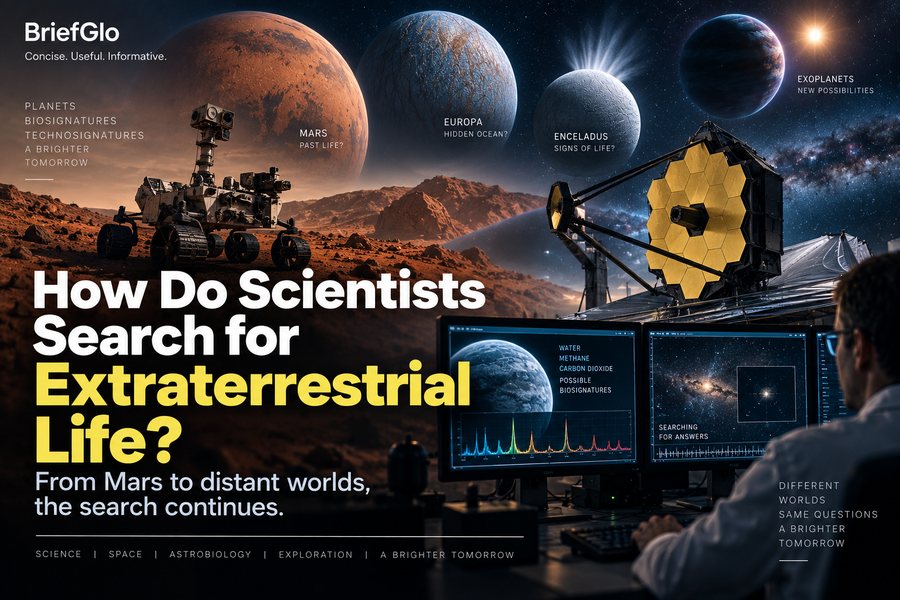
For centuries, the possibility of life beyond Earth belonged largely to philosophy and imagination. Today, it is a serious scientific question investigated with robotic spacecraft, powerful telescopes and laboratory experiments.
Scientists are exploring ancient Martian rocks, studying oceans hidden beneath icy moons and analysing the atmospheres of planets orbiting distant stars.
Others are listening for unusual radio transmissions that might reveal the presence of technological civilisations.
These investigations share a common goal, but they do not all search for the same thing.
Finding a world that could support life is different from finding evidence that life actually exists there. And discovering microorganisms would be very different from detecting an intelligent civilisation.
So how do scientists search for extraterrestrial life, and what would it take to confirm a discovery?
What Is Astrobiology?
Astrobiology is the scientific study of life's origins, evolution, distribution and potential existence beyond Earth.
It brings together astronomy, biology, chemistry, geology and planetary science.
One of its central questions is whether the processes that produced life on Earth could also occur elsewhere.
Researchers study organisms living in extreme terrestrial environments, investigate how organic molecules form and examine the conditions that make planets or moons potentially habitable.
Earth provides the only confirmed example of life, so scientists use what they know about terrestrial biology as a starting point.
However, they also recognise an important limitation: extraterrestrial organisms, if they exist, might not resemble familiar forms of life.
This makes the search challenging. Scientists must identify measurable evidence without assuming that every living system would look or behave exactly like life on Earth.
Where Do Scientists Look for Life?
The search begins by identifying environments where life might survive or where evidence of past organisms could remain preserved.
Liquid water is an important consideration because it supports every known form of terrestrial life.
Scientists also examine whether an environment contains useful chemical ingredients, an accessible energy source and conditions that remain stable long enough for biological processes to occur.
These requirements do not guarantee that life will emerge.
They simply help researchers decide which places deserve closer investigation.
Within our Solar System, Mars and several icy moons are particularly interesting.
Beyond it, astronomers are discovering thousands of exoplanets, some of which may have conditions worth studying.
Different environments require different investigative methods. A rover can examine rocks directly, while a telescope studying a planet light-years away must rely on the information carried by light.
How Scientists Search for Ancient Life on Mars
Mars is one of the most accessible places to investigate whether life existed elsewhere in the Solar System.
Although its surface is cold and dry today, geological evidence shows that liquid water once flowed across parts of the planet.
Ancient rivers, lakes and sedimentary deposits suggest that some Martian environments may have been suitable for microorganisms billions of years ago.
NASA's Perseverance rover is exploring Jezero Crater, where a river once deposited sediments into a lake.
The rover examines rock textures, mineral compositions and chemical features that could preserve information about ancient environments.
It also collects rock samples for possible detailed analysis on Earth in the future.
Some discoveries have revealed intriguing chemical patterns, but none has established that Mars was once inhabited.
Our article on evidence of ancient life on Mars examines why potential biosignatures require careful testing before scientists can draw biological conclusions.
Why Europa and Enceladus Matter
Not every potentially habitable world needs a warm surface.
Some moons in the outer Solar System contain oceans beneath thick layers of ice, maintained partly by internal heating.
Jupiter's moon Europa is believed to possess a global ocean of salty water beneath its frozen exterior.
Scientists want to understand whether that ocean contains the chemistry and energy needed to support life.
NASA's Europa Clipper spacecraft, launched in 2024, is travelling towards Jupiter to investigate Europa's habitability.
It is not designed to detect living organisms directly.
Saturn's moon Enceladus offers a different opportunity.
Its south-polar fractures release water vapour and icy particles into space.
NASA's Cassini spacecraft sampled material from these plumes and detected organic compounds, salts and evidence of chemical reactions that could provide energy.
The findings make Enceladus an important target for future investigations.
Neither moon has provided confirmed evidence of extraterrestrial life, but both demonstrate that potentially habitable environments may exist far from the Sun.
How Scientists Study Distant Exoplanets
The search becomes more difficult beyond our Solar System.
An exoplanet is a planet outside our Solar System, usually orbiting another star.
Most are too distant for scientists to examine directly.
Instead, astronomers detect them by measuring changes in starlight or the small movements caused by a planet's gravity.
Once a planet has been identified, researchers can investigate its size, orbit and possible composition.
For some planets, telescopes can also study atmospheric gases.
During a transit, a small portion of a star's light passes through the planet's atmosphere before reaching the telescope.
Different molecules absorb particular wavelengths, creating patterns that scientists can analyse.
This method is called transmission spectroscopy.
The James Webb Space Telescope has expanded our ability to investigate atmospheric chemistry on distant worlds.
However, detecting gases is not the same as detecting life.
Our guide to how scientists study exoplanet atmospheres explains what these measurements can reveal and why interpreting them is difficult.
What Are Biosignatures?
A biosignature is an observable feature that might indicate biological activity.
Scientists investigate possible biosignatures in rocks, atmospheric gases and other materials.
On Mars, researchers might examine mineral patterns or organic compounds preserved in ancient sediments.
On distant exoplanets, they may search for atmospheric combinations that could be associated with biological processes.
Oxygen and methane are often discussed because living organisms influence their abundance on Earth.
However, both gases can also be produced through non-biological mechanisms.
An unusual chemical signature therefore needs to be considered alongside the planet's wider environment.
Researchers must examine geological processes, atmospheric reactions, stellar activity and possible measurement errors.
A single intriguing molecule is rarely enough to establish a biological explanation.
Our detailed article on biosignatures explores why scientists look for multiple independent clues rather than relying on one observation.
How Scientists Search for Alien Technology
Not every search for extraterrestrial life focuses on microorganisms.
Some researchers investigate whether distant civilisations might produce detectable technological signals.
These are called technosignatures.
The best-known approach is SETI, the Search for Extraterrestrial Intelligence.
Radio telescopes can examine the sky for signals with characteristics that might suggest an artificial origin.
However, Earth itself produces enormous amounts of radio interference.
Satellites, communication systems and equipment near observatories can create signals that initially appear unusual.
Researchers therefore repeat observations, compare different telescope pointings and investigate possible human-made sources.
The search also extends beyond radio waves.
Scientists have considered laser pulses, unusual atmospheric pollutants and excess infrared radiation as possible technological indicators.
Our guides to technosignatures and how scientists search for signals from space explain these methods in greater detail.
No signal has been scientifically confirmed as evidence of extraterrestrial technology.
Why Confirming Extraterrestrial Life Is Difficult
A convincing discovery must survive much more than an initial observation.
Scientists first need to establish that a signal or sample is genuine and has been measured correctly.
They must then investigate whether known physical, chemical or geological processes could explain it.
For spacecraft investigations, contamination is another serious concern.
Organic material or microorganisms carried from Earth could interfere with measurements and create misleading results.
For telescopes, instrument behaviour, stellar activity and incomplete atmospheric models may produce uncertainty.
Independent verification is therefore essential.
Researchers may need observations from different instruments, repeated measurements and laboratory experiments to evaluate competing explanations.
The stronger the claim, the more important it becomes to rule out ordinary explanations.
This process can take years, especially when scientists are investigating environments that cannot be sampled directly.
Have Scientists Found Extraterrestrial Life?
As of October 2026, scientists have not confirmed the discovery of life beyond Earth.
Researchers have identified environments that may be habitable, organic compounds in extraterrestrial materials and chemical features worth further investigation.
These discoveries are scientifically important, but they are not equivalent to finding living organisms.
A planet can contain water without being inhabited.
Organic molecules can form without biology.
An unusual radio signal can originate from human technology or a natural astronomical process.
The absence of confirmed evidence also does not establish that Earth is the only inhabited world.
It means the available observations have not yet met the standard required for a reliable scientific conclusion.
The distinction is essential to understanding both the progress and the limitations of the search.
What Comes Next in the Search for Life?
Future investigations will approach the question from several directions.
Robotic missions may examine planetary rocks and icy moons in greater detail, searching for chemical environments and possible biological traces.
Europa Clipper is expected to arrive at Jupiter in 2030 and investigate whether Europa contains conditions suitable for life.
Meanwhile, increasingly capable telescopes will study the atmospheres of distant planets and search for chemical patterns that could justify further investigation.
Researchers are also developing more sophisticated techniques for analysing large astronomical datasets and distinguishing possible artificial signals from interference.
None of these methods guarantees a discovery.
But together, they allow scientists to investigate a question that once seemed almost impossible to test.
The search for extraterrestrial life is no longer simply about imagining what might exist elsewhere.
It is about collecting evidence, challenging interpretations and developing instruments capable of answering increasingly precise questions.
Whether the first convincing discovery comes from an ancient Martian rock, an icy ocean or a distant planetary atmosphere remains unknown.
What matters is that scientists now have practical ways to look.
Sources and Further Reading
NASA Science — The Search for Life
An overview of NASA's scientific investigations into life's potential beyond Earth.
NASA Science — Life on Other Planets: What Is Life and What Does It Need?
An explanation of habitability, biological requirements and the challenges of recognising extraterrestrial life.
NASA Science — Mars 2020 Perseverance Rover
Official information about the rover's search for evidence of ancient microbial life.
NASA Science — Europa Clipper
Mission details and objectives for investigating Europa's potential habitability.
NASA Science — Searching for Signs of Intelligent Life: Technosignatures
An overview of radio searches and other possible technological indicators.
NASA Science — Finding Life Beyond Earth: What Comes Next?
An examination of future scientific methods and the challenge of confirming life beyond Earth.