For decades, astronomers have searched the universe for signs of life beyond Earth. Radio telescopes listen for unusual signals, space observatories study distant planets, and scientists examine the chemical fingerprints of alien atmospheres.
But there is another way to approach the question.
Instead of asking whether humanity could discover an extraterrestrial civilisation, imagine that someone around another star was looking towards us.
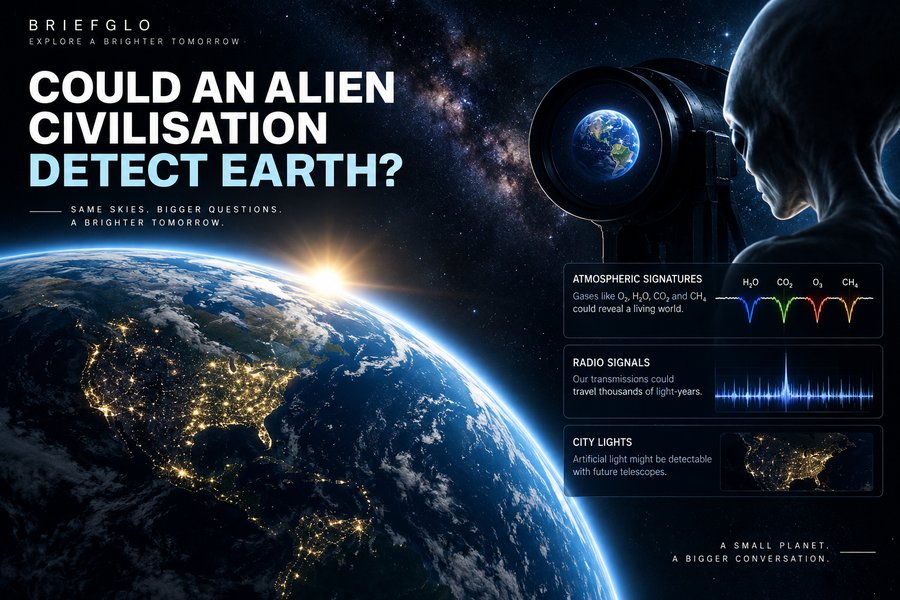
Would Earth stand out? Could another civilisation recognise our atmosphere, detect our radio transmissions or identify the technological activity taking place on the planet's surface?
The answer depends on what they were looking for, how far away they were and the instruments available to them. Surprisingly, scientists can investigate much of this question using technology that already exists on Earth.
They Might Discover Earth Before Discovering Us
An extraterrestrial civilisation would not necessarily need to detect a radio transmission to discover our planet.
Astronomers already identify distant planets by observing their effects on the stars they orbit. One widely used technique is the transit method, which measures the slight reduction in starlight when a planet passes in front of its star.
An observer positioned in the right part of the galaxy could potentially use the same approach to detect Earth crossing the face of the Sun.
From those observations, researchers might estimate Earth's size, orbital period and distance from its star.
Our guide to what an exoplanet is explains how astronomers discover and investigate worlds beyond the Solar System.
Discovering Earth, however, would not automatically reveal that it supports life.
To investigate that possibility, a distant observer would need additional information about the planet's atmosphere and surface.
Earth's Atmosphere Could Reveal Signs of Life
One of Earth's most recognisable characteristics is its atmosphere.
Oxygen, ozone, water vapour and other gases influence how sunlight passes through or reflects from the planet. By examining this light, astronomers can identify chemical features associated with particular molecules.
Scientists use similar methods to study exoplanet atmospheres.
In 2020, NASA reported that astronomers had used the Hubble Space Telescope to detect ozone in Earth's atmosphere during a lunar eclipse. Hubble observed sunlight that had travelled through Earth's atmosphere and then reflected from the Moon.
The experiment helped researchers understand how atmospheric signatures might appear when observing distant Earth-like planets.
Such chemical clues are called biosignatures.
A biosignature is not necessarily proof of life. Some gases can form through non-biological processes, and scientists must examine the wider planetary environment before interpreting their significance.
Nevertheless, an atmosphere containing an interesting combination of gases could make Earth a compelling target for further observation.
A distant civilisation might therefore suspect that our planet supports biological activity long before discovering any evidence of human technology.
Could They Detect Our Radio Signals?
Humanity has been producing radio transmissions for more than a century.
Broadcasting, radar, satellite communications and scientific facilities have all contributed to Earth's expanding electromagnetic presence.
Radio waves travel at the speed of light. A transmission sent 50 years ago has travelled approximately 50 light-years, although whether it remains detectable depends on its original strength, direction and the sensitivity of the receiver.
Not all transmissions are equally easy to detect.
Ordinary television broadcasts and mobile phone signals are relatively weak when viewed across interstellar distances. Their energy spreads out, making them increasingly difficult to distinguish from background noise.
Powerful radar transmissions are a different matter.
In February 2025, researchers associated with the SETI Institute published a study examining how far various human-made signals might be detectable using technology comparable to our own.
Their models suggested that exceptionally powerful planetary radar transmissions, such as those historically produced by the Arecibo Observatory, could potentially be detected from distances of up to 12,000 light-years under favourable assumptions.
That is a remarkable figure, but it requires careful interpretation.
It does not mean Earth is continuously broadcasting an easily recognisable signal throughout a 12,000-light-year region. Powerful radar beams are directional, and detection depends on the receiver's position, equipment and observing conditions.
The study demonstrates what might be possible under specific circumstances, rather than establishing that another civilisation has already detected us.
What Are Technosignatures?
Scientists use the term technosignature to describe an observable feature that might indicate the presence of technology.
Radio transmissions are one example, but they are not the only possibility.
Artificial lighting, industrial chemicals, concentrated laser emissions and unusual energy use could also provide clues about technological activity.
As explored in our guide to technosignatures, researchers are interested in patterns that might be difficult to explain through ordinary natural processes.
Earth offers a useful example because we know exactly which activities are technological.
However, recognising these activities from another star would be considerably more difficult.
A distant observer would receive only a tiny amount of information about our planet, often mixed with much brighter light from the Sun.
The challenge would be to identify a genuine technological signature without confusing it with a natural phenomenon.
Could City Lights Be Visible From Another Star?
At night, large parts of Earth's surface are illuminated by cities, roads and industrial facilities.
From orbit, these lights are easy to recognise. From another planetary system, the situation would be very different.
Earth is small compared with the Sun, and the artificial light produced by civilisation is extremely faint at interstellar distances.
Detecting city lights would require instruments capable of separating the planet's weak light from the much brighter light of its host star.
Researchers have considered artificial illumination as a possible technosignature, particularly when discussing future observatories and hypothetical technological civilisations.
For present-day Earth, however, detecting city lights from another star would be far more challenging than identifying exceptionally powerful radar emissions.
Even if a distant observer could measure the planet's nighttime brightness, interpreting it would require careful analysis.
Unusual illumination would be interesting, but it would not automatically establish the existence of cities.
Industrial Pollution Might Provide Another Clue
Human industry has altered the chemical composition of Earth's atmosphere.
Certain pollutants can absorb light at particular wavelengths, creating spectral features that advanced instruments might be able to identify.
Researchers have explored whether gases associated with industrial activity could serve as technosignatures.
Nitrogen dioxide is one example. It can be produced by combustion processes, including industrial activity, although natural processes also contribute to its presence.
Other proposed indicators include synthetic chemicals such as chlorofluorocarbons.
A 2021 NASA-supported study examined the possibility of detecting nitrogen dioxide in exoplanet atmospheres as evidence of technological activity.
Such observations would be difficult, particularly for distant Earth-sized planets.
There is also an important distinction between detecting a chemical and determining its origin.
A gas associated with industry on Earth might have a different explanation elsewhere. Scientists would need to consider the planet's atmosphere, star and environmental conditions before drawing conclusions.
Industrial pollution is therefore an interesting research possibility, not a reliable shortcut to proving the existence of an advanced civilisation.
How Far Away Could Another Civilisation Detect Us?
Distance changes everything.
The farther a signal travels, the weaker it generally becomes. Light from a planet also becomes increasingly difficult to separate from the glare of its star.
The 2025 SETI Institute study examined several possible signatures of modern Earth, including radar, atmospheric pollution, optical signals and artificial illumination.
Its central finding was that different technologies become detectable at very different distances.
Under the study's assumptions, powerful planetary radar was the most detectable example. Other signatures required a much closer observer or more favourable observing conditions.
The findings also reveal a limitation in how we imagine extraterrestrial detection.
A civilisation hundreds of light-years away would not see Earth as it exists today.
Because light takes time to travel, it would observe our planet's past.
An observer 100 light-years away would receive light and radio emissions that left Earth approximately a century earlier.
If someone were studying Earth from even greater distances, the technological civilisation they might eventually detect would belong to an increasingly distant period of our history.
Has Anyone Actually Detected Earth?
There is currently no verified scientific evidence that an extraterrestrial civilisation has detected Earth, received our transmissions or attempted to communicate with humanity.
That distinction matters.
Researchers can calculate how detectable certain signals might be, but these calculations do not establish that anyone is listening.
They also cannot tell us whether intelligent life exists elsewhere.
The search for extraterrestrial intelligence remains an open scientific investigation, based on observations, models and efforts to identify possible evidence.
Scientists are also studying the reverse question: how could humanity recognise a transmission produced by technology around another star?
Our article on how scientists search for signals from space explores the radio telescopes, interference checks and verification methods involved.
So far, no extraterrestrial technological signal has been independently confirmed.
What Would Earth Look Like to an Alien Astronomer?
Imagine an astronomer observing our Solar System from a nearby star.
With sufficiently capable instruments and the right viewing geometry, they might discover a small rocky planet orbiting the Sun.
Further observations could reveal atmospheric gases associated with habitability and potentially biological activity.
If their instruments were sensitive enough, they might also search for technological clues.
A powerful radar beam travelling in their direction could be particularly interesting. Artificial chemicals or other unusual features might encourage further investigation.
Yet even an advanced observer would face uncertainty.
Finding a planet is not the same as finding life. Detecting a possible biosignature is not the same as proving biology. And identifying an unusual signal does not necessarily mean discovering intelligent technology.
Each conclusion requires stronger evidence than the one before it.
That is precisely why scientists study Earth's detectability: our own planet provides a real example of a living, technological world whose signals can be modelled and tested.
Could Earth Already Be Visible to Someone Else?
Earth has been visible as a planet for billions of years, but its technological signatures are comparatively recent.
Our atmosphere has changed over geological time, while radio transmissions and industrial activity occupy only a tiny fraction of the planet's history.
Whether another civilisation could detect humanity would depend on its location, technology and the moment at which it observed us.
The scientific possibility is real: some forms of human activity could, under suitable conditions, be recognised from beyond the Solar System.
But possibility is not evidence of an actual observer.
For now, we do not know whether another civilisation exists, much less whether it has noticed Earth.
What the research does show is that humanity is beginning to understand how a distant technological society might appear across interstellar distances.
And by studying how detectable our own planet has become, scientists can improve the methods used to search for life and technology elsewhere in the universe.
Sources and Further Reading
NASA — To Find an Extraterrestrial Civilization, Pollution Could Be the Solution.
SETI Institute — Earth Detecting Earth
NASA Science — Searching for Signs of Intelligent Life: Technosignatures