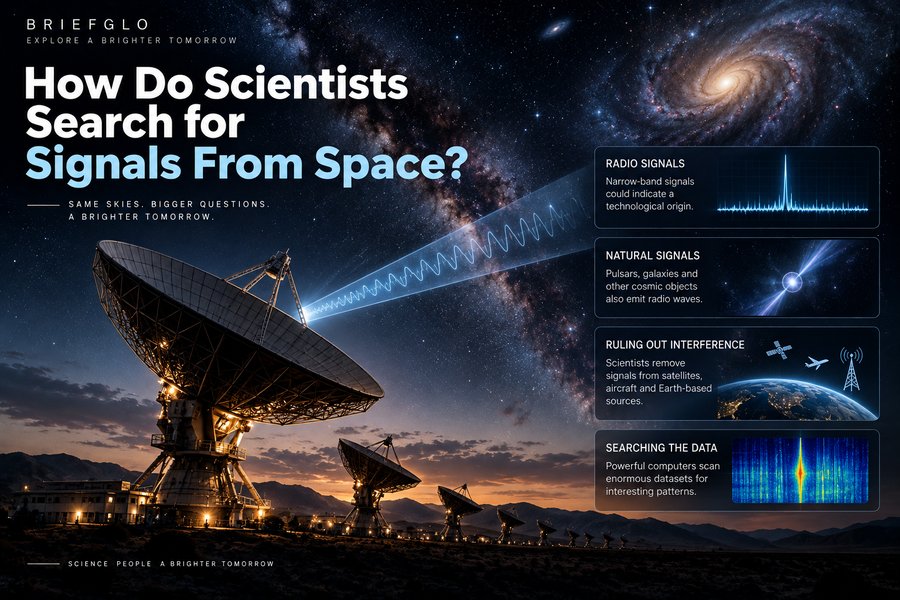
Every second, Earth is surrounded by radio waves arriving from space.
Most come from entirely natural sources: stars, pulsars, galaxies, clouds of gas and some of the most energetic events in the universe. Mixed among them is another possibility that scientists have considered for decades — a signal produced by technology somewhere beyond Earth.
Searching for such a signal is not simply a matter of pointing a radio telescope at the sky and waiting for a message.
The universe is noisy. Earth is even noisier.
Scientists therefore use powerful telescopes, computers and repeated observations to separate interesting signals from the enormous amount of natural and human-made interference around them.
As we explored when asking whether an alien civilisation could detect Earth, our own technology already produces electromagnetic signals. If technological life exists elsewhere, astronomers can ask whether something similar might eventually reach us.
Why Do Scientists Use Radio Telescopes?
Radio waves are particularly useful because they can travel enormous distances through interstellar space.
Unlike visible-light telescopes, which collect the light we can see, radio telescopes use large antennas or dishes to detect radio-frequency energy arriving from the sky.
Some observatories combine many antennas so that they work together as a much larger instrument.
Astronomers use these telescopes for ordinary astrophysics every day. They can study pulsars, galaxies, star-forming regions and other cosmic phenomena.
SETI — the Search for Extraterrestrial Intelligence — uses some of the same principles to search for signals that might have a technological origin.
What Would an Artificial Signal Look Like?
There is no guaranteed signature of extraterrestrial technology.
However, researchers can look for characteristics that may deserve closer attention.
One example is an unusually narrow-band radio signal. Natural astronomical objects often produce radio emissions across relatively broad ranges of frequencies, while engineered transmitters can produce much narrower signals.
Scientists may also look for patterns, repetition or changes in frequency that could be consistent with a transmitter moving relative to Earth.
None of these features proves that a signal is artificial.
They simply help researchers decide which observations are worth investigating further. Such signals are one of several possible forms of technosignature scientists have considered.
The Biggest Problem Is Earth
Ironically, one of the hardest parts of searching for technology beyond Earth is dealing with technology on Earth.
Satellites, mobile communications, radar, aircraft systems and other transmitters fill parts of the radio spectrum with human-made signals.
This is known as radio-frequency interference, or RFI.
A signal that initially appears to come from deep space may turn out to originate from a satellite, a nearby transmitter or equipment around an observatory.
Researchers therefore compare observations from different directions and times. If a signal appears even when a telescope moves away from the target star, for example, that is a strong indication that it may be local interference rather than something coming from the star system.
Computers Search Through Huge Amounts of Data
Modern radio observatories can collect enormous quantities of information.
Scientists cannot manually inspect every frequency recorded by a telescope, so computer systems search the data for potentially interesting patterns.
Algorithms can identify candidate signals, compare observations and help remove known interference.
Promising candidates then require additional investigation.
Researchers may observe the same location again, check whether other telescopes can detect the signal and examine whether known satellites or astronomical phenomena could explain it.
This process is deliberately cautious.
A strange signal is the beginning of an investigation, not the end of one.
Have Scientists Ever Found a Mysterious Signal?
Yes — but mysterious does not mean extraterrestrial.
Astronomy has a long history of discovering signals that initially seemed difficult to explain.
When pulsars were first discovered in 1967, their remarkably regular radio pulses were so unusual that researchers briefly considered whether an artificial explanation should be investigated. Scientists soon established that pulsars are rapidly rotating neutron stars.
There have also been individual SETI candidates that attracted considerable attention.
The famous Wow! signal, detected in 1977, was a strong narrow-band radio signal that appeared during an Ohio State University observing programme. It was never confirmed as an extraterrestrial transmission and has not provided accepted evidence of alien technology.
The lesson is simple: unusual observations can lead to interesting science without requiring an extraordinary explanation.
What Happens If Scientists Find Something Interesting?
A credible candidate would need to survive several tests.
Researchers would first try to rule out terrestrial interference, satellites, spacecraft and known astronomical sources.
They would then attempt to observe the signal again.
Independent confirmation would be particularly important. If observatories in different locations detected the same signal coming from the same part of the sky, the case would become considerably more interesting.
Scientists would also examine its frequency, timing, direction and behaviour.
Only after ordinary explanations had been thoroughly investigated would researchers begin considering more unusual possibilities.
Have We Received a Confirmed Alien Signal?
No.
There is currently no scientifically confirmed radio or optical signal known to have originated from extraterrestrial technology.
That does not make the search pointless.
The Milky Way contains hundreds of billions of stars, and astronomers have discovered thousands of planets beyond our Solar System. The number of possible places to investigate is enormous, while systematic searches have examined only a fraction of the available parameter space.
SETI is therefore better understood as an observational experiment.
Scientists have a question that can be tested: are detectable technological signals reaching Earth from elsewhere in the universe?
So far, the answer remains unknown.
Listening to Space Reveals More Than a Search for Aliens
There is another reason radio astronomy matters.
Even when researchers do not find a technological signal, listening to the universe reveals extraordinary natural phenomena.
Radio observations have helped scientists investigate pulsars, black-hole environments, galaxies and mysterious bursts of energy travelling across vast cosmic distances.
In other words, the tools used to search for technology also open a much wider window onto the universe.
And that gives us our next question:
What exactly exists in the enormous space between the stars?
Sources and Further Reading
NASA Science — Searching for Signs of Intelligent Life: Technosignatures
NASA's overview of scientific searches for possible technological signals, including radio transmissions and other potential technosignatures.
SETI Institute — SETI 101
An introduction to the scientific search for extraterrestrial intelligence and the methods researchers use to investigate possible signals.
Breakthrough Listen — Listen
Information about a major astronomical programme using radio and optical observations to search for possible evidence of technology beyond Earth.
National Radio Astronomy Observatory — What Is Radio Astronomy?
An introduction to how radio telescopes detect emissions from astronomical objects and what radio observations can reveal about the universe.
NASA Science — Neutron Stars and Pulsars
Background on pulsars, naturally occurring astronomical objects whose regular radio signals demonstrated why unusual observations require careful scientific investigation.