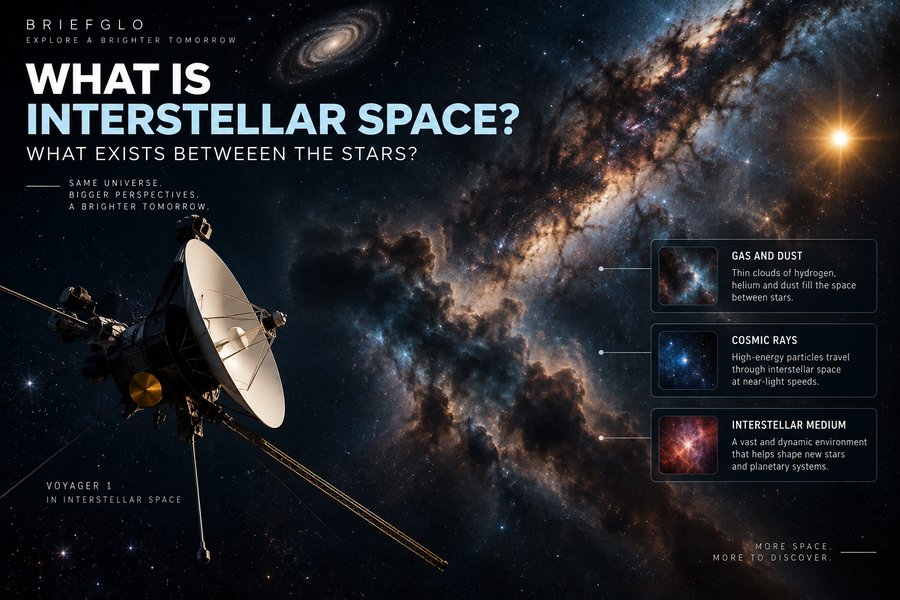
Look at the night sky and the distances between the stars appear completely empty.
They are not.
The enormous regions separating one star system from another contain gas, dust, magnetic fields and energetic particles. This environment is known as interstellar space, and understanding it helps scientists piece together how stars, planets and galaxies evolve.
In our previous article, we looked at how scientists search for signals from space. But those signals do not travel through a perfectly empty universe. Between their source and Earth lies a vast and surprisingly active environment.
Where Does Interstellar Space Begin?
There is no wall marking the end of a star system.
Our Sun constantly releases a stream of charged particles called the solar wind. This creates an enormous protective region around the Solar System known as the heliosphere.
Far beyond the planets, the influence of the solar wind weakens as it encounters material from interstellar space.
The boundary region is called the heliopause.
NASA's Voyager 1 spacecraft crossed the heliopause in 2012, becoming the first human-made object to enter interstellar space. Voyager 2 followed in 2018.
However, neither spacecraft has left the Solar System in every sense of the term. The distant Oort Cloud — a vast theoretical population of icy bodies influenced by the Sun's gravity — extends much farther.
Is Interstellar Space Empty?
Not at all.
Interstellar space contains an extremely thin mixture of matter known as the interstellar medium.
Most of it consists of gas, particularly hydrogen and helium, along with tiny quantities of heavier elements and microscopic dust grains.
The density is extraordinarily low compared with anything we experience on Earth. In some regions, there may be only a few particles in a cubic centimetre.
Yet the distances involved are so enormous that this thin material becomes important on a galactic scale.
Interstellar matter provides some of the raw material from which future stars and planetary systems can eventually form. Not everything associated with interstellar space remains between the stars. Objects travelling from other star systems can occasionally pass through our Solar System, attracting both scientific interest and speculation. One example is 3I/ATLAS and the debate over whether it could be an alien spacecraft.
Giant Clouds Exist Between the Stars
Some regions of interstellar space contain much denser concentrations of gas and dust.
These are known as molecular clouds.
Gravity can cause parts of a molecular cloud to collapse. As material becomes increasingly compressed, its centre becomes hotter and denser.
Eventually, a new star may form.
Material left around the young star can develop into a disc from which planets, moons, asteroids and other objects may emerge. Those planetary systems can eventually contain worlds very different from our own.
In that sense, the apparently dark spaces between stars contain the ingredients for future solar systems.
Our own Solar System ultimately formed from material that had previously existed in interstellar space.
There Are Magnetic Fields and Cosmic Rays Too
Matter is only part of the story.
Interstellar space also contains magnetic fields and cosmic rays — highly energetic particles travelling through the galaxy.
Some cosmic rays originate from violent astronomical events such as supernova explosions, although their exact origins can be complex.
These particles can travel through space at speeds approaching the speed of light.
Earth's atmosphere and magnetic field help protect life on the surface from much of this radiation. Spacecraft travelling far from Earth do not enjoy the same level of protection, making radiation an important challenge for future deep-space exploration.
How Do We Know What Is Out There?
Scientists study interstellar space in several ways.
Telescopes can observe gas and dust at different wavelengths, including radio, infrared, visible, ultraviolet and X-ray light.
Each part of the electromagnetic spectrum reveals different characteristics of the material between stars.
Scientists can also study how light from distant objects changes as it passes through interstellar matter.
But humanity now has something even more unusual: spacecraft measuring parts of this environment directly.
Voyager 1 and Voyager 2 carry instruments capable of detecting particles, magnetic fields and plasma conditions far beyond the major planets.
Their observations have provided scientists with the first direct measurements from beyond the heliopause.
Could Humans Ever Travel Through Interstellar Space?
In principle, yes.
In practice, the distances are formidable.
The nearest star system to the Sun, Alpha Centauri, is more than four light-years away.
Voyager 1 is one of the fastest and most distant spacecraft humanity has ever launched, yet it would still take tens of thousands of years to cover a distance comparable to that separating the Sun from our nearest stellar neighbours at its present speed.
Reaching another star would therefore require technologies far beyond today's conventional spacecraft.
Researchers have proposed concepts involving advanced propulsion, light sails and extremely small robotic probes, but interstellar travel remains an enormous engineering challenge.
Why Does Interstellar Space Matter?
Interstellar space connects almost everything astronomers study.
Stars are born from interstellar material. Dying stars return elements to it. New generations of stars and planets can later form from the enriched material.
The atoms making up Earth — and our own bodies — are part of that larger cycle.
Interstellar space is therefore not simply the emptiness between interesting objects.
It is part of the machinery of a galaxy.
And humans have already sent machines into its outer reaches.
More than four decades after leaving Earth, Voyager 1 is still travelling through this distant environment.
So what is the spacecraft actually doing out there today?
Sources and Further Reading
NASA Science — Interstellar Space
NASA information about the region beyond the heliosphere and humanity's exploration of the interstellar environment.
NASA Science — Voyager 1
Official mission information covering Voyager 1, its journey beyond the planets and its measurements in interstellar space.
NASA Science — Voyager 2
Official information about Voyager 2 and its crossing into interstellar space.
NASA Science — Heliosphere
An explanation of the enormous region created by the solar wind and its interaction with the interstellar environment.
NASA Science — Cosmic Rays
Background information on energetic particles travelling through space and their role in the wider cosmic environment.