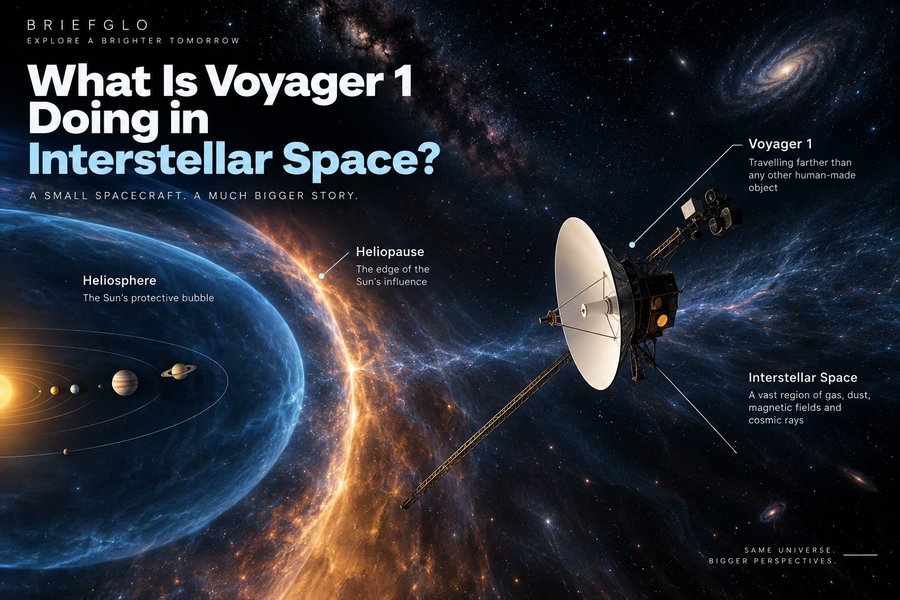
Voyager 1 left Earth in 1977 with a mission that originally focused on Jupiter and Saturn. Nearly half a century later, the spacecraft is still travelling — and still communicating with Earth.
It is now farther from us than any other human-made object.
Voyager 1 crossed the heliopause in 2012 and entered interstellar space, becoming the first spacecraft to operate beyond the protective bubble created by the Sun. It no longer photographs planets, and most of its original instruments have been switched off, but the mission is far from meaningless.
Today, Voyager 1 is doing something no spacecraft before it could do: taking direct measurements of the environment between the stars.
As explored in our guide to interstellar space, this region is not completely empty. It contains particles, plasma waves and magnetic fields — and Voyager 1 is travelling directly through it.. It contains particles, plasma waves and magnetic fields — and Voyager 1 is travelling directly through it.
Where Is Voyager 1 Now?
Voyager 1 is more than 25 billion kilometres from Earth and continues to move farther away.
The spacecraft is travelling beyond the heliosphere, the enormous region around the Sun dominated by the solar wind and the Sun's magnetic influence. To understand how our star creates the solar wind and influences its surrounding environment, read How Does the Sun Work? Inside the Star That Powers Our World.
It crossed the heliopause — the boundary between the heliosphere and interstellar space — in August 2012.
That made Voyager 1 the first human-made object to enter this environment.
There is an important distinction, however.
Voyager 1 has entered interstellar space, but saying that it has completely “left the Solar System” depends on how the Solar System is defined.
The Sun's gravitational influence extends much farther than the heliopause. The distant Oort Cloud, thought to contain vast numbers of icy objects, may extend thousands of astronomical units from the Sun.
Voyager has therefore left the Sun's heliosphere, not necessarily every region gravitationally associated with our star.
What Is Voyager 1 Actually Measuring?
Voyager 1 was originally equipped with instruments designed to investigate planets, particles, magnetic fields and radiation.
Many are now switched off.
That is partly because the spacecraft's mission has completely changed. Cameras that once returned remarkable images of Jupiter and Saturn are of little scientific use in the darkness of interstellar space.
Power is also becoming increasingly limited.
As of 2026, two Voyager 1 science instruments remain operational: the Magnetometer and Plasma Wave Subsystem. This follows two important shutdowns. NASA switched off Voyager 1's Cosmic Ray Subsystem in February 2025 and its Low-Energy Charged Particles experiment on 17 April 2026. The two remaining instruments allow researchers to continue studying magnetic fields and plasma waves beyond the heliopause, even as the spacecraft's available electrical power declines.
The Magnetometer measures magnetic fields around the spacecraft.
The Plasma Wave Subsystem detects waves in the surrounding plasma, helping researchers investigate conditions in the interstellar medium.
These measurements are valuable precisely because Voyager is physically there.
Telescopes can study interstellar space from Earth, but Voyager can sample aspects of this distant environment directly.
Why Are Instruments Being Switched Off?
Voyager 1 does not use solar panels.
At its enormous distance from the Sun, sunlight is far too weak to provide practical power for the spacecraft.
Instead, Voyager uses radioisotope thermoelectric generators, or RTGs.
These systems convert heat produced by the natural radioactive decay of plutonium-238 into electricity.
They were essential for a spacecraft designed to travel far beyond Mars and Jupiter, where conventional solar power was much less practical when Voyager was designed.
But RTGs do not produce the same amount of electricity forever.
Voyager's available electrical power gradually declines, forcing engineers to make difficult decisions about which systems can remain active.
NASA switched off Voyager 1's Cosmic Ray Subsystem in February 2025. In April 2026, engineers also shut down its Low-Energy Charged Particles experiment to conserve power.
The goal is simple: sacrifice individual instruments so the spacecraft itself can continue operating for longer.
How Can Earth Still Communicate With Voyager 1?
This is one of the most remarkable parts of the mission.
Voyager 1 communicates with Earth using its large high-gain antenna.
On Earth, NASA relies on the Deep Space Network, a global system of enormous radio antennas located in California, Spain and Australia.
Their locations allow NASA to maintain communication with distant spacecraft as Earth rotates.
The challenge with Voyager is distance.
A radio command sent from Earth does not arrive immediately. In 2026, it takes roughly 23 hours for a signal travelling at the speed of light to reach Voyager 1.
A reply then needs roughly the same amount of time to return.
That means a simple command-and-response sequence can take nearly two days.
Engineers cannot control Voyager as though they were operating a nearby satellite. Commands have to be carefully planned, transmitted and then patiently awaited.
How Weak Is Voyager's Signal?
Voyager's transmitter is extraordinarily modest compared with the distance its signal must cross.
By the time its radio transmission reaches Earth, the signal is incredibly faint.
NASA's Deep Space Network uses huge antennas and highly sensitive receivers to detect it against background radio noise.
The data rate is also tiny by modern standards.
Voyager science data can be returned at around 160 bits per second.
A modern internet connection can transfer millions or billions of bits every second.
Yet those 160 bits are arriving from a machine built in the 1970s, travelling more than 25 billion kilometres away in an environment no other spacecraft has explored so deeply.
Speed is not the impressive part.
Receiving anything at all is.
What Happened to Voyager's Cameras?
Voyager 1's cameras have been switched off since 1990.
Before that happened, NASA instructed the spacecraft to turn back towards the inner Solar System for one final family portrait.
Among the resulting images was the famous Pale Blue Dot photograph of Earth, taken from roughly 6 billion kilometres away.
Earth appeared as little more than a tiny point of light.
The cameras were then shut down to conserve power and because there were no more planetary targets on Voyager 1's trajectory.
Turning them back on today would not provide the spectacular photographs people sometimes imagine.
Interstellar space is extraordinarily dark, while the spacecraft's remaining scientific priorities concern fields and plasma rather than conventional photography.
Is Voyager 1 Still Inside the Milky Way?
Very much so.
“Interstellar space” should not be confused with “intergalactic space”.
Voyager 1 has travelled beyond the heliosphere, but it remains deep inside the Milky Way galaxy.
The Milky Way is roughly 100,000 light-years across. Beyond our Solar System, astronomers have already discovered thousands of planets orbiting other stars.
Voyager's journey, extraordinary by human standards, is microscopic compared with the scale of our galaxy.
Even reaching the nearest star would take an enormous amount of time at Voyager's current speed.
Voyager 1 is not aimed towards a particular star that it will visit. It will simply continue travelling through the galaxy after its systems eventually stop working.
What Happens to Voyager 1 Next?
Voyager 1 is approaching another symbolic milestone.
According to NASA's mission countdown, Voyager 1 is expected to reach a distance of one light-day from Earth on 18 November 2026, at approximately 5:16 a.m. Eastern Standard Time. This milestone measures the time light takes to travel between Earth and the spacecraft, not Voyager's own travel speed.
That means light — travelling at about 300,000 kilometres per second — would need an entire day to cross the distance separating Earth and the spacecraft.
Voyager itself is not travelling anywhere close to the speed of light. The milestone simply illustrates how extraordinarily far away it has become.
The spacecraft will not remain operational forever.
Its available power continues to decline, and engineers will eventually have to switch off more systems.
NASA cannot give an exact date for the final transmission because the lifetime of individual systems depends on power, temperature and spacecraft health.
Eventually, however, Voyager 1 will become silent.
Its journey will continue.
The Golden Record Will Travel With It
Attached to Voyager 1 is one of the mission's most unusual objects: the Golden Record.
The gold-plated copper disc contains sounds, music, spoken greetings, images and scientific information intended to represent Earth and human civilisation.
It was designed as a message for any intelligent beings that might somehow encounter the spacecraft in the distant future.
There is no expectation that this will happen.
Space is enormous, and Voyager is extremely unlikely to pass close to another civilisation — if technological civilisations exist elsewhere at all.
The Golden Record is therefore as much a time capsule as a message.
Long after Voyager loses contact with Earth, the record could remain attached to the spacecraft as it travels between the stars.
Why Voyager 1 Still Matters
Voyager 1 was built with 1970s technology for a planetary mission.
Nobody expected its original journey past Jupiter and Saturn to become an interstellar science mission lasting almost half a century.
Yet it has become something much larger.
It gave humanity close views of the outer planets, crossed a boundary no spacecraft had crossed before and continues to return measurements from an environment we cannot yet reach in any other way.
Voyager also demonstrates the true scale of space.
After travelling continuously since 1977, humanity's most distant spacecraft is still only beginning its journey through the wider galaxy.
And that raises an even bigger question.
Voyager 1's journey also reveals how difficult it would be to reach another star. Even the nearest stellar system lies more than four light-years away. Our article, Could Humans Ever Travel to Another Star?, examines the propulsion technologies, travel times and engineering challenges that such a mission would face.
Sources and Further Reading
- NASA Science — Voyager 1
- NASA Science — Where Are Voyager 1 and Voyager 2 Now?
- NASA Science — Voyager Interstellar Mission
- NASA Science — Voyager Spacecraft
- NASA Science — NASA Shuts Off Instrument on Voyager 1 to Keep Spacecraft Operating
- NASA Science — Voyager Frequently Asked Questions
- NASA Science — Interstellar Science