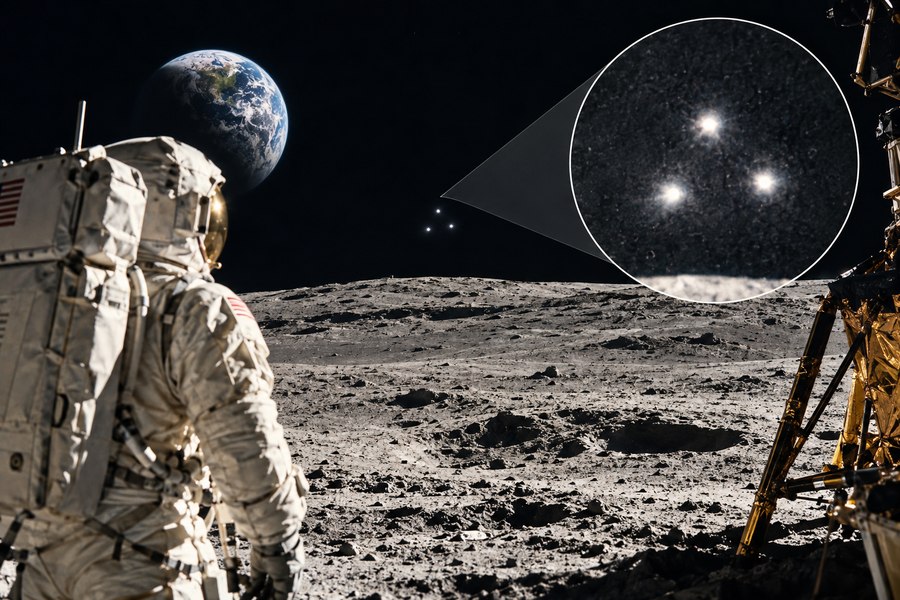
More than half a century after Apollo 17 carried humans to the Moon for the final time, one of its photographs has unexpectedly returned to the centre of the UFO debate.
The image looks familiar at first.
A grey lunar landscape stretches beneath a completely black sky.
But above the horizon are three small bright objects arranged in what appears to be a triangular formation.
For decades, unusual objects in Apollo photography have circulated through UFO forums, documentaries and conspiracy theories.
This case is different for one important reason.
The photograph is now included in an official US government UAP archive.
The record, designated NASA-UAP-VM006, was released on 8 May 2026 through the government's Presidential Unsealing and Reporting System for UAP Encounters, or PURSUE. The database identifies NASA as the source agency, Apollo 17 as the mission, 1972 as the incident date and the Moon as the location. War
More intriguingly, preliminary government analysis has reportedly considered the possibility that the feature represents a physical object in the scene rather than simply a photographic artefact. The original Apollo 17 film has also been obtained for further analysis. UAP Archives
That sounds extraordinary.
But “potentially physical” is a long way from “alien spacecraft”.
So what exactly did Apollo 17 photograph?
What Is the Apollo 17 UFO Photo?
Apollo 17 was launched on 7 December 1972 with Eugene Cernan, Ronald Evans and Harrison Schmitt aboard.
Cernan and Schmitt eventually landed in the Taurus-Littrow valley while Evans remained in lunar orbit aboard the command module America.
It became the sixth successful crewed lunar landing and remains the most recent time humans walked on the Moon. NASA Space Science Data Archive
Among the enormous photographic record produced by the mission is the image now catalogued by the government as NASA-UAP-VM006.
The photograph shows the lunar landscape with three small bright features visible against the dark sky.
Their apparent arrangement is what makes the photograph visually striking.
They seem to form a triangle.
Sky News described the newly released record as an Apollo 17 photograph showing three dots in triangular formation and reported that the Pentagon said there was no consensus about the anomaly's nature. Sky News
For UFO enthusiasts, three lights immediately evoke one of the most familiar shapes in modern UFO mythology: the triangular craft.
But an apparent triangle does not necessarily mean three lights belong to one object.
That distinction is crucial.
Are We Looking at One Triangular UFO?
There is no evidence establishing that.
Three points in an image can create a triangle simply because any three non-collinear points define one.
To demonstrate that the lights belonged to a single physical object, investigators would need additional information connecting them.
For example, did all three move together?
Were they located at the same distance?
Did another photograph capture them from a different angle?
Was there any visible structure connecting the lights?
Without that information, describing the photograph as a “triangular spacecraft” goes beyond what the image itself establishes.
What we actually have are three anomalous bright features.
That is already interesting.
There is no need to make the evidence more extraordinary than it is.
Why Is the Government Looking at It Now?
The photograph became part of a much broader government disclosure effort in 2026.
On 8 May, the US Department of War announced the first release of records through PURSUE, an interagency UAP disclosure programme involving organisations including NASA, AARO, the FBI, intelligence agencies and other federal bodies. War
Searching the official database for Apollo 17 now returns multiple records.
They include mission transcripts, scientific and technical crew debriefings, audio material, medical debriefings and the NASA-UAP-VM006 image itself. War
This does not mean the government has classified Apollo 17 as an extraterrestrial encounter.
It means historical material considered relevant to UAP investigation has been collected and released for further examination.
That is a much narrower claim.
What Did the Preliminary Analysis Find?
Reports accompanying the renewed discussion of Apollo 17 imagery suggest that the three bright features have attracted further attention. However, their physical nature has not been independently established by the publicly verifiable NASA material examined here.
NASA maintains extensive Apollo 17 photographic archives, including image indexes and technical documentation. Comparing the relevant original frame with adjacent photographs, camera information and mission records would be essential before determining whether the features originated in the photographed scene or the photographic process.
Until a documented analysis establishes their nature, the most accurate description remains that they are unidentified visual features.
Could the Three Objects Be Film Artefacts?
Absolutely.
That remains one of the possibilities that must be tested.
Apollo photographs were captured on physical film in an extraordinarily demanding environment.
Dust, scratches, processing defects, reflections and other photographic effects can create features that later appear mysterious.
This is why access to the original film matters so much.
Suppose a bright spot appears only in one frame.
That provides one type of evidence.
If the same object appears across several consecutive photographs and changes position consistently relative to the lunar surface, the situation becomes considerably more interesting.
Investigators could potentially reconstruct its apparent movement.
The photograph alone cannot answer those questions.
The original photographic sequence might.
But Apollo 17 Astronauts Also Reported Strange Objects
This is where the story becomes more complicated.
The photograph is not the only unusual material connected with Apollo 17 in the newly released records.
An Apollo 17 transcript included in the archive documents astronauts discussing bright particles or fragments drifting around the spacecraft.
Ronald Evans described bright fragments moving past as the spacecraft manoeuvred.
Harrison Schmitt compared the sight outside the window to the Fourth of July.
Evans subsequently described some of the objects as jagged, angular fragments that appeared to be tumbling. UFO Search
That sounds dramatic until the surrounding context is considered.
The astronauts themselves discussed possible spacecraft-related explanations.
Material associated with the separated Saturn V stage was among the possibilities considered.
This is a perfect example of why historical UFO quotations should not be separated from their context.
Astronauts observing unidentified objects does not automatically mean they believed they were seeing alien spacecraft.
What About the Strange Flashes?
Other Apollo 17 observations are harder to picture.
Government summaries of the mission transcript identify periods in which crew members reported flashes and moving phenomena.
Eugene Cernan described an intense flash between his eyes and later reported additional flashing or rotating phenomena.
Schmitt also reported observations, while possible spacecraft components were again considered as explanations for at least some of them. UFO Papers
Apollo astronauts were also exposed to cosmic radiation beyond much of Earth's protective magnetic environment.
Visual light flashes experienced by astronauts became a recognised phenomenon during Apollo missions.
That makes it particularly important not to combine every mention of a “flash”, “light” or “object” into one single UFO event.
Different observations may have completely different causes.
Did They See Something on the Moon Itself?
One transcript entry is particularly interesting.
During the mission, Schmitt reported seeing a flash on the lunar surface north of the crater Grimaldi. UFO Papers
Transient lunar phenomena have been reported by observers for centuries. Our guide to transient lunar phenomena examines how temporary flashes and changes in lunar brightness may arise from natural processes or observational effects.
These can involve temporary changes in brightness or colour apparently occurring on the lunar surface.
Historically, proposed explanations have included impacts, lighting effects and other natural processes.
Again, a flash on the Moon is not evidence of an alien base.
But when combined with strange photographs and astronaut observations, it is easy to understand why Apollo material became fertile territory for UFO mythology.
Could Spacecraft Debris Explain Some Apollo UFOs?
Yes.
Spaceflight creates debris.
Stages separate.
Panels detach.
Ice can form and break away.
Paint and insulation can become visible.
Objects that are relatively close to a spacecraft may look extremely strange because there is almost no familiar visual reference for judging distance in space.
An object a few metres away can appear similar to a much larger object kilometres away.
Sunlight creates another complication.
Against black space, a small reflective fragment can become intensely bright.
If it tumbles, its brightness may flash periodically.
That can produce exactly the type of observation that sounds extraordinary when described without context.
The Apollo 17 crew themselves considered separated spacecraft material when discussing some of the objects they observed. UFO Papers
Then Why Is the Apollo 17 Photo Still Interesting?
Because the correct explanation has not yet been publicly established.
If investigators already knew that the three features were scratches, dust or spacecraft debris, there would be considerably less reason to continue analysing the original film.
Instead, the public record says there is no consensus about the anomaly and that additional analysis is being conducted. UAP Archives
That makes the photograph a legitimate unresolved historical case.
Unresolved, however, has a very specific meaning.
It means the available evidence has not yet produced a sufficiently confident identification.
It does not mean extraterrestrial.
This distinction is central to understanding what a UAP actually means.
Why Are There So Many UFO Stories About the Moon?
The Moon has long attracted speculation because its unfamiliar landscape can make ordinary features appear mysterious. Apollo photographs contain reflections, shadows and other visual details that may look unusual without their original context.
Historical astronaut observations have also contributed to UFO stories, although different incidents may have unrelated explanations.
The important question is whether a particular anomaly remains unexplained after its photographic and mission records have been examined.
What About the Alien Base on the Moon Theory?
This is where Apollo UFO stories frequently lead.
The theory proposes that an advanced non-human civilisation maintains — or once maintained — structures somewhere on the Moon. The alien base on the Moon theory has a long history, but no verified evidence currently establishes that extraterrestrial installations exist on the lunar surface.
Some versions place the alleged installations on the lunar far side.
Others connect them to unusual craters, lights or supposed artificial structures visible in NASA photographs.
There is currently no verified evidence demonstrating that an extraterrestrial base exists on the Moon.
No confirmed artificial structures have been identified.
No authenticated physical material from the Moon has demonstrated technological manufacture by a non-human civilisation.
And the Apollo 17 photograph does not change that.
Even if investigators eventually establish that the three bright features represent physical objects in space, another question immediately follows:
What objects?
Establishing physicality would be important.
Establishing extraterrestrial origin would require substantially more evidence.
Could Something Be Hidden on the Far Side of the Moon?
The phrase “dark side of the Moon” creates unnecessary mystery.
The lunar far side receives sunlight just like the near side.
It is called the far side because tidal locking causes approximately the same lunar hemisphere to face Earth continuously.
Spacecraft have photographed the far side extensively. Our examination of UFO claims about the far side of the Moon explains what lunar exploration has actually revealed and why the far side is not permanently dark.
Modern lunar missions from several countries have mapped the Moon at high resolution.
That does not make every metre of lunar terrain completely understood.
But the far side is not an unexplored hemisphere permanently hidden from humanity.
This distinction deserves its own article because it sits at the centre of many Moon-UFO theories.
Could an Ancient Civilisation Have Left Something There?
As a hypothesis, it is possible to imagine.
The Moon has existed for billions of years.
Its surface changes much more slowly than Earth's because it lacks oceans, weather and active plate tectonics.
That makes it an interesting location when discussing hypothetical ancient technological artefacts.
If an advanced civilisation had visited the Solar System millions of years ago, the Moon could theoretically preserve evidence longer than many environments on Earth.
But “a good place to preserve an artefact” is not evidence that such an artefact exists.
That distinction is essential.
A scientifically interesting possibility becomes a discovery only when observations support it.
What Evidence Would Prove a Genuine Moon UFO?
One photograph would probably not be enough.
A strong case would ideally contain multiple images from different positions.
Precise timestamps would matter.
Camera orientation would matter.
Mission trajectory data would matter.
If an object appeared across consecutive frames, researchers could attempt to reconstruct its motion.
Independent sensors would strengthen the case further.
Spectral information could reveal something about composition.
Radar could establish range.
Physical material would be even more significant.
This is the difference between an anomaly and strong UAP evidence.
The Apollo 17 investigation is interesting precisely because researchers now have access to original historical material that may allow some of these questions to be tested more carefully.
Could Modern AI Solve the Apollo 17 Mystery?
AI can help analyse old imagery.
It can detect patterns.
It can compare frames.
It can identify features difficult for humans to notice.
But AI cannot manufacture missing evidence.
An enhancement algorithm may make three dots look sharper.
That does not mean the sharpened shape represents information genuinely recorded by the camera.
This is particularly important with historical UFO photographs.
AI-generated detail can easily be mistaken for recovered detail.
The original film remains more valuable than a spectacular enhancement circulating online.
What Happens Next?
The most interesting part of the Apollo 17 UFO story may still be ahead.
The public archive states that the original film has been obtained and that fuller analysis is expected. NASA's wider approach to unexplained observations also shows why better data and transparent scientific analysis matter more than speculation when attempting to identify unusual phenomena. UAP Archives
That creates a rare opportunity.
Many famous historical UFO photographs survive only as copies, scans or newspaper reproductions.
Here, investigators potentially have access to original mission photography alongside extensive NASA records describing spacecraft position, camera geometry and mission activity.
That does not guarantee a spectacular answer.
The investigation may ultimately identify an ordinary photographic or spacecraft-related explanation.
But if the anomalous features survive those tests, the case becomes considerably more interesting.
So, Did Apollo 17 Photograph a UFO Near the Moon?
In the literal sense of the word “unidentified”, the photograph contains features whose nature has not yet been publicly resolved.
That is enough to justify investigation.
It is not enough to conclude that Apollo 17 photographed an extraterrestrial spacecraft.
The government record itself is cautious.
Preliminary analysis reportedly suggests the feature could represent a physical object, but no consensus about its nature has been announced. UAP Archives
That leaves several possibilities open.
Photographic artefact.
Spacecraft debris.
A known object viewed under unusual conditions.
Or something investigators have not yet identified.
The alien hypothesis belongs on that list only as a hypothesis, not as the conclusion.
Why the Apollo 17 UFO Mystery Matters
The Apollo 17 case deserves careful investigation because NASA preserves extensive mission photography, transcripts and technical records. These materials offer researchers an opportunity to compare unusual visual features with original photographic and operational evidence.
Whether the explanation involves film artefacts, spacecraft-related material or something not yet identified, the conclusion should follow the evidence rather than the mystery surrounding the image.
Sources and Further Reading
NASA — Apollo 17 Mission
NASA — Apollo 17 Photography Index
NASA Planetary Data System — Apollo 17 Documentation Collection
NASA — Apollo 17 Lunar Surface Photography
NASA — Lunar Photographic Data Sets