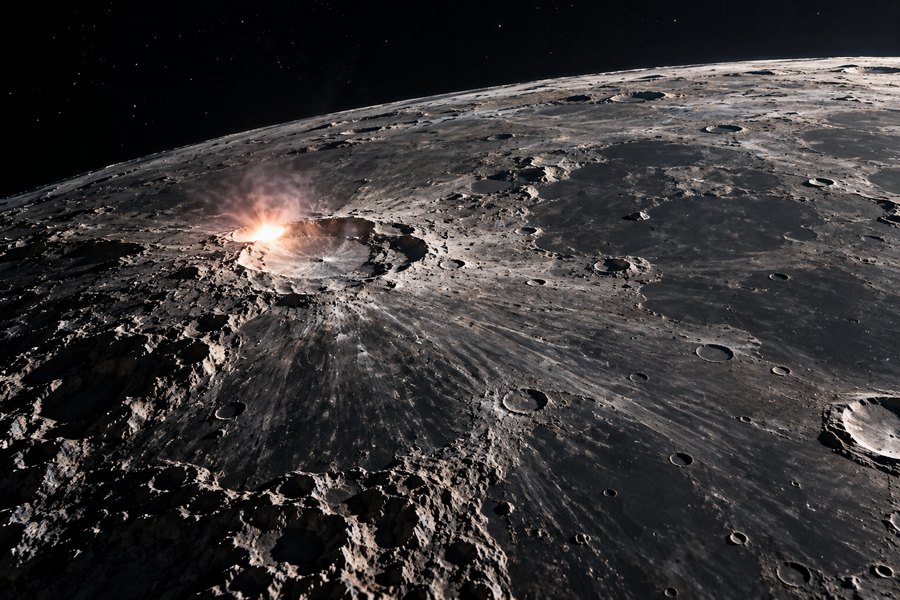
For centuries, people watching the Moon have occasionally reported something unexpected.
A point of light suddenly appears.
Part of a crater becomes brighter.
A reddish glow seems to spread across the surface.
A feature appears hazy or temporarily obscured before returning to normal.
These reports are collectively known as transient lunar phenomena, or TLPs.
Unlike many modern UFO stories, the idea did not begin on social media. Astronomers have documented reports of temporary changes in the Moon's appearance for generations, and scientific studies have attempted to determine whether at least some represent genuine events occurring on or above the lunar surface. DOI
The mystery is therefore more complicated than asking whether strange lights have been reported.
They have.
The difficult question is what produced them.
What Are Transient Lunar Phenomena?
A transient lunar phenomenon is a temporary change in the appearance of a localised area of the Moon.
Reports have included white brightenings, red or blue colour changes, hazes, obscured surface details and brief flashes. Importantly, these events generally leave no obvious permanent surface change visible to Earth-based observers. DOI
Some reports last only moments.
Others have reportedly persisted longer.
Because many historical observations were made visually through telescopes, determining exactly what happened decades or centuries later can be extremely difficult.
Atmospheric distortion may affect what an observer sees.
Telescope optics can introduce artefacts.
Human perception can misinterpret subtle changes in brightness or colour.
But those limitations do not necessarily explain every report.
How Long Have People Reported Strange Lights on the Moon?
Reports stretch back centuries.
By the twentieth century, enough observations had accumulated for researchers to begin compiling and comparing them systematically.
A major 1972 analysis examined more than 900 reports collected from 1540 to 1970, with hundreds containing enough information for further analysis. The reports included brightenings, reddish and bluish phenomena and events described as gaseous or obscuring. ScienceDirect
This historical record is important.
It shows that mysterious lunar lights are not simply a modern extension of UFO culture.
Observers were reporting temporary lunar changes long before the contemporary idea of UAPs existed.
Why Is Aristarchus So Important?
One lunar location appears unusually often in the historical record: Aristarchus.
Aristarchus is a bright impact crater on the Moon's near side, surrounded by geologically distinctive terrain.
A later analysis of historical TLP reports found that roughly half of the more robust reports in its sample involved Aristarchus and the surrounding region. Plato and several other locations also appeared repeatedly. arXiv
That concentration is intriguing.
If every report were simply random observer error, researchers might expect reports to be distributed more evenly.
But concentration alone does not identify the cause.
Aristarchus is already one of the Moon's brightest and most visually distinctive features, which may itself influence observation.
The challenge is separating genuine lunar activity from observational selection.
Did NASA Ever Take These Reports Seriously?
Yes.
During the Apollo era, transient lunar phenomena were sufficiently interesting for organised observation programmes.
Research published in Icarus in 1967 described Operation Moon Blink, which used optical devices designed to detect temporary red or blue lunar colour changes. NASA also organised a supplementary network of observers to help confirm observations and report events to a collection centre at Goddard Space Flight Center. ScienceDirect
NASA historical material also describes efforts to record the nature, magnitude, frequency and distribution of transient lunar phenomena and obtain independent confirmation from geographically separated observatories. NASA
That history is significant.
NASA investigating a phenomenon does not mean NASA concluded it was extraterrestrial.
It means the reports were considered sufficiently interesting to investigate scientifically.
Could Meteoroids Produce Flashes on the Moon?
Yes.
The Moon has almost no atmosphere capable of protecting its surface from incoming space debris.
Small meteoroids can therefore strike the lunar surface at high velocity.
The resulting impact can produce a short flash visible from Earth under suitable conditions.
This provides a well-established natural mechanism for at least one category of temporary lunar light.
NASA technical material specifically distinguishes recorded meteoroid impact flashes from the much more uncertain broader category of transient lunar phenomena. NASA Technical Reports
That distinction matters.
A flash may initially appear mysterious.
Once an impact explanation is supported by observation, however, it is no longer necessary to invoke an unknown craft or unusual lunar activity.
Could Gas Escape From Inside the Moon?
This possibility has received scientific attention for decades.
The Moon is often described as geologically quiet compared with Earth, but that does not necessarily mean absolutely nothing happens beneath its surface.
One proposed explanation for some TLP reports involves gases escaping through fractures in the lunar crust.
Such outgassing might disturb extremely fine lunar dust.
If dust particles were temporarily lifted or rearranged, the way sunlight reflected from a region could change.
Research has explored whether changes in the structure of lunar dust could produce noticeable variations in brightness. Nature
Another study proposed that gas release could lift bright soil grains above the surface, potentially producing temporary brightening. ScienceDirect
These hypotheses are scientifically interesting because they attempt to connect visual reports with physical lunar processes.
They do not require extraterrestrial activity.
Could Earth's Atmosphere Create False Moon Mysteries?
Absolutely.
Every ground-based observation of the Moon must pass through Earth's atmosphere.
Atmospheric turbulence can distort fine details.
Changes in transparency can alter brightness.
Chromatic effects may introduce temporary colour.
The telescope itself can add further complications.
Then there is the observer.
Human vision is remarkably good at detecting patterns but not perfectly reliable at measuring subtle colour and brightness changes.
This is one reason historical TLP reports are difficult to interpret.
A single observer seeing a red glow through one telescope is much weaker evidence than several independent observatories recording the same event simultaneously.
Why Are Multiple Observers So Important?
Imagine an astronomer reports a bright red region inside a lunar crater.
That observation is interesting.
Now imagine another observatory hundreds of kilometres away records the same region changing colour at exactly the same time.
The probability of a local atmospheric or instrumental explanation becomes lower.
Add calibrated photographs from a third location and the evidence becomes stronger again.
This is why scientific investigation depends so heavily on independent confirmation.
The goal is not simply to collect more strange stories.
It is to determine whether different instruments record the same physical event.
Are Transient Lunar Phenomena UFOs?
Not in the normal sense.
Most TLP reports describe apparent changes on or immediately above the lunar surface rather than structured objects flying through space.
However, the subjects overlap because unusual lunar lights frequently become incorporated into UFO theories.
A flash over a crater can become a spacecraft.
A temporary glow can become evidence of activity inside a hidden installation.
Several unexplained observations can then be assembled into a larger narrative about extraterrestrial activity on the Moon.
That is where careful terminology becomes important.
Unidentified does not mean extraterrestrial.
And unexplained does not mean inexplicable.
Do Lunar Lights Support the Alien Base Theory?
There is currently no verified evidence that transient lunar phenomena are produced by an alien base.
Meteor impacts provide a known explanation for some flashes.
Atmospheric and optical effects may explain other observations.
Changes involving lunar dust or outgassing have also been investigated as possible mechanisms.
Some historical reports remain difficult to reconstruct because the original observations contain too little information.
That uncertainty leaves room for speculation. These reports are sometimes linked to the alien base on the Moon theory, although no verified evidence connects transient lunar lights to extraterrestrial installations.
The alien base on the Moon theory therefore requires evidence beyond the existence of unusual lights.
What About the Apollo UFO Cases?
Apollo missions provide another interesting connection between lunar mysteries and UAP research.
Astronauts photographed and described objects or lights that were not immediately identified.The Apollo 17 UFO case shows how unusual features in historical lunar photography can attract renewed attention decades after the original mission.
More recently, historical Apollo material has been reconsidered within the wider discussion of unidentified anomalous phenomena.
But there is an important difference between an apparent light on the lunar surface and an object photographed against the black sky.
The first may involve lunar geology, impact activity or observational effects.
The second may involve spacecraft debris, reflections, film artefacts or a genuinely unidentified physical object.
Combining every unusual Apollo observation into one phenomenon risks making the mystery larger while making the evidence less precise.
The Apollo 12 UFO case demonstrates why individual photographs need to be examined alongside neighbouring frames, camera conditions and mission records.
Why Doesn't an Unexplained Case Prove Something Extraordinary?
Because science works by narrowing possibilities.
Suppose researchers observe a flash but cannot determine its cause.
The correct conclusion is:
The cause remains unidentified.
It is not:
Therefore the cause was extraterrestrial.
This difference sounds obvious, but it sits at the centre of almost every UFO debate.
An unresolved observation can be real. The same principle applies when evaluating UAP evidence, where the quality and independence of the underlying data matter more than how unusual an observation initially appears.
It can be scientifically interesting.
It can justify further investigation.
None of those statements identifies its cause.
The same evidentiary standard should apply whether the mystery appears in Earth's atmosphere, deep space or on the surface of the Moon.
Could Modern Technology Finally Solve the Mystery?
Modern observing technology provides opportunities that earlier astronomers did not have.
Digital cameras can continuously monitor lunar regions.
Multiple observatories can coordinate observations.
Precise timestamps allow independent recordings to be compared.
Orbital spacecraft can examine the same region from above.
Spectroscopy can potentially reveal information about temporary emissions.
Impact-monitoring systems can distinguish at least some meteor events from other observations.
The ideal future TLP event would therefore be recorded simultaneously from Earth and lunar orbit.
Researchers could then compare brightness, colour, duration, location and any corresponding surface changes. Unlike these temporary events, Reiner Gamma's mysterious lunar swirl is a permanent surface feature that scientists can examine repeatedly using orbital imagery.
Instead of asking what an observer thought they saw, scientists would have measurements.
That is the difference between a mystery story and a testable scientific event.
So Are the Mysterious Lights on the Moon Real?
Some certainly are.
Meteoroid impacts can produce genuine flashes.
Other temporary lunar changes may involve illumination, dust or geological processes.
At the same time, NASA technical literature notes that many broader TLP reports remain poorly documented and disputed. NASA Technical Reports
The historical record therefore should not be treated as one single phenomenon with one explanation.
Different observations may have completely different causes.
One report could be atmospheric distortion.
Another could be an impact.
Another might involve lunar dust.
And some may remain unresolved because the necessary data were never collected.
That is what makes transient lunar phenomena scientifically interesting.
They occupy the boundary between observation and explanation.
The mystery is real.
But the explanation has to be earned through evidence.
Sources and Further Reading
Sources and Further Reading
NASA — Lunar Impact Monitoring
NASA Science — Impact Flash!
NASA Technical Reports — Lunar Transient Phenomena: Manifestations and Possible Causes
NASA Technical Reports — Comparative Analyses of Observations of Lunar Transient Phenomena
NASA Technical Reports — Lunar Impact Flash Locations