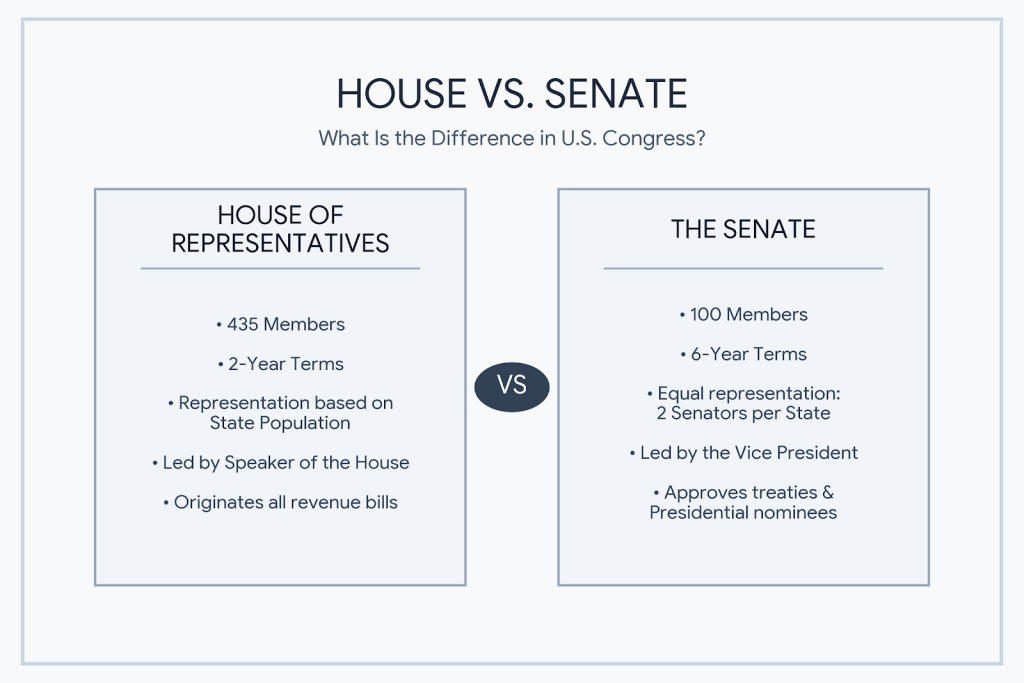
The United States Congress has two chambers: the House of Representatives and the Senate. Both help make federal laws, approve government spending and hold the executive branch accountable.
Yet they are not interchangeable.
The House represents Americans according to population, while the Senate gives every state an equal number of seats. Members serve different terms, face different election cycles and exercise some powers that the other chamber does not possess.
These differences were deliberately built into the American political system.
Understanding how the House and Senate work helps explain why a bill can pass one chamber but fail in the other, why some presidential appointments require Senate approval and why congressional elections matter even when the presidency is not on the ballot.
What Is the Difference Between the House and Senate?
The House of Representatives and the Senate are the two chambers of the United States Congress, which forms the legislative branch of the federal government.
The most important difference is how they represent Americans.
House seats are distributed among states according to population, with each state guaranteed at least one representative.
The Senate gives every state two senators, regardless of population.
This creates two different forms of representation within the same legislature.
| Feature | House of Representatives | Senate |
|---|---|---|
| Voting members | 435 | 100 |
| Representation | Based on state population | Two senators per state |
| Term length | 2 years | 6 years |
| Minimum age | 25 | 30 |
| Minimum citizenship period | 7 years | 9 years |
| Presiding officer | Speaker of the House | Vice president, with a president pro tempore |
| Revenue bills | Must originate in the House | May propose or concur with amendments |
| Impeachment | Has the sole power to impeach | Has the sole power to try impeachments |
| Presidential nominations | No general confirmation role | Provides advice and consent for specified appointments |
| Treaties | No general treaty-consent role | Consents to treaties by a two-thirds vote of senators present |
Both chambers are established by Article I of the U.S. Constitution.
Their different structures are central to how Congress operates.
Why Does Congress Have Two Chambers?
The American Constitution was written in 1787, when delegates disagreed over how states should be represented in the proposed national legislature.
Delegates from more populous states generally favoured representation based on population.
Delegates from smaller states worried that such a system would leave them with little influence.
The eventual solution became known as the Great Compromise, or Connecticut Compromise.
It created a bicameral legislature, meaning a legislature with two chambers.
The House would represent states according to population, while the Senate would provide equal representation for every state.
This compromise helped secure agreement on the Constitution.
It also created an additional layer of legislative review.
Rather than allowing a single assembly to make federal laws, the Constitution generally requires both chambers to approve the same legislation.
For the broader historical context, read our guide to the U.S. Constitution.
What Is the House of Representatives?
The House of Representatives is the larger chamber of Congress.
It has 435 voting members, with seats allocated among the states according to population figures from the national census.
Every state is guaranteed at least one representative.
Representatives serve two-year terms and are elected from congressional districts.
Because all House seats are contested every two years, the chamber can respond relatively quickly to changes in voter preferences.
The House also includes delegates from certain U.S. territories and a delegate from the District of Columbia, as well as Puerto Rico's resident commissioner.
These members have different voting rights from the 435 voting representatives.
The House is led by the Speaker, who is elected by the chamber and plays a major role in its organisation and legislative proceedings.
The House operates through committees that examine legislation, conduct hearings and oversee federal agencies.
What Is the Senate?
The Senate is the smaller chamber of Congress.
It has 100 members because each of the 50 states elects two senators.
Senators serve six-year terms.
Their elections are staggered, meaning approximately one-third of Senate seats are normally contested every two years.
This arrangement gives the Senate greater continuity than the House.
Senators represent entire states rather than individual congressional districts.
The Constitution originally provided for senators to be chosen by state legislatures.
That changed with the Seventeenth Amendment, ratified in 1913, which established direct election of senators by the people.
The vice president of the United States serves as president of the Senate and may cast a vote when the chamber is equally divided.
In practice, the Senate is usually presided over by another senator.
The Senate majority leader plays an important role in managing the chamber's legislative agenda.
Why Do House Members Serve Two Years but Senators Serve Six?
The different terms reflect different constitutional purposes.
The House was designed to maintain a relatively close connection with voters.
Frequent elections allow the composition of the chamber to change quickly in response to public opinion.
The Senate was designed to provide greater institutional stability.
Longer, staggered terms mean the entire chamber is never normally replaced in a single election.
This arrangement can encourage longer-term consideration of legislation and national policy.
However, longer terms do not make senators politically independent of voters.
They still face elections, and their decisions can influence whether they are re-elected.
The two chambers therefore balance different forms of democratic accountability.
What Powers Does the House of Representatives Have?
The House shares most federal legislative powers with the Senate.
However, the Constitution assigns it certain responsibilities.
Starting Revenue Bills
Article I, Section 7 requires bills for raising revenue to originate in the House.
The Senate may propose or agree to amendments, including substantial changes.
This gives the House a constitutionally recognised starting role in revenue legislation, although the Senate remains central to the final legislative outcome.
Impeachment
The House has the sole power of impeachment.
Impeachment is the process of formally accusing certain federal officials of misconduct under the Constitution.
It does not, by itself, remove an official from office.
After impeachment, the Senate conducts a trial to determine whether removal is warranted.
Electing a President in Exceptional Circumstances
Under the Twelfth Amendment, if no presidential candidate receives an Electoral College majority, the House chooses the president from the eligible candidates specified by the amendment.
In this unusual procedure, each state delegation receives one vote.
It is not the normal method of electing an American president.
Our guide to how U.S. elections work explains the Electoral College and the regular election process.
What Special Powers Does the Senate Have?
The Senate has several constitutional responsibilities that the House does not share in the same way.
Confirming Presidential Appointments
The president nominates individuals for certain federal offices, including Supreme Court justices, federal judges and senior executive positions.
Many of these appointments require the Senate's advice and consent.
The Senate can approve or reject nominations.
Congress has also authorised alternative appointment arrangements for some offices, so not every federal position requires Senate confirmation.
Approving Treaties
The president negotiates treaties, but the Constitution requires the advice and consent of two-thirds of senators present before the president may ratify a treaty under Article II.
Not every international agreement follows this treaty procedure.
Some agreements are made under other legal authorities.
Conducting Impeachment Trials
When the House impeaches a federal official, the Senate has the sole power to try the impeachment.
A conviction requires a two-thirds vote of senators present.
When the president is tried, the Chief Justice of the United States presides.
A conviction can result in removal from office, with possible disqualification from future federal office under the applicable constitutional procedures.
How Do the House and Senate Pass a Law?
For most federal legislation, both chambers must approve the same text before it can become law.
Consider a proposal to improve national transport infrastructure.
A member of Congress introduces a bill.
The proposal may be examined by committees, debated and amended.
If one chamber passes the bill, the other chamber must also consider it.
The Senate might approve the House version or make changes.
If the chambers approve different versions, they must resolve those differences before the legislation can proceed.
Once both chambers pass identical legislation, the bill is normally presented to the president.
The president may sign it, veto it or take another action permitted under Article I.
Congress can override a presidential veto with a two-thirds vote in each chamber.
The process illustrates why a proposal supported by one chamber does not automatically become federal law.
Why Can a Bill Pass the House but Fail in the Senate?
The two chambers have different members, constituencies, procedures and political priorities.
A bill might receive majority support in the House but not enough support in the Senate.
Senate debate rules can also make passage more difficult for certain legislation.
For many measures, ending debate requires invoking cloture, which generally requires three-fifths of senators duly chosen and sworn.
With 100 senators, that usually means 60 votes.
This is related to the Senate's filibuster rules.
However, the 60-vote threshold does not apply to every Senate action.
Some nominations and certain budget-related legislation follow different procedures.
It would therefore be incorrect to say that every bill requires 60 Senate votes to pass.
The practical result is that legislation may face different obstacles in each chamber, even when the same political party controls both.
What Is the Filibuster?
A filibuster is a Senate practice used to delay or block action on certain matters.
It is associated with the Senate's tradition of extended debate.
Under current Senate rules and precedents, many legislative measures can be subject to debate that cannot be ended by a simple majority alone.
The cloture procedure allows the Senate to bring debate towards a conclusion when the required number of senators support doing so.
The filibuster is controversial.
Supporters argue that it can protect minority-party participation and encourage broader agreement.
Critics argue that it can prevent legislation supported by a majority of senators from receiving a final vote.
The House does not have an equivalent general filibuster practice because its debate procedures are more tightly structured.
Which Chamber Has More Power?
Neither chamber is universally more powerful.
Both are necessary for most federal legislation.
The House has the exclusive power to initiate impeachment and the constitutional requirement that revenue bills originate there.
The Senate has distinctive responsibilities involving treaty consent, appointments and impeachment trials.
The House's larger membership and frequent elections make it more responsive to changes in electoral representation.
The Senate's equal state representation and longer terms give it a different institutional role.
Which chamber has greater influence depends on the issue being considered.
For example, the Senate is especially important when a president nominates a Supreme Court justice.
Both chambers are essential when Congress considers ordinary legislation or federal spending.
The two-chamber system is one part of the wider structure of checks and balances in the U.S. government.
How Do House and Senate Elections Differ?
House elections occur every two years for all 435 voting seats.
Senate elections also occur every two years, but only the seats in the relevant election class are normally contested.
House candidates run in congressional districts, while Senate candidates run statewide.
The eligibility requirements also differ.
A representative must be at least 25 years old, have been a U.S. citizen for at least seven years and be an inhabitant of the state when elected.
A senator must be at least 30, have been a citizen for at least nine years and be an inhabitant of the state when elected.
Both chambers can experience changes in party control during midterm elections.
Those changes can significantly affect a president's ability to advance legislation.
How Does Congress Check the President?
Congress is part of the legislative branch, while the president leads the executive branch.
The Constitution gives Congress several ways to check executive authority.
Congress passes legislation and controls federal appropriations.
The House can impeach federal officials, and the Senate can conduct impeachment trials.
The Senate also reviews specified presidential appointments.
Congressional committees can conduct oversight hearings and investigate the administration of federal programmes.
These powers do not mean Congress controls every presidential decision.
The president also possesses independent constitutional authority.
The system is intended to create accountability through institutions with different responsibilities.
Understanding this relationship is important when evaluating disputes over executive orders, federal spending and appointments.
Why Does the House vs. Senate Difference Matter?
The distinction matters because congressional decisions affect national policy.
A proposed law may have strong support among representatives from populous districts but face opposition from senators representing smaller states.
A president may have enough political support to advance legislation in the House but struggle to obtain Senate approval.
Judicial appointments may proceed through the Senate even though the House has no confirmation vote.
Changes in congressional control can also affect oversight and budget negotiations.
These differences are not accidental complications.
They reflect the constitutional decision to combine population-based representation with equal state representation.
For an explanation of the wider division of authority, see our article on federal versus state government.
Frequently Asked Questions
What is the main difference between the House and Senate?
The House represents states according to population, while the Senate gives every state two senators. Their terms, election arrangements and certain constitutional powers also differ.
How many members are in the House and Senate?
The House has 435 voting representatives, and the Senate has 100 senators.
How long do senators and representatives serve?
Senators serve six-year terms. Members of the House serve two-year terms.
Does the Senate have more power than the House?
Neither chamber is universally superior. Each has distinct constitutional responsibilities, and both must generally approve federal legislation.
Can the House pass a law without the Senate?
Generally, no. Ordinary federal legislation must be approved by both chambers in identical form and then satisfy the constitutional requirements for becoming law.
Why does every state have two senators?
Equal representation in the Senate resulted from a compromise during the Constitutional Convention of 1787 between states with different populations.
Final Thoughts
The House of Representatives and the Senate are two parts of the same institution, but they serve different constitutional purposes.
The House reflects population-based representation and faces elections every two years.
The Senate represents states equally and provides greater continuity through longer, staggered terms.
Both chambers participate in federal lawmaking, while each possesses certain exclusive responsibilities.
Their differences can make government decisions slower and more complicated.
But they also ensure that federal legislation must pass through two institutions with different forms of representation.
Understanding the House and Senate provides a clearer picture of how Congress works and why congressional decisions can be just as consequential as presidential elections.
Sources and Further Reading
U.S. House of Representatives — The House Explained
Official overview of House membership, leadership and legislative responsibilities.
United States Senate — About the Senate
Official information about the Senate's history, structure and constitutional role.
United States Senate — Powers and Procedures
Explanation of Senate procedures and constitutional responsibilities.
Congress.gov — The Legislative Process
Official explanation of how bills move through Congress and become law.
Congress.gov — Constitution Annotated
Analysis of Article I, congressional powers and constitutional requirements.
National Archives — The Constitution: What Does It Say?
Historical and legal overview of the Constitution and its original articles.