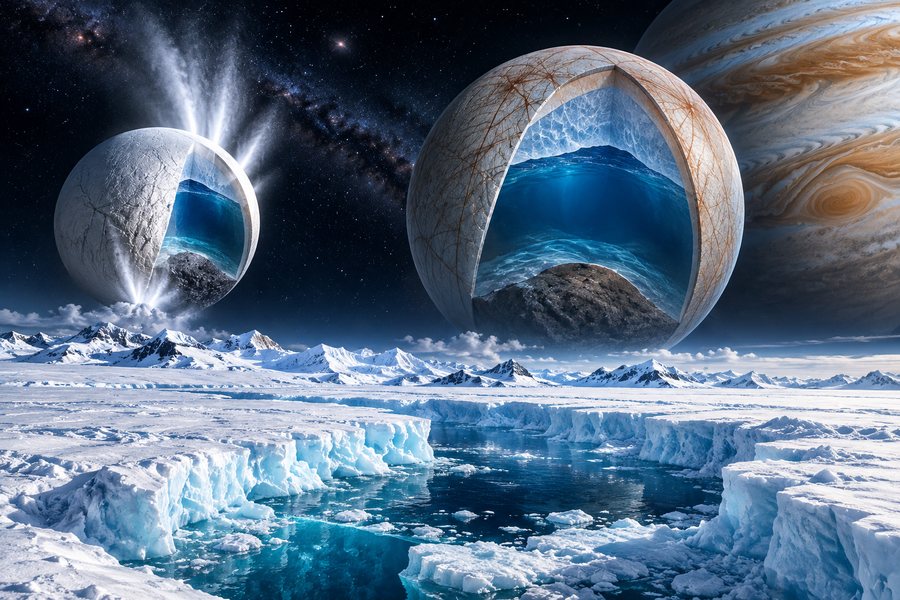
For much of human history, the search for life beyond Earth focused on places that looked remotely like our own world.
A planet needed reasonable temperatures, liquid water at the surface and perhaps an atmosphere capable of supporting familiar biology.
The Solar System has gradually complicated that picture.
Some of its most interesting potential habitats do not have blue oceans visible from space.
Their oceans are hidden beneath ice.
Jupiter’s moon Europa is believed to contain a vast subsurface ocean. Saturn’s moon Enceladus also hides liquid water beneath its frozen exterior and ejects material from that interior into space.
Meanwhile, here on Earth, scientists have discovered microorganisms surviving beneath Antarctic ice in cold, dark environments isolated from direct sunlight.
The comparison is not perfect.
But it has transformed an important question in astrobiology:
Could an apparently frozen world still be alive underneath?
Antarctica Changed What a Habitable Environment Can Look Like
A thick layer of ice once seemed like an obvious obstacle to life.
Research beneath Antarctica has shown why that assumption is too simple.
Liquid-water environments exist beneath the Antarctic Ice Sheet, and microbial communities have been identified in subglacial environments such as Lake Whillans.
These organisms do not depend on sunlight in the same way that plants at Earth's surface do.
Instead, microorganisms can exploit chemical reactions involving minerals, water and material in the sediment.
NASA-supported researchers have consequently used Antarctic subglacial environments as analogues for understanding possible habitats on icy moons. Astrobiology
Our previous investigation into life beneath Antarctica’s ice examined how surprisingly diverse those hidden ecosystems can become.
The implication for astrobiology is important.
A frozen surface does not necessarily mean a frozen interior.
What Is an Ocean World?
NASA uses the term “ocean worlds” for bodies that contain substantial amounts of liquid water.
Earth is obviously one.
But it is not alone.
Several moons and dwarf planets in the Solar System are believed to contain water beneath their surfaces.
Among the most important candidates for astrobiology are Europa and Enceladus.
NASA's Ocean Worlds Life Surveyor project also identifies Europa, Enceladus, Titan, Ganymede and Ceres among important targets for investigating watery or icy environments. Phòng Thí Nghiệm Đ propulsion NASA
These worlds are very different from Earth at the surface.
Europa appears as a fractured globe of ice.
Enceladus is small, bright and frozen.
Yet beneath those hostile exteriors may be environments considerably more interesting than their surfaces suggest.
Europa May Hide an Enormous Ocean
Europa is one of Jupiter's largest moons.
Its exterior is dominated by water ice crossed by long fractures and ridges.
Below that frozen shell, evidence indicates the presence of a global saltwater ocean.
That makes Europa one of the Solar System's most compelling places to investigate habitability.
Liquid water alone, however, is not enough.
Life as we understand it also needs suitable chemistry and an energy source.
One possibility involves interactions between Europa's ocean and the rocky material beneath it.
If water reaches the rocky seafloor, chemical reactions could potentially provide usable energy.
A similar principle operates in environments on Earth where microorganisms survive without sunlight.
This does not establish that organisms inhabit Europa.
It explains why its hidden ocean deserves investigation.
The possibility of life on Europa ultimately depends on what conditions actually exist inside that ocean.
Europa Clipper Is Looking for Habitability, Not Aliens
NASA's Europa Clipper mission is particularly important because its objective is sometimes misunderstood.
It is not simply travelling to Europa to photograph aliens.
The mission is designed to investigate whether Europa possesses conditions that could support life.
Its instruments can study the moon's ice shell, composition, geology and possible exchange of material between the ocean and surface.
For example, thermal imaging can search for relatively warm regions associated with recent activity, while spectrometers can investigate salts, organic compounds and other materials.
Other instruments can examine particles potentially ejected from Europa. Astrobiology
That distinction matters.
Habitability is not the same as inhabited.
Finding an environment capable of supporting biology would be extraordinary.
Finding biology itself would require another level of evidence.
Enceladus Gives Scientists Something Europa Cannot Easily Offer
Europa's ocean is difficult to reach because it lies beneath ice. This hidden ocean is why the question of life on Enceladus has become increasingly important in modern astrobiology.
Enceladus presents an unusual shortcut.
Near the moon's south pole, enormous plumes eject water vapour, ice particles and other material into space.
Some of that material originates from the interior ocean.
A spacecraft therefore does not necessarily need to drill through kilometres of ice to sample material associated with the hidden water.
It can potentially fly through the plume.
NASA's Cassini mission did exactly that.
Measurements detected molecular hydrogen associated with the plume. Scientists have interpreted this as evidence consistent with interactions between water and warm rock inside Enceladus, potentially involving hydrothermal processes. Astrobiology
The moon's ocean also appears to contain phosphorus, an element important for biological processes on Earth. NASA-supported research has indicated that dissolved phosphorus could be relatively abundant there. Astrobiology
Again, none of this proves life exists.
It establishes something more precise:
Enceladus possesses several ingredients that make its ocean scientifically compelling.
Antarctica Helps Scientists Understand These Alien Oceans
Europa and Enceladus are hundreds of millions of kilometres away.
Antarctica is considerably easier to reach.
That makes Earth's subglacial environments valuable natural laboratories.
Researchers can study how microorganisms obtain energy in darkness, how ecosystems function at low temperatures and how water interacts with rock beneath ice.
They can also confront a practical problem that future missions will face:
How do you sample a pristine environment without contaminating it?
If equipment carrying terrestrial microorganisms enters an alien ocean, scientists could contaminate the very environment they are attempting to study.
Worse, contamination could create a false positive in the search for extraterrestrial life.
Techniques developed for clean sampling beneath Antarctic ice therefore have relevance beyond Earth.
NASA has explicitly highlighted sub-ice sampling technologies as potential stepping stones towards exploring icy ocean worlds. Astrobiology
NASA Went Back to Antarctica in 2026
The connection is not merely theoretical.
In early 2026, researchers from NASA's Goddard Space Flight Center and the University of Maryland collected Antarctic seawater samples near the Antarctic Peninsula.
Their objective was to study water comparable in certain respects to the oceans thought to exist on icy worlds.
NASA noted that worlds including Europa are believed to contain enormous quantities of liquid water beneath ice and may possess ingredients relevant to life, including carbon, nitrogen and chemical energy. NASA Science
Scientists can use Antarctic samples to refine instruments and analytical techniques before attempting similar measurements much farther from Earth.
In that sense, Antarctica is becoming a testing ground for future alien-ocean science.
Life Does Not Necessarily Need Sunlight
One of the biggest conceptual changes in astrobiology came from discoveries on Earth itself.
For a long time, the Sun appeared to be the foundation of almost every ecosystem.
Plants capture sunlight.
Animals ultimately depend on plants or organisms connected to them.
But some ecosystems can function using chemical energy instead.
Deep-sea hydrothermal environments demonstrate this particularly clearly.
Microorganisms can obtain energy from chemical reactions involving compounds emerging from Earth's interior.
That possibility matters enormously for ocean worlds.
Sunlight cannot penetrate kilometres of ice and reach the deep ocean beneath.
But if water interacts with a rocky seafloor, chemistry could potentially provide another energy source.
Antarctic subglacial ecosystems offer another example of biology persisting where direct sunlight is unavailable.
Life does not necessarily require a sunny surface.
It requires accessible energy.
Could Complex Life Exist in These Oceans?
This question is much harder.
Microbial life is comparatively simple and can survive in extraordinarily hostile environments.
Large multicellular organisms generally require substantially more energy and more complex ecological systems.
That means a subsurface ocean capable of supporting microorganisms would not automatically support something resembling fish, squid or other large animals.
Researchers would need to understand the available energy budget, chemistry, nutrient cycling and stability of the environment.
NASA scientists discussing Enceladus have generally focused expectations on microbial life rather than large organisms, partly because of the likely chemistry and energy constraints. NASA
The scientifically cautious starting point is therefore not:
“Could there be giant alien creatures under the ice?”
It is:
“Could microbial metabolism function there at all?”
What Would Evidence of Alien Life Actually Look Like?
Finding liquid water would not prove life.
Finding organic molecules would not prove life either.
Organic chemistry can occur without biology.
Scientists therefore look for combinations of evidence.
Potential biosignatures might include particular organic molecules, unusual chemical imbalances, cellular structures or patterns that are difficult to explain through non-biological chemistry.
Ideally, several independent measurements would point towards the same biological explanation.
This is why detecting extraterrestrial life is so difficult.
An exciting anomaly is only the beginning.
Scientists must determine whether geology, chemistry, contamination or instrument behaviour could produce the same observation.
Could We Ever Drill Through Europa's Ice?
Perhaps, but it would be an enormous engineering challenge.
A future probe might eventually melt or drill through an icy shell and deploy instruments into the water beneath.
Such concepts are often called cryobots.
The difficulties are substantial.
The probe would need to survive intense radiation near Jupiter, penetrate an unknown thickness of ice, communicate through that ice and avoid contaminating Europa's environment with organisms from Earth.
Antarctica allows engineers and scientists to practise parts of that problem much closer to home.
Earth's ice is therefore not only an analogue for alien environments.
It can also serve as a proving ground for the technology that may eventually explore them.
The Search for Alien Life May Be Moving Underground
For decades, popular culture imagined extraterrestrial life standing on the surface of another planet beneath an alien sky.
Reality may be less visible.
Some of the Solar System's potentially habitable environments could be hidden completely from telescopes.
A moon can appear frozen and lifeless while maintaining liquid water underneath.
An environment can exist in permanent darkness yet still contain chemical energy.
Earth itself has taught scientists both lessons.
That does not mean Europa or Enceladus contains life.
No extraterrestrial organism has been confirmed in either ocean.
But Antarctica has demonstrated that environments beneath ice cannot be dismissed simply because their surfaces appear hostile.
The search for life beyond Earth may therefore require scientists to look not only farther into space —
but deeper beneath the surface.
Sources and Further Reading
NASA — Samples Antarctic Water to Inform Search for Life on Icy Worlds
NASA Astrobiology — Antarctica’s Subglacial Lakes Support Prospects for Life on Icy Moons
NASA Astrobiology — Europa Clipper
NASA JPL — Ocean Worlds Life Surveyor
NASA Astrobiology — Phosphorus and the Prospects for Life on Enceladus
NASA Astrobiology — Antarctica's Subglacial Lakes Support Prospects for Life on Icy Moons+
NASA Europa Clipper — Ingredients for Life
NASA — Cassini Data Reveals Building Block for Life in Enceladus' Ocean
NASA — Life Signs Could Survive Near Surfaces of Enceladus and Europa