Updated: 19 October 2026
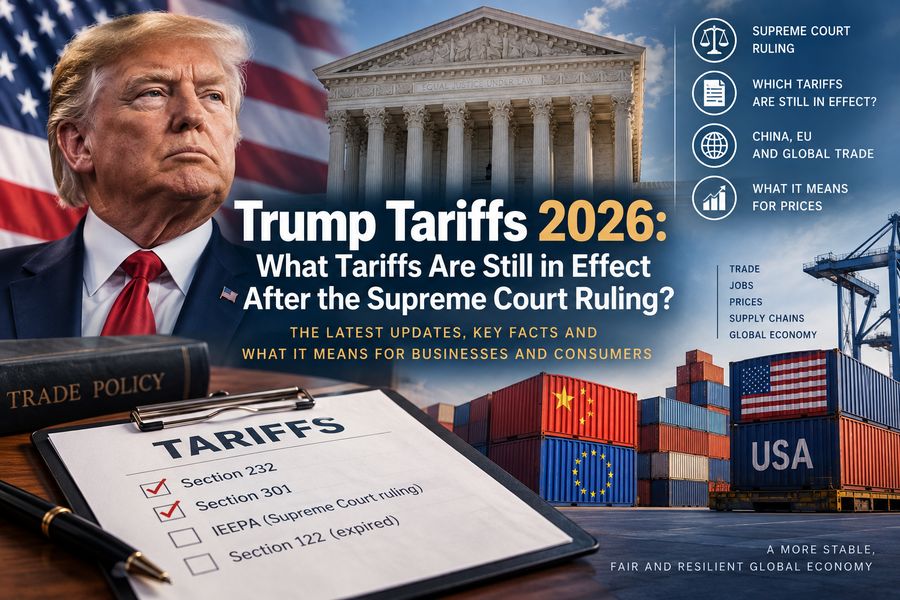
Donald Trump's tariff policy has undergone a major legal and economic shift in 2026. A Supreme Court ruling in February struck down the administration's use of emergency economic powers to impose sweeping import duties. But the decision did not bring US tariffs to an end.
Instead, the administration turned to other trade laws, including temporary import surcharges, national-security tariffs and measures targeting foreign trade practices.
By October, some of those duties had expired, while others remained in force or were being considered through ongoing investigations.
For businesses, consumers and trading partners, the result is a complicated system in which the tariff applied to a product depends on its origin, classification and the legal authority used.
So which Trump tariffs are still in effect in 2026, and what does the Supreme Court ruling actually mean?
What Did the Supreme Court Decide About Trump's Tariffs?
On 20 February 2026, the US Supreme Court ruled that the International Emergency Economic Powers Act, or IEEPA, does not authorise the president to impose tariffs.
The decision addressed duties introduced under emergency declarations, including measures affecting Canada, Mexico, China and a wider range of US trading partners.
The Court's ruling was significant because it placed a legal limit on the use of emergency economic powers for taxation at the border.
However, it did not remove the president's ability to impose tariffs under other laws where Congress has delegated specific trade powers.
This distinction is central to understanding the situation in October 2026.
The Supreme Court rejected a particular legal basis for tariffs. It did not declare all presidential tariffs unlawful.
The administration subsequently relied on alternative statutory authorities, each with its own conditions and limitations.
Which Trump Tariffs Are Still in Effect in 2026?
There is no single tariff rate that applies to every product entering the United States.
Different measures operate under different laws, and some goods may be subject to more than one duty.
The Congressional Research Service's 8 October 2026 fact sheet summarises actions in effect as of 30 September, alongside investigations that could lead to further restrictions.
| Legal authority | Position in October 2026 | What it means |
|---|---|---|
| IEEPA | Not a valid authority for imposing tariffs | Supreme Court ruling of 20 February 2026 |
| Section 122 | Temporary surcharge expired on 24 July 2026 | The broad temporary duty is no longer in effect |
| Section 232 | Multiple sector-specific tariffs remain | Measures based on national-security investigations |
| Section 301 | Targeted tariffs remain, with investigations continuing | Measures addressing specified foreign trade practices |
| Section 338 | Used for selected trade restrictions | A separate authority affecting certain imports |
The practical tariff rate depends on the product, exporting country, applicable exclusions and customs classification.
Businesses therefore need to examine the specific measure rather than rely on a general headline about Trump's tariff policy.
Why Did the Section 122 Tariff Expire?
Following the Supreme Court ruling, the administration announced a temporary 10% import surcharge under Section 122 of the Trade Act of 1974.
The measure took effect in February 2026 and was intended to provide an alternative legal basis for broad import duties.
However, Section 122 has a strict time limit.
It permits temporary measures for no more than 150 days unless Congress authorises an extension.
The surcharge expired on 24 July 2026.
It was also challenged in court, adding another layer of legal uncertainty during its operation.
By October, it would therefore be inaccurate to describe the temporary Section 122 surcharge as a tariff still being collected.
Its expiration did not eliminate duties imposed under other trade laws.
That is why the overall tariff picture remained complicated even after the broad temporary measure ended.
How Do Section 232 Tariffs Work?
Section 232 of the Trade Expansion Act of 1962 allows the president to restrict imports following an investigation into whether they threaten to impair US national security.
The Department of Commerce plays a central role in that process.
Section 232 measures have affected industries including steel, aluminium, automobiles and automobile parts.
During 2026, the administration continued using this authority across several product categories.
The applicable rates are not necessarily identical across countries or goods.
Some arrangements include exceptions, negotiated treatment or specific product rules.
Supporters argue that these tariffs can protect strategic industries and reduce dependence on foreign suppliers.
Critics argue that higher import costs may burden American manufacturers, reduce competition and create difficulties for businesses relying on international supply chains.
Both effects are relevant when assessing the economic consequences.
A tariff intended to support domestic production can also increase costs for companies that use imported materials.
For an explanation of how these duties are collected, see our guide to how tariffs work and who pays them.
What Is Section 301, and Why Does It Matter?
Section 301 of the Trade Act of 1974 allows the United States Trade Representative to investigate certain foreign trade practices and take action when those practices meet statutory criteria.
Unlike the emergency powers considered by the Supreme Court, Section 301 provides a specific framework for trade investigations and responses.
In 2026, the administration used this authority to pursue measures involving forced-labour import restrictions and other trade concerns.
A major action announced in July imposed tariffs of 10% or 12.5% on goods from 60 economies, subject to specified exemptions.
Other Section 301 investigations remained active, including an examination of structural excess manufacturing capacity.
This means that tariff policy can change as investigations are completed and new decisions are announced.
It also means that countries affected by a measure may challenge its justification or negotiate with Washington.
For importers, the relevant questions are whether a particular product is covered, whether an exclusion applies and when the measure became effective.
The label Section 301 tariff alone does not provide the complete answer.
Why Is Trump Still Using Tariffs?
The Trump administration has presented tariffs as a tool for protecting domestic industries, encouraging manufacturing investment, addressing trade practices it considers unfair and strengthening its negotiating position.
Supporters argue that import duties can give American producers an advantage over foreign competitors and encourage companies to relocate production to the United States.
They also view tariffs as leverage in negotiations with major trading partners.
Critics question whether those benefits outweigh the costs.
Higher duties can make imported machinery, components and consumer products more expensive.
Companies may face difficult decisions about pricing, suppliers and investment.
Trading partners can also respond with their own restrictions.
The economic outcome depends on the products affected, the availability of domestic alternatives and how businesses adapt.
Tariffs are therefore both an economic policy and a negotiating instrument.
Their effectiveness cannot be judged solely by the revenue they collect or the size of the announced rates.
Could Tariffs Still Raise Prices for American Consumers?
Yes. Import tariffs can contribute to higher prices, although the effect varies by product and market.
A tariff is generally collected from the US importer when goods enter the country.
The importer may absorb part of the cost, negotiate a lower price with its supplier or pass some of the increase to customers.
Businesses that depend on imported materials can face higher production costs even when the finished product is manufactured in America.
Retail prices may not rise immediately because companies often have existing inventories or contracts.
Over time, however, higher costs can influence pricing decisions and purchasing behaviour.
The impact also depends on competition and the availability of alternative suppliers.
A company facing several competing products may have less freedom to increase prices than one selling a specialised component.
Our analysis of how Trump's tariffs could affect consumer prices examines these effects in greater detail.
The key point is that the legal status of a tariff and its economic consequences are separate questions.
A duty can be legally authorised while still creating costs for households and businesses.
What Do the Tariffs Mean for China and the European Union?
China and the European Union remain central to US trade policy, but the measures affecting them cannot be reduced to one universal rate.
Some tariffs are tied to particular products, while others arise from investigations into specific trade practices.
The United States also maintains separate trade negotiations and arrangements with different partners.
For European businesses, the impact depends on the goods being exported and whether sector-specific duties or exemptions apply.
Manufacturers using transatlantic supply chains may face costs even when they are not the direct importers of finished products.
For China, the relationship includes longstanding Section 301 measures and continuing trade disputes.
These developments can influence sourcing decisions, investment and the location of manufacturing.
Our analysis of Donald Trump vs the EU and the wider trade dispute examines the political and commercial tensions involved.
It is also useful to consider the broader US vs EU economy rather than judging the relationship solely by tariff announcements.
Could New Tariffs Lead to Another Trade War?
Tariffs can trigger responses from affected trading partners.
A country facing new US import duties may challenge them through legal channels, negotiate an agreement or impose countermeasures on American exports.
If both sides repeatedly increase restrictions, the dispute can become a trade war.
That process can disrupt established supply chains and create uncertainty for businesses planning investments.
Exporters may lose access to markets or face higher costs when selling abroad.
Consumers may encounter price increases or reduced product choices.
However, retaliation is not inevitable.
Governments can also negotiate exemptions, revised trade arrangements or compromises that limit the economic damage.
The risk depends on the scale of the measures and the willingness of the countries involved to reach an agreement.
Our guide to what a trade war is and how it affects economies explains the process in more detail.
What Should Businesses Watch for Next?
Businesses trading with the United States should monitor both new policy announcements and the formal documents implementing them.
A proposed tariff is not necessarily an effective tariff.
Likewise, an investigation does not automatically mean that additional duties will be imposed.
Importers need to check the Harmonized Tariff Schedule, customs guidance, applicable exclusions and the effective dates of individual measures.
The continuing use of Section 232 and Section 301 makes product-specific analysis especially important.
Trade negotiations may also change the treatment of particular countries or industries.
Companies with complex supply chains may need to review supplier contracts, pricing assumptions and customs classifications.
For readers following policy developments, the most reliable sources include the Congressional Research Service, the Office of the United States Trade Representative and US Customs and Border Protection.
These provide a firmer basis for decisions than a headline referring simply to a new Trump tariff.
Trump Tariffs 2026: What Is the Bottom Line?
The Supreme Court's February 2026 decision changed the legal foundation of Trump's tariff policy, but it did not end US import duties.
Tariffs imposed under IEEPA were invalidated as a matter of presidential authority.
The temporary Section 122 surcharge subsequently expired in July.
Meanwhile, sector-specific Section 232 tariffs and targeted Section 301 measures continued to shape US trade policy.
Other authorities and ongoing investigations added further complexity.
The result is not one simple tariff system but a collection of measures applying to different products and trading partners.
For businesses and consumers, the important questions are which duties actually apply, how long they remain in force and who ultimately bears their economic cost.
As of October 2026, the clearest conclusion is that Trump's tariffs have changed substantially — but they have not disappeared.
Frequently Asked Questions
Did the Supreme Court cancel all Trump tariffs in 2026?
No. The Court ruled that IEEPA does not authorise the president to impose tariffs. Measures imposed under other statutory authorities were not automatically cancelled.
Is the temporary 10% tariff still in effect?
No. The temporary Section 122 surcharge expired on 24 July 2026.
Who pays tariffs on goods imported into the United States?
US importers generally pay customs duties at the border. The economic cost may then be shared among importers, suppliers, businesses and consumers.
Sources and Further Reading
Congressional Research Service — Active Presidential Tariff Actions in 2026
An 8 October 2026 fact sheet covering active tariff measures and ongoing investigations.
Congressional Research Service — Supreme Court Rules Against Tariffs Imposed Under IEEPA
A legal analysis of the February 2026 Supreme Court decision.
Congressional Research Service — Section 232 of the Trade Expansion Act of 1962
An explanation of national-security tariff authority and its use.
Congressional Research Service — Section 301 of the Trade Act of 1974
An overview of investigations and trade remedies under Section 301.
U.S. Trade Representative — Official Website
Official trade investigations, policy announcements and decisions.
U.S. International Trade Commission — Harmonized Tariff Schedule
The official US tariff classification and duty schedule.
U.S. Customs and Border Protection — Trade
Customs guidance and information for importers.