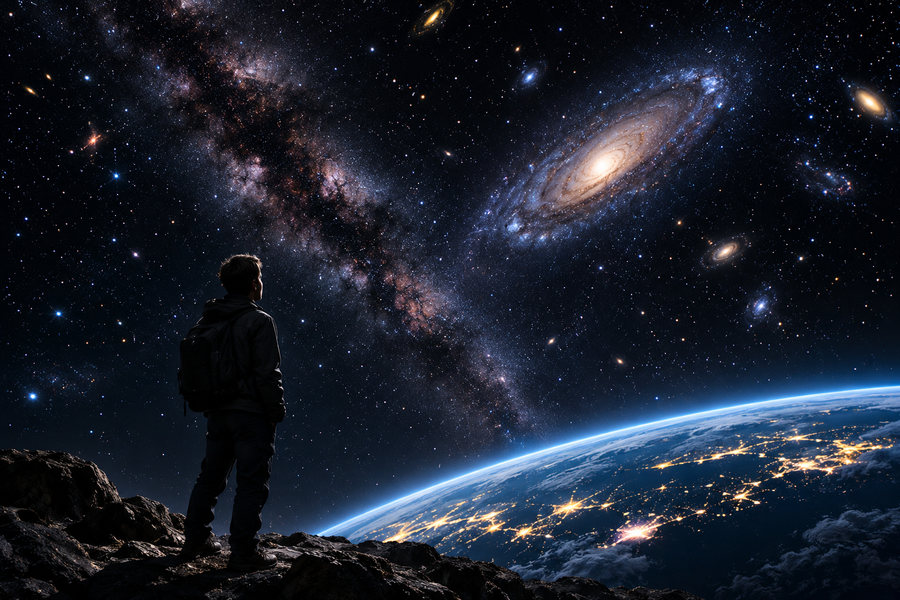
On a clear night, the sky can appear almost completely black, interrupted only by scattered stars, planets and the faint glow of distant celestial objects. Yet the universe contains an extraordinary number of stars, many of them shining far more brightly than our Sun.
This raises a surprisingly difficult question: if light is travelling through space from countless stars and galaxies, why doesn't it illuminate the entire night sky?
The answer goes far beyond the absence of sunlight. It reveals fundamental facts about the age of the universe, the behaviour of light and the expansion of space itself.
Astronomers have studied this puzzle for centuries. Today, it is commonly known as Olbers' paradox, and understanding it offers a fascinating introduction to modern cosmology.
Why Should the Night Sky Be Bright?
Imagine standing in the middle of an enormous forest. No matter which direction you look, your line of sight will eventually encounter a tree.
Now imagine a universe that has existed forever, extends infinitely in every direction and contains stars distributed throughout space.
Under these assumptions, every line of sight should eventually reach the surface of a star.
A distant star appears fainter than a nearby one because its light spreads across an increasingly large area. However, as we look farther into space, the volume containing potential stars also increases.
In a simplified, static and infinitely old universe with a uniform distribution of stars, the combined light would make the entire sky intensely bright.
But that is not what we observe.
Instead, most of the night sky appears dark, with individual stars occupying only a small fraction of what we can see.
This contradiction became one of astronomy's most intriguing historical questions.
What Is Olbers' Paradox?
Olbers' paradox is named after Heinrich Wilhelm Olbers, a German astronomer who discussed the problem in the early nineteenth century.
Although earlier thinkers had considered similar questions, Olbers helped establish the puzzle as an important astronomical problem.
The paradox begins with several assumptions: the universe is infinitely old, unchanging and filled with stars extending indefinitely in every direction.
If those conditions were true, the night sky should not contain large dark regions.
Every direction would eventually lead to a luminous stellar surface.
The fact that our sky is dark suggests that at least some of those assumptions are incorrect.
Modern astronomy has shown that the universe is neither static nor infinitely old in its present history.
It has evolved dramatically, and the light reaching Earth carries evidence of that evolution.
The Universe Has Not Existed Forever
One of the most important reasons the night sky remains dark is that the universe has a finite age.
Current cosmological measurements place its age at approximately 13.8 billion years.
Although this is an immense amount of time by human standards, it is not infinite.
Light travels at a finite speed of approximately 299,792 kilometres per second in a vacuum.
Even at that remarkable speed, light from extremely distant regions needs billions of years to reach us.
Because the universe has a finite age, not every region of space has had enough time to send light that could reach Earth today.
There is a limit to the portion of the universe from which signals could have reached us since the early universe.
Astronomers call this the observable universe.
The observable universe is not necessarily the entire universe. It represents the region we can, in principle, observe from our location.
Because space has expanded while light has travelled, the present-day distance to the most distant observable regions is much greater than 13.8 billion light-years.
The finite history of the universe also means that stars have not been shining forever.
Stars formed, evolved and, in many cases, eventually exhausted their fuel.
This limited history of light production is central to understanding why the sky is not uniformly bright.
For more background on how stars generate their light, explore our article explaining what a star is.
How Does the Expansion of the Universe Affect Light?
The universe is not simply a collection of galaxies floating through an unchanging space.
On very large scales, space itself is expanding.
As light travels through this expanding universe, its wavelength becomes stretched.
This process is known as cosmological redshift.
Visible light contains different wavelengths corresponding to different colours. Red light has a longer wavelength than blue light.
When light from a sufficiently distant galaxy is stretched by cosmic expansion, it can shift beyond the visible spectrum into infrared wavelengths.
Light stretched even further may occupy longer-wavelength regions of the electromagnetic spectrum.
Our eyes detect only a small portion of that spectrum.
Consequently, some radiation travelling through the universe is invisible to us even though it can be detected by scientific instruments.
Cosmic expansion also reduces the energy carried by individual photons as their wavelengths increase.
This further reduces the contribution of distant sources to the brightness of the sky.
However, expansion is not the only explanation for the darkness. The finite age and limited luminous history of stars remain essential parts of the answer.
Why Doesn't Starlight Fill Every Empty Space?
It might seem reasonable to assume that billions of galaxies should collectively produce enough light to eliminate every dark patch in the sky.
After all, many galaxies contain billions of stars, and some contain considerably more.
But the number of stars is not the only factor that determines the brightness we observe.
Distance, the age of stellar populations, the time available for light to travel and the expansion of the universe all matter.
A telescope can reveal galaxies in regions that appear empty to the naked eye.
Deep astronomical observations have shown that apparently dark areas may contain numerous distant galaxies.
Nevertheless, those galaxies are often extraordinarily faint.
Their combined visible light is not sufficient to make the entire night sky resemble the surface of a star.
The darkness between visible objects is therefore not proof that those directions contain absolutely nothing.
It reflects the limits of the light reaching us and the wavelengths our eyes can detect.
Does Cosmic Dust Absorb All the Missing Light?
An early proposed solution to Olbers' paradox suggested that dust and gas between stars might block enough light to keep the sky dark.
Interstellar dust really does absorb and scatter light.
Astronomers routinely account for this effect when observing stars and galaxies through dusty regions.
However, dust alone cannot resolve the paradox in an infinitely old, static universe.
If dust continually absorbed radiation from an unlimited number of stars over an unlimited period, it would gain energy and become warmer.
The heated material would then radiate energy of its own.
Rather than permanently eliminating the incoming energy, dust would redistribute it into different wavelengths.
This is why simply imagining a universe filled with light-blocking dust does not provide a complete explanation.
Dust influences what astronomers observe, but it does not replace the need to consider the universe's finite history and expansion.
Is Space Really Completely Dark?
Space is not completely devoid of light.
Even regions that appear black to human eyes can contain radiation at wavelengths we cannot see.
One of the most important examples is the cosmic microwave background, often abbreviated as CMB.
This radiation is a faint remnant of the early universe, dating to a time when the cosmos had cooled enough for light to travel freely through space.
That occurred approximately 380,000 years after the Big Bang.
Over billions of years, cosmic expansion stretched this ancient radiation to microwave wavelengths.
Today, the cosmic microwave background fills the sky in every direction.
It is far too faint and too long in wavelength for human eyes to detect.
However, specialised instruments can measure it with extraordinary precision.
In a sense, the sky contains a nearly universal background glow. It simply exists outside the visible range.
The European Space Agency's Planck mission studied this radiation to investigate the universe's early conditions and subsequent evolution.
These observations have become an important foundation of modern cosmology.
Why Does the Sky Look Black in Space Photographs?
Photographs taken in space often show an intensely black background, even when brightly illuminated spacecraft, planets or astronauts appear in the foreground.
This does not mean that stars have disappeared.
The appearance is largely related to how cameras record light.
When a camera is exposed for a short period to capture a bright subject, faint background stars may not produce enough signal to appear in the image.
To photograph faint stars and distant galaxies, astronomers often use longer exposures or specialised imaging techniques.
Earth's atmosphere also plays a role in how we experience the sky.
During the day, sunlight is scattered by molecules in the atmosphere, creating the familiar blue sky.
In space, there is no comparable atmosphere surrounding the observer to scatter sunlight across the entire sky.
As a result, the background can remain black even when a nearby object is brightly illuminated by the Sun.
The difference is not that sunlight stops travelling through space. Light continues moving through the vacuum, but it does not make empty space visibly glow simply by passing through it.
What Can Telescopes Reveal in the Darkness?
Modern telescopes allow astronomers to examine parts of the universe that are invisible to unaided human vision.
The Hubble Space Telescope has revealed distant galaxies in apparently empty patches of sky.
The James Webb Space Telescope observes primarily in infrared wavelengths, making it particularly valuable for studying objects whose light has been stretched by cosmic expansion.
Other observatories detect radio waves, X-rays, ultraviolet radiation and different parts of the electromagnetic spectrum.
Each wavelength provides a different view of the universe.
A region that appears dark in visible light may contain energetic processes or distant objects that become detectable at other wavelengths.
The study of light from remote galaxies also connects to broader questions about how astronomers investigate worlds beyond our Solar System.
For example, our guide to exoplanet atmospheres explains how scientists use light to study the chemical properties of distant planetary environments.
Although those measurements concern planets rather than the overall brightness of the universe, both rely on understanding how light carries information across space.
Does the Darkness Mean the Universe Is Empty?
The darkness of the night sky does not mean the universe is mostly empty of matter or radiation in an absolute sense.
Space contains galaxies, stars, gas, dust, radiation and other components that astronomers study through their gravitational and electromagnetic effects.
However, the distribution of matter is highly uneven on smaller scales.
Stars are concentrated within galaxies, and galaxies form groups, clusters and larger cosmic structures.
Enormous regions between these structures can have extremely low densities of matter.
Even where radiation is present, it may be too faint or outside the visible spectrum for human eyes.
The universe is therefore not a uniformly illuminated environment.
Its appearance depends on what we observe, how sensitive our instruments are and which wavelengths we measure.
What Does Olbers' Paradox Teach Us About the Universe?
Olbers' paradox is a powerful example of how an everyday observation can reveal fundamental scientific principles.
The darkness of the night sky might initially seem too ordinary to require an explanation.
Yet it challenges the idea of an eternal, unchanging universe filled uniformly with stars.
The modern explanation depends on several connected discoveries.
The universe has a finite age. Stars have finite lifetimes. Light travels at a limited speed. And the expansion of space changes the radiation reaching us.
Together, these facts explain why the combined light of distant stars does not turn the entire night sky bright.
They also demonstrate how astronomy has moved beyond studying individual celestial objects to investigating the history and structure of the cosmos itself.
The next time you look into a dark patch between the stars, consider what that darkness represents.
It is not merely an absence of visible light.
It is evidence that the universe has a history, that light takes time to travel and that space continues to evolve.