Look into a clear night sky and stars can seem almost permanent. The same points of light appear year after year, while the patterns formed by familiar constellations barely seem to change within a human lifetime.
In reality, stars are anything but static.
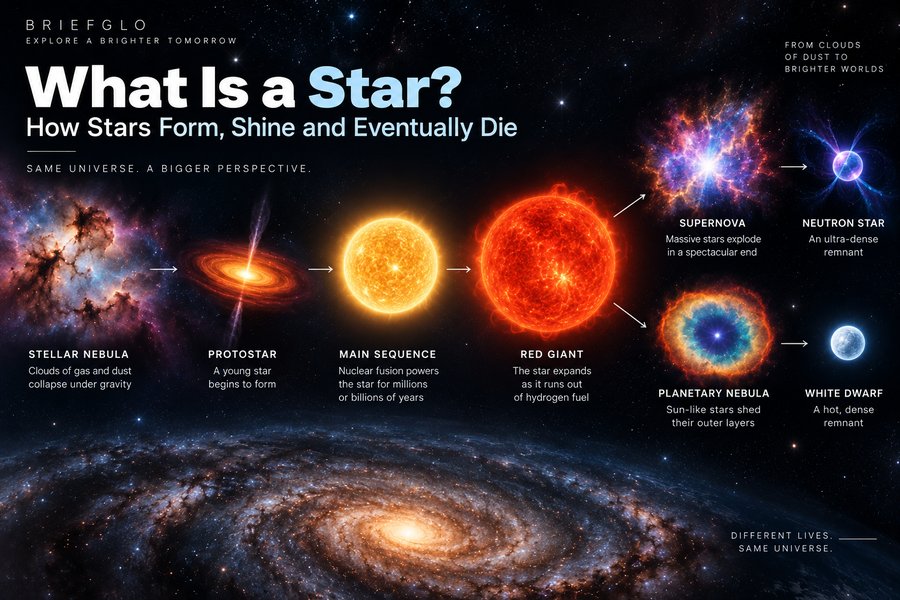
They are enormous natural furnaces shaped by gravity. They are born inside cold clouds of gas and dust, spend millions or billions of years producing energy, change dramatically as their fuel is exhausted and eventually leave behind stellar remnants or scatter material back into space.
Our Sun is one of them.
The nearby red dwarfs we recently explored — including Barnard’s Star and Proxima Centauri — are stars too, despite being much smaller and fainter than the Sun.
Understanding how stars work is therefore one of the foundations of astronomy. It explains not only the lights above us, but also where many of the chemical ingredients found in planets — and in ourselves — ultimately came from.
What Exactly Is a Star?
A star is a huge sphere of hot matter held together by its own gravity.
Most ordinary stars are composed primarily of hydrogen and helium, although they contain smaller quantities of heavier elements.
At the centre of a star, conditions can become extraordinarily hot and dense.
Under sufficient pressure and temperature, atomic nuclei can fuse together.
For most of a star's main life, the central process involves hydrogen being converted into helium through nuclear fusion.
That process releases energy.
The energy gradually moves outwards through the star before eventually escaping into space as radiation, including the visible light that can cross enormous distances before reaching our eyes and telescopes.
Stars therefore do not shine because they are simply “burning” in the everyday chemical sense.
A star is powered by nuclear processes occurring deep inside it.
Why Doesn't a Star Collapse?
Gravity is constantly pulling a star's material towards its centre.
If gravity acted alone, the star would collapse.
But conditions inside an active star create pressure pushing outwards.
For much of a star's life, these opposing effects reach a remarkably stable balance known as hydrostatic equilibrium.
Gravity pulls inward.
Internal pressure pushes outward.
NASA describes the life of a star as a continuing struggle between these forces. During the stable main-sequence phase, nuclear reactions in the core provide the energy that helps maintain this balance.
The balance can persist for an extraordinary length of time.
Our Sun, for example, formed about 4.6 billion years ago and remains in its main-sequence stage.
Small red dwarfs can last vastly longer.
Some may continue shining for trillions of years.
Where Are Stars Born?
Stars begin inside enormous clouds containing gas and dust.
Some regions within these clouds become denser than their surroundings. Gravity begins pulling material together, causing a region to contract.
As more matter accumulates, the centre becomes increasingly dense and hot.
At this early stage, the forming object is called a protostar.
Material surrounding the young star can flatten into a rotating disc. These discs are especially important because the leftover material can eventually contribute to the formation of planets, moons, asteroids and other objects. These distant worlds are explored in more detail in our guide to exoplanets, including how astronomers detect planets orbiting other stars and assess whether some might support life.The young object does not become a true main-sequence star immediately.
Its core must become hot and dense enough for sustained hydrogen fusion.
NASA describes temperatures of roughly 10 million degrees as necessary for the core of a developing star to begin sustained hydrogen fusion and enter its stellar life properly.
Once that happens, a new star has effectively switched on.
What Is the Main Sequence?
Most stars spend the majority of their lives in a stage called the main sequence.
Our Sun is currently a main-sequence star.
During this period, hydrogen fusion occurs in the core while the star maintains a relatively stable balance between gravity and internal pressure.
But main-sequence stars are not all alike.
Some are much hotter and more massive than the Sun.
Others are considerably smaller, cooler and dimmer.
Astronomers classify stars partly according to their spectra and temperatures using the sequence:
O, B, A, F, G, K and M.
O-type stars are extremely hot and luminous.
M-type stars are much cooler and include the red dwarfs that dominate the stellar population.
The Sun is classified as a G2 star.
This classification helps astronomers understand far more than colour. A star's spectrum can reveal information about its temperature, composition and physical conditions.
Why Do Some Stars Live Much Longer Than Others?
A surprisingly simple factor determines much of a star's future:
mass.
It might seem logical that a star containing more fuel should live longer.
For stars, the opposite can happen.
Massive stars have much hotter and more extreme interiors. They consume their nuclear fuel at tremendous rates and can exhaust important stages of that fuel relatively quickly.
Some massive stars survive for only millions of years.
Small red dwarfs use their hydrogen much more slowly.
Their lives can potentially extend into the trillions of years — hundreds of times longer than the universe has existed so far.
That means no ordinary red dwarf born after the Big Bang has yet had enough time to reach the natural end of such an extraordinarily long lifespan.
The universe simply is not old enough.
What Happens When a Star Runs Out of Hydrogen?
A star does not immediately disappear when the hydrogen available for fusion in its core becomes depleted.
Instead, its structure begins to change.
Exactly what happens next depends heavily on its mass.
For a star broadly similar to our Sun, the core contracts while the outer regions expand.
The star eventually becomes a red giant.
Later, the outer layers can be expelled into space, leaving the hot central remnant behind.
That remnant becomes a white dwarf.
A white dwarf no longer performs the central fusion that powered the star during its main-sequence life. It gradually cools over immense periods of time. Our guide to white dwarfs explains how these compact stellar remnants form, why they remain so dense and what happens as they gradually lose their stored heat.
The fate of a much more massive star is considerably more violent.
Why Do Some Stars Explode as Supernovae?
Massive stars can continue fusing progressively heavier elements after their hydrogen and helium stages.
For the largest stars, this sequence eventually produces an iron-rich core.
At that point, the situation changes fundamentally.
Fusing iron does not provide the star with the same useful energy source needed to support the core against gravity.
The core can collapse.
The resulting event can trigger an enormous stellar explosion called a supernova.
For a brief period, the explosion can become extraordinarily luminous and eject stellar material into surrounding space.
But the explosion is not necessarily the end of the core.
Depending on its mass and circumstances, the collapsed remnant can become a neutron star or a black hole.
This is why the death of a massive star can create some of the most extreme objects known in the universe.
Are We Really Made From Material Created by Stars?
There is genuine science behind the familiar phrase that we are made of “star stuff”, although the full story is more complicated than the slogan suggests.
The early universe produced primarily hydrogen and helium, along with small quantities of lithium.
Stars later became important factories for heavier elements.
Nuclear processes inside stars produce new atomic nuclei, while stellar explosions and other energetic events contribute to the creation and distribution of additional elements.
Material expelled by stars can enter interstellar space. This material becomes part of the gas and dust found between the stars, where it can eventually contribute to the formation of new stellar systems.
Over time, enriched gas and dust may become incorporated into new molecular clouds, new stars and new planetary systems.
The carbon, oxygen and many other elements associated with planets and living organisms therefore have a history stretching back through earlier generations of stars.
A star's death can provide ingredients for worlds that do not yet exist.
Is the Sun an Ordinary Star?
In many respects, yes.
The Sun is not the largest, hottest or most luminous star in the Milky Way.
It is a G-type main-sequence star roughly halfway through its main period of hydrogen fusion.
What makes the Sun exceptional from our perspective is not that it belongs to some unique class of star.
It is exceptional because it is our star.
At an average distance of roughly 150 million kilometres from Earth, the Sun provides the energy that dominates our planet's climate and supports almost every ecosystem on its surface.
Other stars are so distant that they appear as tiny points even through many telescopes.
The Sun is close enough for astronomers to study its surface, atmosphere, magnetic fields and eruptions in extraordinary detail.
In that sense, it acts as our nearest laboratory for stellar physics.
How Many Stars Are There?
Counting every star in the universe directly is impossible.
Even within the Milky Way, many stars are faint, obscured by dust or difficult to distinguish across enormous distances.
Astronomers therefore estimate stellar populations using observations and models rather than counting every star individually.
Our galaxy alone contains an enormous population of stars, from dim red dwarfs to rare luminous giants.
And the Milky Way is only one galaxy among an immense population of galaxies across the observable universe.
Yet stars are not distributed randomly.
They form systems, clusters, stellar populations and galaxies, interacting with the gas, dust and gravitational structures around them.
Our Sun is simply one member of that much larger cosmic population.
Stars Are More Than Points of Light
The stars above us are not decorations fixed to the night sky.
Each is a physical object with its own mass, temperature, composition, age and history.
Some are newly formed.
Some resemble the Sun.
Others are enormous stars racing through comparatively short lives.
Small red dwarfs may continue shining long after stars like the Sun have disappeared.
And some massive stars will eventually collapse, producing neutron stars or black holes.
Studying these different lives allows astronomers to reconstruct how galaxies evolve and how chemical elements move from one generation of stars to another.
But there is one star we can examine far more closely than any other.
It is only eight light-minutes away, has shaped every day in Earth's history and will eventually transform dramatically as it ages.
To explore our nearest star in greater detail, read How Does the Sun Work? Inside the Star That Powers Our World, which explains nuclear fusion, solar activity and the Sun's eventual transformation into a white dwarf.