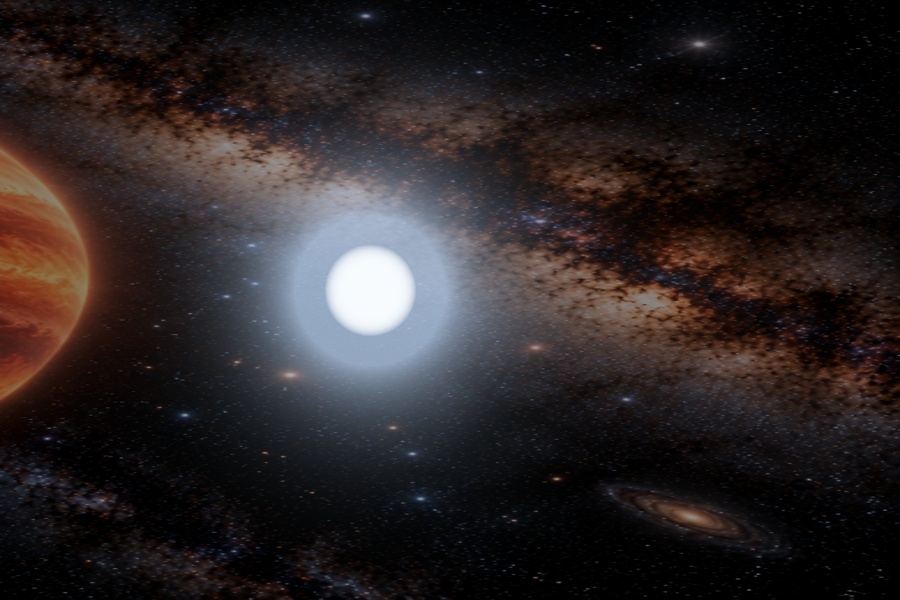
Stars seem almost permanent when viewed from Earth. The Sun rises every morning, familiar constellations return each season, and the night sky changes so slowly that an entire human lifetime barely registers. Yet every star has a history, and every star eventually changes. Some of the most massive stars end their lives in spectacular explosions. Others follow a quieter path, shedding their outer layers and leaving behind a compact, intensely hot remnant. That remnant is called a white dwarf. Despite the name, a white dwarf is not simply a small version of an ordinary star. It no longer produces energy through sustained nuclear fusion in the way the Sun does today. Instead, it survives as an extraordinarily dense object supported by quantum physics, gradually releasing heat accumulated during its earlier life. Understanding white dwarfs helps astronomers reconstruct the histories of stars, estimate the ages of stellar populations and explore some of the most extreme conditions found in the universe.
What Is a White Dwarf?
A white dwarf is the dense stellar remnant left behind after a low- or intermediate-mass star completes the main stages of its evolution. Most stars in the Milky Way are expected to end their lives this way. A typical white dwarf contains a substantial fraction of the Sun's mass compressed into a body roughly comparable in size to Earth. That combination produces remarkable density. A small amount of white dwarf material would weigh enormously more than the same volume of ordinary matter on Earth. Most white dwarfs consist largely of carbon and oxygen, although their internal compositions depend on the masses and evolutionary histories of their parent stars. Some lower-mass remnants contain helium, while certain more massive white dwarfs may contain oxygen and neon. The important point is that a white dwarf is not an active hydrogen-burning star. It is the exposed remnant of a star whose central nuclear reactions have effectively ended. Unlike white dwarfs, brown dwarfs never become massive enough to sustain ordinary hydrogen fusion, making their formation and evolution fundamentally different.
How Does a Star Become a White Dwarf?
A star like the Sun spends most of its life fusing hydrogen into helium in its core. Once that central hydrogen supply is depleted, the star's structure changes and its outer layers expand, eventually producing a red giant.
Later, helium fusion and further internal changes occur before the star sheds much of its outer material. The exposed core becomes a white dwarf, supported by electron degeneracy pressure rather than the thermal pressure associated with sustained core fusion.
This is a gradual evolutionary process, not the core-collapse explosion experienced by some massive stars.
For the earlier stages of stellar evolution, see What Is a Star? How Stars Form, Shine and Eventually Die.
Will the Sun Become a White Dwarf?
Yes. In approximately five billion years, the Sun will leave its present main-sequence stage and begin evolving towards a red giant.
Its expanding outer layers will transform the inner Solar System. Eventually, the Sun will shed much of its outer material, leaving a dense, Earth-sized white dwarf that gradually cools over billions of years.
The Sun is not massive enough to undergo an ordinary core-collapse supernova.
For more on its current energy production and distant future, see How Does the Sun Work?.
Why Are White Dwarfs So Dense?
The density of a white dwarf comes from the enormous gravitational compression of its remaining mass. In an ordinary star, internal gas pressure and energy generated through fusion help oppose gravity. A white dwarf relies on a different form of support. Its electrons are governed by the rules of quantum mechanics, including the Pauli exclusion principle. Under extreme compression, electrons produce what physicists call electron degeneracy pressure. This pressure can resist further gravitational collapse even when the star is no longer generating significant energy through fusion. The result is a compact, stable remnant. An unusual consequence is that adding mass to a white dwarf generally makes it smaller. Greater gravity compresses the material more strongly. This relationship differs sharply from what we expect when comparing ordinary objects, where greater mass often means greater size.
How Hot Is a White Dwarf?
Newly formed white dwarfs can have surface temperatures exceeding 100,000 kelvin. They are therefore extremely hot, even though they no longer sustain ordinary nuclear fusion. Their energy comes primarily from stored thermal energy left over from earlier stages of stellar evolution. As that heat escapes into space, the white dwarf gradually cools. Because white dwarfs have relatively small surfaces compared with ordinary stars, their total luminosities can be modest despite high temperatures. Over billions of years, they become cooler and fainter. Their appearance also changes as their temperatures decline. A young white dwarf may radiate strongly at ultraviolet wavelengths, while an older one emits a greater proportion of its radiation at longer wavelengths. Astronomers study these cooling patterns to investigate both stellar physics and the history of the galaxy.
What Is the Chandrasekhar Limit?
One of the most important concepts in white dwarf physics is the Chandrasekhar limit. It describes the approximate maximum mass that a non-rotating white dwarf supported by electron degeneracy pressure can sustain. For a typical carbon-oxygen composition, the limit is around 1.4 times the mass of the Sun. The exact value depends on physical assumptions and composition. The limit is named after physicist Subrahmanyan Chandrasekhar, whose work helped explain the behaviour of extremely dense stellar matter. As a white dwarf approaches this mass, electron degeneracy pressure becomes insufficient to maintain the same kind of stable structure. What happens next depends on the object's composition and circumstances. In some systems, the result may be a thermonuclear supernova. Other evolutionary pathways can involve collapse. The Chandrasekhar limit is therefore central to understanding why certain stellar remnants remain stable while others undergo dramatic transformations.
Can White Dwarfs Explode?
Although white dwarfs are usually associated with the quiet endings of stars, some can participate in powerful explosions. This is particularly important in binary star systems. If a white dwarf orbits another star, it may gain material from its companion under suitable conditions. The additional matter can change conditions within or on the surface of the white dwarf. In some cases, accumulated hydrogen undergoes a sudden thermonuclear reaction, producing a nova. A nova can cause the system to brighten dramatically without necessarily destroying the white dwarf. Under different circumstances, a carbon-oxygen white dwarf can undergo a runaway thermonuclear explosion associated with a Type Ia supernova. Such explosions may arise through more than one evolutionary pathway, including interactions between white dwarfs. Type Ia supernovae are especially important because their observed brightness can help astronomers measure enormous cosmic distances. White dwarfs therefore contribute to research extending far beyond stellar evolution.
Do White Dwarfs Have Atmospheres?
Yes, although their atmospheres are very different from those of planets. Many white dwarfs have thin outer layers dominated by hydrogen or helium. Astronomers classify them partly by the spectral features visible in their light. For example, DA white dwarfs show prominent hydrogen absorption lines, while other classes display helium or different atmospheric signatures. Their enormous surface gravity influences how elements are distributed. Heavier material often sinks beneath lighter atmospheric layers, although convection and ongoing accretion can complicate this picture. In some cases, astronomers detect heavier elements in white dwarf atmospheres. These observations are particularly interesting because they can indicate that the white dwarf has recently accreted rocky material. The chemical signatures may provide clues about the composition of planetary bodies that once orbited the star.
Can Planets Survive Around a White Dwarf?
The transformation of a star into a white dwarf can be devastating for nearby planets. During the red giant phase, the star expands and loses mass. Close planets may be engulfed or severely altered. More distant planets, however, can survive, although their orbits may change as the star loses material. Astronomers have discovered evidence of planetary systems associated with white dwarfs. Some observations reveal dusty discs, rocky debris or material falling onto the stellar remnant. These findings suggest that planetary systems can continue evolving long after their stars leave the main sequence. Gravitational interactions may disturb surviving planets and smaller bodies, sending some material towards the white dwarf. The result can be a complicated system containing remnants of an earlier planetary population. White dwarfs may therefore preserve evidence of planets that existed billions of years before the present observations.
Could Life Exist Around a White Dwarf?
A planet orbiting close to a white dwarf might receive enough energy to maintain liquid water under suitable atmospheric conditions. However, such environments face unusual challenges.
The star's earlier red giant phase could have destroyed nearby planets or stripped their atmospheres. A planet that later moved into a close orbit would need to remain dynamically stable and retain or replenish the conditions necessary for life.
White dwarfs also cool over time, causing their habitable zones to evolve.
These possibilities remain theoretical, and no life has been confirmed around a white dwarf.
For a broader explanation of planetary habitability, see What Is the Habitable Zone?.
What Is a Black Dwarf?
A black dwarf is the hypothetical final stage of a white dwarf that has cooled so much that it emits very little detectable radiation. The concept follows naturally from white dwarf cooling. As a white dwarf loses its stored heat, it becomes progressively dimmer. Given enough time, it would eventually become an extremely cold stellar remnant. However, the universe is approximately 13.8 billion years old. That is not enough time for ordinary white dwarfs to cool into true black dwarfs. Consequently, no black dwarf has ever been observed. Their eventual existence is predicted by stellar evolution models, but they belong to the universe's extremely distant future. The distinction is important because black dwarfs are not black holes. A black dwarf would remain a compact object supported by matter pressure, not a region of spacetime from which light cannot escape.
How Do White Dwarfs Help Scientists Measure Time?
White dwarfs can act as cosmic clocks. Because their cooling behaviour can be modelled, astronomers can estimate how long individual remnants have been losing heat. When researchers examine a population of white dwarfs, their temperatures and luminosities provide clues about the ages of the stars that produced them. This method is especially useful in star clusters, where many stars formed during approximately the same period. By studying the faintest and coolest white dwarfs in a cluster, astronomers can place constraints on its age. The technique requires careful modelling of stellar interiors, atmospheric properties and cooling rates. Nevertheless, it offers an independent way to investigate the history of stellar populations. In this sense, white dwarfs are more than the remains of dead stars. They preserve information about events that occurred billions of years ago.
Why White Dwarfs Matter
White dwarfs reveal what happens when a star can no longer maintain the fusion processes that defined most of its life. They demonstrate how quantum mechanics can support matter under extraordinary gravitational pressure. They also connect stellar evolution with planetary science, supernova research and measurements of cosmic history. Their quiet appearance can be deceptive. Some remain stable for billions of years. Others interact with companion stars, accumulate material or participate in spectacular explosions. Around them, planetary debris may preserve the chemical signatures of worlds that no longer exist. The Sun itself will eventually join this population. Long after its present light has disappeared, its remaining core will continue cooling in the darkness. For astronomers, white dwarfs are not simply the final chapter in the lives of ordinary stars. They are laboratories for understanding matter, gravity and the long-term evolution of the universe.
Sources and Further Reading
NASA Science — Types of Stars
ESA/Hubble — White Dwarf
NASA Science — White Dwarf Stars
NASA Science — What's a Nova?
NASA Science — White Dwarfs Research and Discoveries