Proxima Centauri may be our closest neighbouring star, but travel only a little farther through our stellar neighbourhood and another remarkable system appears.
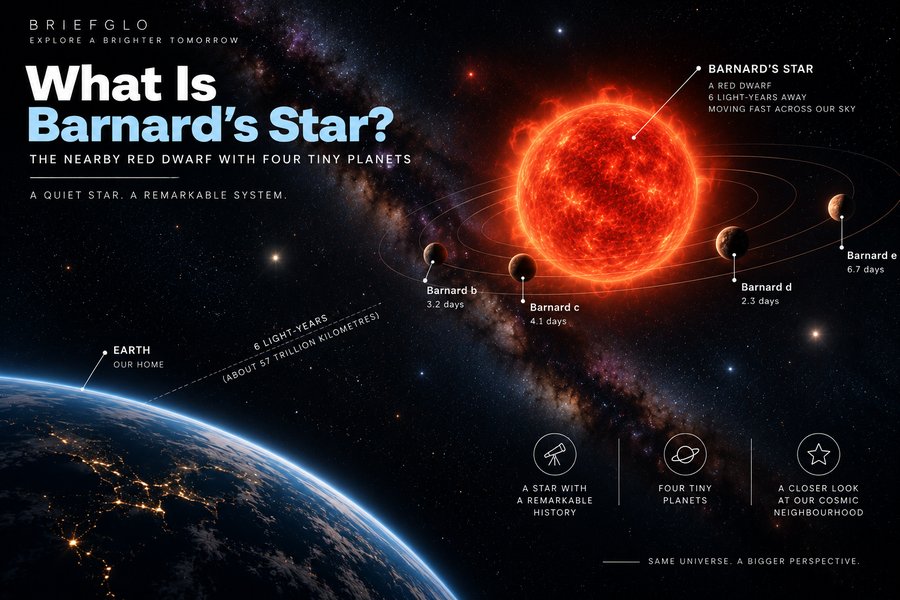
Barnard’s Star lies roughly six light-years from Earth. It is a small red dwarf, too faint to see with the unaided eye, yet it has fascinated astronomers for more than a century.
Part of that fascination comes from movement. Barnard’s Star appears to travel across Earth's sky faster than any other known star.
More recently, however, the attention has shifted to what is travelling around it.
Astronomers have now identified four small rocky planets orbiting Barnard’s Star, each with less mass than Earth. Their discovery demonstrates just how precisely modern telescopes can measure the tiny gravitational effects produced by distant worlds.
After exploring Proxima Centauri, Barnard’s Star takes us one step farther into the neighbourhood surrounding our Sun — and reveals how even a faint point of light can contain an entire planetary system.
How Far Away Is Barnard’s Star?
Barnard’s Star is located about six light-years from Earth in the constellation Ophiuchus.
That makes it the second-closest stellar system to us after the three-star Alpha Centauri system, which includes Proxima Centauri.
More specifically, Barnard’s Star is the nearest individual star to the Sun beyond the Alpha Centauri group.
Six light-years sounds close when discussing the Milky Way, a galaxy stretching roughly 100,000 light-years across.
For spacecraft, it is anything but close.
A light signal needs approximately six years to travel between Barnard’s Star and Earth. Any spacecraft relying on propulsion comparable with today's deep-space probes would need tens of thousands of years to cover such a distance. That enormous timescale is the central problem facing any realistic attempt at interstellar travel.
Astronomically speaking, Barnard’s Star is almost next door.
For humanity, there is still an enormous ocean of space between us.
Why Is Barnard’s Star Moving So Fast Across the Sky?
One characteristic makes Barnard’s Star particularly famous: its proper motion.
Proper motion describes the apparent movement of a star across the background sky as seen from Earth.
Stars are not fixed objects. They travel through the Milky Way, just as the Sun does. Most are simply so distant that their movement is difficult to notice over a human lifetime.
Barnard’s Star is different.
Because it is relatively close and moving rapidly relative to us, its position changes noticeably when astronomers compare observations taken years apart.
It has the largest known proper motion of any star.
This does not mean Barnard’s Star is physically travelling through space faster than every other star in the galaxy.
It means its combination of distance and motion produces the greatest apparent movement across our sky.
That distinction is important — and it is one reason astronomers have been watching this unassuming red dwarf for generations.
What Kind of Star Is Barnard’s Star?
Barnard’s Star is a red dwarf, or M-type star.
Like Proxima Centauri, it is considerably smaller and cooler than the Sun.
Red dwarfs are especially important to astronomy because they are extremely common throughout the Milky Way. Our guide to how stars form, shine and evolve explains why red dwarfs can burn their fuel so slowly and remain active for far longer than stars like the Sun.Their low masses also allow them to consume their nuclear fuel very slowly, giving them potentially enormous lifetimes.
Barnard’s Star itself is thought to be much older than the Sun.
Yet looking at it from Earth is surprisingly difficult.
Despite its proximity, the star is far too faint to see with the naked eye. A telescope is required.
This illustrates one of the quirks of our stellar neighbourhood: some of the closest stars to Earth are not the spectacular bright objects dominating the night sky.
They are small red dwarfs quietly glowing nearby.
Does Barnard’s Star Have Planets?
Yes — and this is where the system becomes particularly interesting.
Astronomers currently recognise four small planets around Barnard’s Star: Barnard b, c, d and e.
Barnard b was announced in 2024 following observations using ESPRESSO, an extremely precise instrument installed on the European Southern Observatory's Very Large Telescope in Chile.
At the time, observations also suggested three additional planetary candidates.
Further measurements changed the picture.
In March 2025, researchers using data from the MAROON-X instrument on the Gemini North telescope, together with ESPRESSO observations, reported evidence confirming a compact system of four sub-Earth planets.
The planets are remarkable partly because they are so small.
NASA reports masses ranging from roughly one-fifth to one-third the mass of Earth. Detecting the gravitational influence of worlds this small from six light-years away requires extraordinary precision.
The Four Planets Are Surprisingly Close to Their Star
Barnard b, c, d and e all orbit extremely close to their host star.
Their years are measured in days rather than months.
Barnard d completes an orbit in approximately 2.3 days.
Barnard b takes about 3.2 days.
Barnard c takes roughly 4.1 days.
Barnard e, the most distant of the four, completes its orbit in approximately 6.7 days.
For comparison, Mercury takes 88 days to orbit the Sun.
Such short orbital periods might initially sound surprising, but Barnard’s Star is much smaller than our Sun and these planets form an extremely compact system.
Their proximity also has an important consequence.
None of the four currently known planets lies within Barnard’s Star's traditional habitable zone. NASA says they orbit too close to their star and are therefore likely too hot for life as we know it.
Finding a rocky planet does not automatically mean finding another Earth. To understand why orbital distance matters, read our guide to the habitable zone, which explains why a rocky planet is not necessarily capable of supporting liquid water or life.
How Can Astronomers Detect Such Tiny Planets?
None of these discoveries requires astronomers to see a detailed photograph of the planet.
Instead, scientists can measure the planet's gravitational effect on its star.
A star with orbiting planets does not remain completely stationary. The star and its planets move around their shared centre of mass.
From Earth, this produces extremely small changes in the star's motion towards and away from us.
Those changes can be detected through the radial velocity method. It is one of several techniques astronomers use to discover exoplanets that cannot be observed directly.
The challenge becomes extreme when the planet is small.
According to NASA, the radial-velocity signals associated with Barnard’s four planets are only around 0.2 to 0.5 metres per second. Meanwhile, activity within the star itself can produce noise several times larger.
Researchers therefore have to model the star's own behaviour carefully before attempting to isolate the much weaker planetary signals.
The result is less like taking a photograph and more like finding a whisper inside a noisy room.
Barnard’s Star Has a Complicated Planet-Hunting History
There is another reason astronomers treat discoveries around Barnard’s Star carefully.
Claims of planets around this star have appeared before.
During the twentieth century, astronomer Peter van de Kamp argued that observations showed planetary companions around Barnard’s Star. Later studies failed to support those conclusions.
Much more recently, a different planet candidate was announced in 2018.
That proposed world was described as a super-Earth on a much wider orbit, taking roughly 233 days to circle the star.
But subsequent analyses cast serious doubt on its existence.
ESO now explicitly notes that newer research suggests the 2018 candidate does not exist. The currently recognised Barnard b is an entirely different, much smaller planet on a roughly three-day orbit.
This history is not evidence that astronomy is unreliable.
It demonstrates how science corrects itself.
A signal can appear convincing with one dataset. Better instruments, additional observations and independent analyses can later strengthen it — or reveal another explanation.
Why the New Discoveries Are Different
Modern planet searches have instruments that earlier generations of astronomers could only imagine.
ESPRESSO measures tiny changes in starlight using the Very Large Telescope in Chile.
MAROON-X performs extremely precise radial-velocity measurements using the Gemini North telescope in Hawaiʻi.
Combining observations from different instruments helps researchers determine whether a repeating signal genuinely behaves like an orbiting planet rather than stellar activity or instrumental noise.
That is particularly important for Barnard’s Star.
The signals produced by its tiny planets are exceptionally subtle.
The fact that astronomers can now detect sub-Earth-mass worlds around a nearby star shows how dramatically exoplanet science has advanced.
Could There Be More Planets Around Barnard’s Star?
Possibly.
The four confirmed planets tell us what current observations have revealed, not necessarily everything that exists in the system.
There could be additional planets on wider orbits that have not yet produced sufficiently clear signals.
That possibility is scientifically interesting because the four known worlds are all too close to Barnard’s Star to occupy its habitable zone.
A still-undetected planet farther out could experience very different conditions. The 2025 study also placed useful limits on what might remain undiscovered. Its measurements ruled out planets more massive than approximately 0.57 Earth masses within the star's estimated habitable zone at a 99% detection probability. Smaller planets, however, have not been completely excluded. That is why the possibility of another world remains open without providing evidence that one actually exists.
But until such a world is actually detected and confirmed, it remains only a possibility.
There is currently no confirmed habitable planet around Barnard’s Star, and no evidence of life there.
The distinction between what might exist and what observations actually show is essential when discussing distant planetary systems.
Why Barnard’s Star Matters
Barnard’s Star is not spectacular because it contains a known second Earth.
It matters because it shows how much astronomers can learn from very little.
From six light-years away, scientists can measure movements in starlight corresponding to speeds slower than an ordinary person walking.
From those tiny signals, they can infer the existence of worlds smaller than Earth.
And when an earlier planetary interpretation fails to survive better observations, scientists can revise the picture rather than preserve an attractive story.
Our local region of the Milky Way is beginning to look less like a collection of isolated stars and more like a neighbourhood filled with planetary systems.
Proxima Centauri has planets. The nearest example is explored in our guide to Proxima Centauri b, a planet orbiting within the traditional habitable zone of the star closest to the Sun.
Barnard’s Star has planets.
Many other nearby stars do too.
But both Proxima Centauri and Barnard’s Star belong to the same broad stellar family: red dwarfs.
They are small, cool and extremely common.
Understanding why these stars are so abundant — and why they can survive for extraordinary lengths of time — takes us naturally to a much bigger question.
Barnard's Star also demonstrates how diverse planetary systems can be. To explore the wider picture, read What Is an Exoplanet? And Which Ones Could Support Life?, which explains how astronomers discover distant worlds and investigate their potential habitability.
Sources and Further Reading
- NASA Science — Four Little Planets, One Big Step
- NASA Exoplanet Archive — Barnard's Star Planetary System
- European Southern Observatory — Scientists Discover Planet Orbiting Closest Single Star to Our Sun
- National Science Foundation — Four Planets Discovered Around Barnard's Star
- The Astrophysical Journal Letters — Four Sub-Earth Planets Orbiting Barnard's Star from MAROON-X and ESPRESSO
- European Southern Observatory — Super-Earth Orbiting Barnard's Star (2018; Later Disputed)