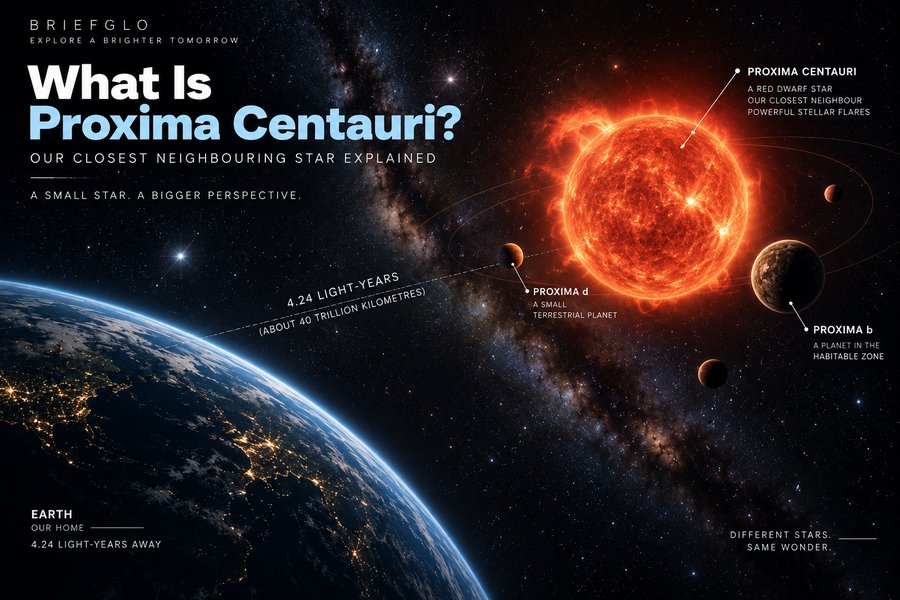
Just over four light-years from Earth, a small red dwarf called Proxima Centauri hosts one of the most intriguing planets known to astronomers.
Proxima Centauri b, discovered in 2016, is the closest confirmed exoplanet to our Solar System. It completes an orbit around its star in just over 11 days and lies within the star's traditionally defined habitable zone.
That sounds promising, but distance from a star is only one part of the story. Proxima Centauri produces powerful stellar flares, and scientists have yet to establish whether its nearby planet possesses a substantial atmosphere or liquid water.
The discovery therefore presents an extraordinary opportunity and a difficult scientific question: could a roughly Earth-mass world orbiting our nearest stellar neighbour support conditions suitable for life?
To answer that, we need to examine both the planet and the unusually active star it orbits.
How Far Away Is Proxima Centauri?
Proxima Centauri lies approximately 4.24 light-years from Earth.
One light-year is the distance light travels through a vacuum in one year — about 9.46 trillion kilometres.
That means Proxima Centauri is roughly 40 trillion kilometres away.
The figure is difficult to appreciate because distances inside our own Solar System are tiny by comparison.
Light from the Sun reaches Earth in a little over eight minutes. Light from Proxima Centauri needs more than four years.
Whenever astronomers observe the star, they are therefore seeing it as it existed more than four years earlier.
For human technology, the distance is far more intimidating. Even our fastest deep-space missions operate at speeds that are minuscule compared with the speed of light.
This is why the apparently simple phrase “nearest star” can be misleading.
Proxima is close astronomically.
It is extraordinarily distant technologically.
What Kind of Star Is Proxima Centauri?
Proxima Centauri is a red dwarf, a type of star that is smaller, cooler and much less luminous than the Sun.
NASA observations describe Proxima as having only around one-eighth of the Sun's mass.
Because it produces far less visible light than our star, Proxima cannot be seen with the unaided eye despite being closer to us than any star beyond the Sun.
Red dwarfs are particularly interesting to astronomers because they are extremely common.
They also consume their nuclear fuel slowly.
Large, luminous stars can have comparatively short lives on astronomical timescales. Small red dwarfs can remain active for vastly longer periods.
NASA notes that Proxima Centauri could remain a main-sequence star for trillions of years — far longer than the present age of the universe.
Small does not necessarily mean quiet, however.
Proxima Centauri Is a Flare Star
Proxima Centauri can produce powerful stellar flares.
These events occur when magnetic activity releases large amounts of energy, causing the star's brightness and radiation output to increase dramatically for a period of time.
Astronomers have observed particularly energetic flares from Proxima.
For planets orbiting close to a red dwarf, that activity matters.
Strong ultraviolet and X-ray radiation can interact with planetary atmospheres. Over long periods, repeated stellar activity could influence whether a planet retains an atmosphere and what conditions exist on its surface.
This becomes especially important because the habitable zone around a cool red dwarf lies much closer to the star than Earth's orbit around the Sun.
A planet can therefore receive an appropriate overall amount of stellar energy while still experiencing a very different radiation environment.
This is one reason astronomers do not describe a planet as habitable simply because its orbit lies within a habitable zone.
Is Proxima Centauri Part of Alpha Centauri?
Yes.
The terminology can initially be confusing because Alpha Centauri appears to be several stars rather than one.
The system contains Alpha Centauri A, Alpha Centauri B and Proxima Centauri.
Alpha Centauri A and B form a relatively close binary pair and orbit one another roughly every 80 years.
Proxima Centauri lies much farther from that pair but is gravitationally associated with them, making the wider Alpha Centauri system a three-star system.
Alpha Centauri A and B are also more similar to the Sun than Proxima is.
From Earth, the pair appears much brighter in the southern sky, while faint Proxima requires optical assistance to observe.
The arrangement gives astronomers something remarkable almost on our cosmic doorstep: multiple stars with very different characteristics sharing the same broad stellar system.
Does Proxima Centauri Have Planets?
Yes.
The most famous is Proxima Centauri b, usually shortened to Proxima b.
Astronomers announced its discovery in 2016 after detecting the subtle gravitational influence of the planet on its host star.
Proxima b completes an orbit in roughly 11 days. Current measurements place its orbital period at approximately 11.18 Earth days, with a minimum mass close to 1.06 times that of Earth. The planet orbits at roughly 0.0485 astronomical units from its star, far closer than Earth orbits the Sun. These figures make Proxima b a compelling target for research, but they do not establish its surface conditions or atmospheric composition.
That would place it extraordinarily close to a star by the standards of our Solar System, but Proxima Centauri is much cooler and dimmer than the Sun.
As a result, Proxima b orbits within the region commonly described as the star's habitable zone.
The discovery immediately attracted attention because it placed a roughly Earth-mass planet around the nearest star to the Sun.
But “in the habitable zone” requires careful interpretation.
Could Proxima b Support Life?
We do not know.
A habitable zone describes the range of orbital distances where temperatures could potentially allow liquid water on a planet's surface, provided other conditions are suitable.
It does not tell us whether water is actually present.
It does not tell us whether the planet has an atmosphere.
And it certainly does not demonstrate that life exists there.
Proxima Centauri's frequent flares add another complication. Powerful stellar activity could expose a nearby planet to intense radiation and potentially affect its atmosphere.
Whether Proxima b has retained a substantial atmosphere remains a crucial question. Astronomers can investigate such distant atmospheres by analysing how planetary systems interact with and alter the light reaching our telescopes.
Its mass, composition, magnetic environment, atmospheric properties and geological history would all matter when assessing its potential habitability.
This is precisely why modern astrobiology rarely relies on a single measurement.
A promising orbit is a reason to investigate a planet. For a closer look at what makes a world potentially suitable for life, explore What Is an Exoplanet? And Which Ones Could Support Life?.
It is not evidence of biology.
Are There Other Planets Around Proxima Centauri?
Proxima Centauri hosts more than one confirmed planet.
Alongside Proxima b, astronomers have identified Proxima Centauri d, a smaller planet completing an orbit in approximately 5.12 days. Its minimum mass is about 0.26 times that of Earth.
Another proposed planet, Proxima Centauri c, remains a candidate rather than a confirmed world in the NASA Exoplanet Archive.
The distinction matters because apparent planetary signals can sometimes be affected by stellar activity or limitations in the available observations. Researchers must test competing explanations before treating a proposed planet as confirmed.
For now, Proxima b and Proxima d are the confirmed planets listed in the archive, while Proxima c remains under investigation.
How Do Astronomers Find Planets Around Such a Distant Star?
Scientists do not need to photograph a planet directly to discover it.
One important technique is called the radial velocity method.
A planet does not technically orbit a perfectly stationary star. Both the star and planet orbit their shared centre of mass.
The planet's gravitational pull therefore causes the star to move slightly towards and away from us.
Astronomers can detect this tiny motion by measuring changes in the star's spectrum.
This was central to the discovery of Proxima b.
The method is extraordinarily sensitive. Scientists are effectively detecting the influence of a comparatively tiny world through subtle changes in light that has travelled more than four years before reaching their instruments.
Modern exoplanet astronomy is therefore less about seeing distant worlds as photographs and more about extracting information hidden within starlight.
Could We Ever Send a Spacecraft There?
Proxima Centauri's proximity makes it an obvious target for discussions about future interstellar exploration.
But “nearby” remains relative.
A spacecraft travelling at approximately Voyager-like speeds would require tens of thousands of years to cross a distance comparable to 4.24 light-years.
That makes conventional spacecraft unsuitable for a practical mission to Proxima.
Researchers have therefore explored much more ambitious concepts, including extremely lightweight probes accelerated by powerful laser beams and reflective sails.
Such concepts could, in principle, reach a meaningful fraction of the speed of light.
They remain enormously difficult engineering projects rather than operational spacecraft. Our article on interstellar travel explores the propulsion concepts, travel times and engineering challenges involved in reaching another star.
A mission would need to survive extreme acceleration, interstellar dust, decades of travel and the challenge of transmitting information across more than four light-years.
Even after reaching Proxima Centauri, a signal sent back towards Earth would itself need another 4.24 years to arrive.
What Would the Sky Look Like From Proxima Centauri?
Proxima Centauri would not offer a science-fiction sky filled with gigantic nearby stars.
Alpha Centauri A and B would be prominent objects from the Proxima system, but most of the distant universe would remain recognisable as the same Milky Way we inhabit.
Our own Sun would become just another star in the sky.
From more than four light-years away, Earth would be extraordinarily difficult to distinguish from the glare of the Sun using technology comparable to our own astronomical instruments.
This reversal of perspective is useful.
When astronomers struggle to investigate a small planet orbiting Proxima Centauri, an observer there would face similar fundamental problems trying to study Earth.
The universe may contain an enormous number of planets, but the distances between neighbouring systems make detailed observation difficult.
Why Proxima Centauri Matters
Proxima Centauri matters because it transforms interstellar astronomy from something abstract into something almost tangible.
There is another star only 4.24 light-years away.
That star has planets.
At least one of those worlds occupies an orbit that makes it scientifically interesting when discussing planetary environments and the possibility of liquid water.
None of this tells us that life exists there.
What it does tell us is perhaps more important scientifically: planetary systems are not confined to distant corners of the galaxy. There is one around the star immediately next door.
For now, humanity can only investigate Proxima Centauri remotely.
But telescopes are becoming increasingly capable of examining nearby planetary systems and their environments.
And Proxima is only one member of our stellar neighbourhood.
Move slightly farther away from the Sun and another remarkable red dwarf appears — one travelling across our sky faster than almost any other star.
So what is Barnard's Star, and why has this nearby system become another important target for exoplanet astronomers?
Sources and Further Reading
NASA Science — Our Nearest Celestial Neighbor? An Exotic 3-Star System
NASA overview of Proxima Centauri, its relationship with Alpha Centauri A and B and the nearby planetary system.
NASA Science — Proxima Centauri
Hubble information about Proxima's size, brightness, classification as a flare star and unusually long expected stellar lifetime.
NASA Science — Sun: Facts
NASA reference for the distance between the Sun and the Alpha Centauri system, including Proxima Centauri's approximately 4.24-light-year distance.
NASA Science — Neighbouring Star's Large and Frequent Flares
NASA discussion of observations showing strong stellar flare activity from Proxima Centauri and its relevance to nearby planets.
NASA Science — Exoplanet Facts
NASA explanation of exoplanet detection techniques and Proxima b's position as our nearest known exoplanet neighbour.
NASA Science — Proxima Centauri d
NASA Exoplanet Archive information on the small terrestrial planet Proxima Centauri d.
European Southern Observatory — Planet Found in Habitable Zone Around Nearest Star
ESO's original announcement of the discovery of Proxima b using radial-velocity observations.
NASA Exoplanet Archive — Proxima Centauri Planetary System
NASA Science — Proxima Centauri b: Planet Facts