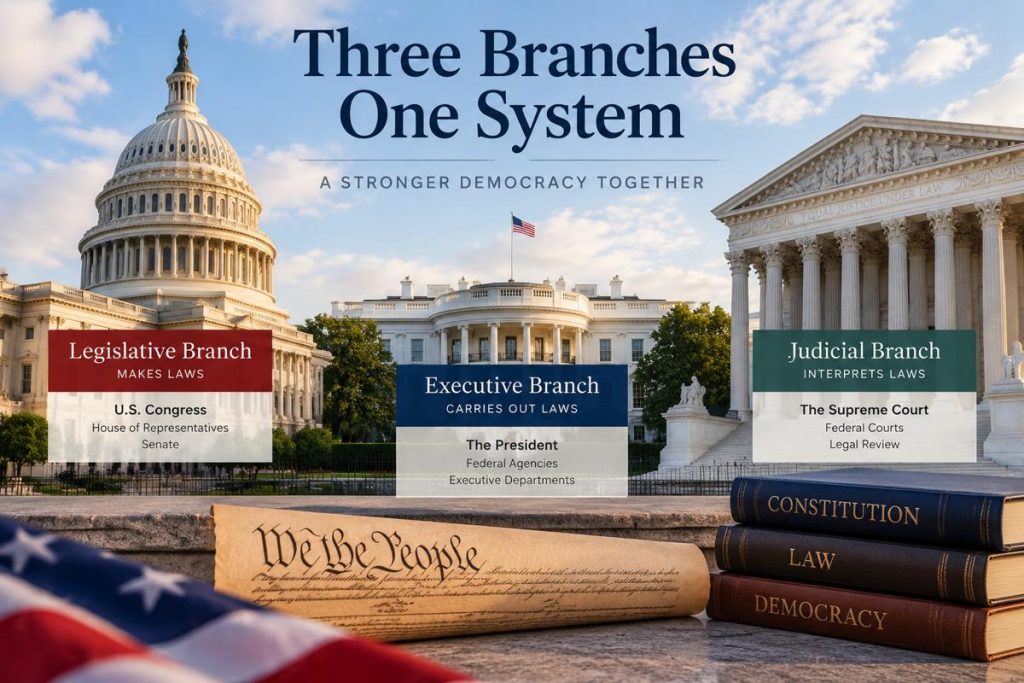
The United States has a president, a Congress and a Supreme Court. Each plays a different role in government, but none is supposed to exercise unlimited authority.
This arrangement was deliberate.
When the American Constitution was written in 1787, its authors faced a difficult question: how could they create a national government strong enough to function without giving too much power to one person or institution?
Their answer was to divide federal authority among three branches: legislative, executive and judicial.
The system remains a defining feature of American government. It influences how laws are passed, how presidents exercise their powers and how disputes over government actions are resolved.
Understanding why these branches exist also helps explain why political decisions in the United States can take time.
Why Does the U.S. Government Have Three Branches?
The three-branch system was created to prevent the concentration of government power.
The Constitution assigns different responsibilities to Congress, the president and the federal courts.
Congress makes federal laws, the executive branch carries them out, and the judiciary interprets and applies the law in cases within its jurisdiction.
These responsibilities are not completely isolated.
Each branch also has powers that can limit or influence the others.
This arrangement combines two principles: separation of powers and checks and balances.
The aim is to allow government to function while reducing the risk that one institution can make, enforce and judge the law without meaningful oversight.
Where Did the Idea of Three Branches Come From?
The American system was influenced by political debates about liberty and government authority.
The French philosopher Montesquieu argued that political freedom was endangered when legislative, executive and judicial powers were concentrated in the same hands.
His ideas influenced the authors of the American Constitution.
James Madison also discussed the importance of separating government powers in The Federalist Papers, particularly Federalist No. 47.
The founders did not simply copy an existing model.
They developed a system in which the branches would remain institutionally distinct while sharing certain responsibilities.
This reflected their experience under British rule and the difficulties of governing under the Articles of Confederation.
The resulting Constitution attempted to balance two competing concerns: an ineffective national government and an excessively powerful one.
For the historical background, see our guide to the U.S. Constitution.
What Are the Three Branches of the U.S. Government?
The first three articles of the Constitution establish the federal government's principal branches.
| Branch | Constitutional basis | Main responsibility |
|---|---|---|
| Legislative | Article I | Makes federal laws |
| Executive | Article II | Implements and enforces federal laws |
| Judicial | Article III | Interprets laws and resolves legal disputes |
These descriptions provide a useful starting point, although each branch has additional constitutional responsibilities.
Their powers are designed to overlap in selected areas, allowing one branch to check another.
The Legislative Branch: Congress
The legislative branch consists of the United States Congress.
Congress has two chambers: the House of Representatives and the Senate.
Members of the House represent congressional districts, with representation distributed among states according to population.
Every state has two senators, regardless of its population.
Together, the chambers consider legislation, approve federal spending and exercise oversight of government activities.
Congress also has constitutional powers involving taxation, interstate and foreign commerce, and declarations of war.
A bill normally must pass both chambers in identical form before being presented to the president.
Congress therefore does not operate as a single body controlled by one individual.
The two-chamber structure creates an additional layer of review within the legislative branch itself.
Our comparison of the House of Representatives and the Senate explains their different responsibilities.
The Executive Branch: The President and Federal Agencies
The executive branch is headed by the president.
Its primary responsibility is to implement and enforce federal laws.
The branch includes executive departments and agencies involved in national security, public administration, economic policy and other government functions.
The president also serves as commander in chief of the armed forces and performs important diplomatic responsibilities.
However, presidential authority is subject to constitutional and statutory limits.
The president cannot independently create a federal law through the ordinary legislative process.
Executive orders and other presidential directives must have a lawful basis and can be challenged in court.
Congress also controls appropriations and exercises oversight of executive agencies.
This relationship illustrates why the executive branch is powerful but not independent of the rest of government.
The Judicial Branch: The Federal Courts
Article III establishes the federal judiciary, including the Supreme Court.
Congress has authority to establish lower federal courts.
Federal judges resolve disputes within the jurisdiction granted by the Constitution and federal law.
Courts interpret statutes, apply legal rules and determine how constitutional provisions affect particular cases.
One of the judiciary's most important functions is judicial review.
This allows courts, in cases properly before them, to determine whether government actions are consistent with the Constitution.
The principle became firmly established in American constitutional law through the Supreme Court's 1803 decision in Marbury v. Madison.
Federal courts do not simply review every political decision on request.
They must operate within rules governing jurisdiction, standing and the types of disputes they can hear.
Their authority is substantial, but it also has legal limits.
What Is Separation of Powers?
Separation of powers means dividing government authority among distinct institutions.
In the American system, the Constitution assigns legislative powers to Congress, executive power to the president and judicial power to the federal courts.
The purpose is to make it more difficult for any single institution to control the entire government.
For example, a president cannot normally pass legislation without Congress.
Congress cannot simply decide the outcome of a federal court case.
Federal judges do not administer executive agencies.
However, separation of powers does not mean the branches never interact.
The Constitution deliberately gives them overlapping responsibilities in areas such as legislation, appointments and accountability.
That is where checks and balances become important.
How Do Checks and Balances Work?
Checks and balances allow each branch to restrain certain actions by the others.
The Constitution establishes several mechanisms.
| Government action | Constitutional check |
|---|---|
| Congress passes a bill | The president may veto it |
| President vetoes a bill | Congress may override the veto with two-thirds majorities in both chambers |
| President nominates federal judges | The Senate must provide advice and consent |
| Government action is challenged | Federal courts may review its constitutionality in a proper case |
| Executive branch spends federal funds | Congress controls appropriations |
| Federal officials commit serious misconduct | Congress has impeachment and removal powers under constitutional procedures |
These powers are not equally distributed, and their application depends on the relevant constitutional provisions.
For example, the House has the sole power of impeachment, while the Senate conducts impeachment trials.
The president nominates Supreme Court justices, but appointment requires Senate confirmation.
The judiciary can invalidate unconstitutional actions, although courts rely on other institutions to implement many decisions.
The system is designed to encourage accountability rather than guarantee agreement.
A Simple Example: How a Federal Law Is Passed
Consider a proposed federal law addressing transport safety.
A member of Congress introduces legislation.
The proposal may be reviewed by committees, debated and amended.
If both the House and Senate approve the same text, the bill is presented to the president.
The president may sign it into law or veto it.
If the president vetoes the bill, Congress can attempt an override.
Once a law takes effect, executive agencies may be responsible for implementing its requirements.
If a legal dispute arises, a federal court may interpret the law or assess a constitutional challenge.
This example shows how different branches can participate in the life of a single law.
It also demonstrates why the system can be slower than one in which a single institution makes every decision.
Why Can't the President Control All Three Branches?
The Constitution does not give the president unrestricted authority over Congress or the federal judiciary.
Members of Congress are elected separately and serve under their own constitutional terms.
Federal judges appointed under Article III generally hold office during good behaviour, protecting them from removal merely because their decisions are unpopular.
The president can influence government through appointments, legislative proposals and executive action.
However, Congress has independent constitutional powers, and federal courts exercise judicial authority.
These institutional differences help prevent political control from becoming concentrated in a single office.
They do not eliminate conflict or guarantee that every decision will be effective.
Instead, they create formal limits and procedures for addressing disagreements.
Does the Three-Branch System Make Government Slower?
It can.
A proposal may require approval from both chambers of Congress and the president.
Government actions may also face legal challenges.
Disagreements between branches can delay legislation, appointments or spending decisions.
Supporters of the system argue that this is partly intentional.
Requiring different institutions to participate can encourage scrutiny and reduce the risk of hasty decisions.
Critics argue that the same arrangements can create gridlock, particularly when political parties control different branches or chambers.
Both effects are possible.
The Constitution prioritises divided authority and institutional accountability, not the fastest possible decision-making process.
How Does This Affect Everyday Life?
The three branches influence decisions that affect ordinary Americans.
Congress establishes federal laws and determines funding for many government programmes.
Executive agencies administer services, enforce regulations and implement legislation.
Federal courts resolve legal disputes involving federal law and constitutional rights.
For example, a federal consumer-protection law may be passed by Congress, enforced by an executive agency and interpreted by a court when disagreements arise.
This does not mean every everyday issue belongs to the federal government.
State and local governments also exercise extensive authority over public services and laws.
The distinction is explained in our guide to federal versus state government.
Are the Three Branches Completely Equal?
The branches are separate and coordinate parts of the federal government, but they do not possess identical powers.
Congress controls legislation and appropriations.
The president directs the executive branch and exercises constitutional executive responsibilities.
The judiciary decides legal disputes within its jurisdiction.
Their influence can vary depending on the issue.
For example, Congress has a central role in creating statutes, while courts have a central role in deciding constitutional questions presented in cases.
The Constitution does not require every branch to have the same number of employees, the same budget or identical authority.
The objective is a distribution of responsibilities with meaningful constitutional limits.
What Is the Difference Between Separation of Powers and Federalism?
These two concepts are closely related but distinct.
Separation of powers divides authority among the legislative, executive and judicial branches of the federal government.
Federalism divides authority between the federal government and the states.
A state government may also have its own legislative, executive and judicial institutions.
However, the US Constitution does not require every state to organise those institutions in precisely the same way as the federal government.
Understanding both concepts helps explain why American government contains several levels of authority and multiple institutions within each level.
Frequently Asked Questions
Why are there three branches of government?
The Constitution divides federal power among three branches to prevent excessive concentration of authority and create checks and balances.
What are the three branches called?
They are the legislative branch, executive branch and judicial branch.
Which branch makes laws?
Congress, consisting of the House of Representatives and Senate, exercises federal legislative power.
Which branch enforces laws?
The executive branch, headed by the president, is responsible for implementing and enforcing federal laws.
Which branch interprets laws?
Federal courts interpret and apply federal law and the Constitution in cases within their jurisdiction.
Can one branch overrule another?
In certain circumstances. For example, Congress can override a presidential veto, and courts can invalidate unconstitutional government actions.
Final Thoughts
The United States has three branches of government because its Constitution was designed to distribute political authority rather than concentrate it.
Congress makes federal laws, the executive branch implements them and the judiciary resolves legal disputes.
Each branch also has powers that can limit the others.
This arrangement can produce delays and disagreements, but those features are connected to its purpose: requiring government institutions to exercise authority within constitutional boundaries.
The three-branch system is not a guarantee against political conflict or abuse of power.
It is a framework intended to make power accountable and provide legal mechanisms for resolving disputes.
Understanding that framework is an essential starting point for understanding American government.
Sources and Further Reading
USAGov — Branches of the U.S. Government
Official explanation of the legislative, executive and judicial branches and their responsibilities.
National Archives — The Constitution: What Does It Say?
Overview of the Constitution's seven articles and the separation of powers.
Congress.gov — Constitution Annotated
Official congressional reference covering constitutional principles, powers and judicial interpretation.
U.S. House of Representatives — Branches of Government
Explanation of the federal branches and their constitutional roles.
United States Courts — Court Role and Structure
Official information on the judiciary, judicial review and the federal court system.
Government Publishing Office — Structure of the U.S. Government
Government reference guide to the structure of federal institutions.