Updated: 19 October 2026
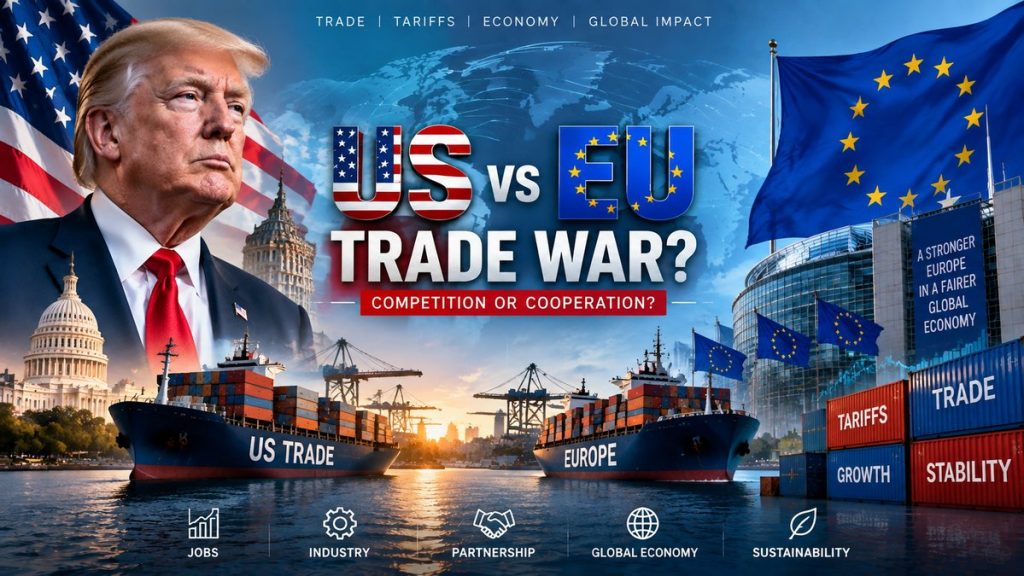
Trade tensions between the United States and the European Union have been a defining issue of Donald Trump's economic policy. Tariffs on European products, disagreements over market access and the threat of retaliation have raised questions about the future of one of the world's largest trading relationships.
For businesses, the uncertainty has been significant. Manufacturers need to know what duties apply to their products, while investors and consumers want to understand whether higher trade barriers will affect prices and economic growth.
However, describing the situation simply as a new US–EU trade war misses an important development.
In July 2025, Trump and European Commission President Ursula von der Leyen reached a political agreement intended to prevent a broader escalation. The framework was subsequently implemented through measures adopted in 2026.
The relationship remains complex, but it is now shaped by both trade restrictions and an agreement designed to manage them.
Why Did Trump and the EU Clash Over Trade?
Donald Trump's trade policy has placed considerable emphasis on tariffs, domestic manufacturing and reducing perceived imbalances in America's international economic relationships.
His administration has argued that tariffs can strengthen US industry, encourage investment and improve negotiating leverage.
The European Union has taken a different approach, generally favouring negotiated trade rules and warning that broad tariffs can disrupt international supply chains.
Disagreements have centred on several issues, including trade balances, industrial competitiveness, market access and tariffs on manufactured goods.
These tensions matter because the two economies are closely connected.
American businesses sell technology, services, energy and industrial products to European customers. European companies export vehicles, pharmaceuticals, machinery and other goods to the United States.
Both sides also invest heavily in each other's markets.
A tariff dispute therefore affects more than the companies directly exporting goods.
It can influence suppliers, retailers, employees and investment decisions across the Atlantic.
How Important Is US–EU Trade?
The United States and European Union maintain one of the world's largest bilateral economic partnerships.
According to the European Commission, trade in goods and services reached approximately €1.8 trillion in 2025.
That represents around €4.9 billion in commercial exchanges each day.
Mutual investment stocks totalled approximately €4.9 trillion in 2024.
These figures help explain why both governments have strong incentives to avoid a prolonged trade conflict.
The relationship is also more balanced than merchandise statistics alone suggest.
In 2025, the EU recorded a substantial goods trade surplus with the United States, while America maintained a large surplus in services.
The European Commission estimated that the remaining overall trade gap was relatively small compared with total bilateral trade.
This distinction matters because political arguments often focus on goods while overlooking services and investment.
For a fuller breakdown, read our guide to US vs EU trade.
What Happened During the 2025 Tariff Dispute?
Trade tensions intensified during 2025 as the Trump administration pursued new import duties and threatened additional restrictions.
European manufacturers faced uncertainty over access to the American market, particularly in industries such as automobiles, metals and machinery.
The EU prepared possible countermeasures in response to American tariffs.
Businesses on both sides were concerned that escalating restrictions could lead to higher costs and reduced trade.
Negotiations continued through the summer.
On 27 July 2025, Trump and von der Leyen announced a political agreement at Turnberry, Scotland.
A joint statement followed on 21 August 2025, outlining a framework for tariff treatment and wider economic cooperation.
The agreement did not establish unrestricted free trade.
Instead, it aimed to reduce uncertainty, limit escalation and create more predictable conditions for businesses.
What Did the US–EU Trade Agreement Include?
The 2025 agreement established several important principles.
A central feature was a 15% all-inclusive US tariff ceiling for most covered EU exports.
The European Commission described this as a maximum rate rather than an additional 15% charge imposed on top of every existing duty.
The framework also provided for more favourable treatment of selected products.
These included certain aircraft and aircraft parts, generic pharmaceuticals and unavailable natural resources.
On the European side, the EU committed to removing tariffs on US industrial goods and improving market access for specified agricultural and seafood products.
The agreement also provided a basis for further discussions on energy, investment, regulatory cooperation and strategic supply chains.
However, its implementation required legal measures.
Political announcements and actual customs rules are not the same thing.
Businesses must therefore check the applicable tariff classification and current regulations rather than relying on a headline percentage alone.
What Changed in 2026?
Several developments reshaped the legal and commercial environment.
The Supreme Court Ruling
On 20 February 2026, the US Supreme Court issued a decision concerning the Trump administration's use of the International Emergency Economic Powers Act to impose tariffs.
The ruling limited the use of that statute as a basis for tariff measures.
However, it did not eliminate every American tariff.
Other legal authorities, including provisions dealing with particular industries and trade practices, remained relevant.
The decision added complexity to the tariff system and required businesses to review which measures continued to apply.
Our article on Trump tariffs in 2026 examines the changing legal framework in more detail.
Implementation of the EU–US Agreement
The European Parliament and Council adopted legislation implementing key EU commitments under the 2025 agreement.
The main framework entered into force on 1 July 2026.
It adjusted duties on selected American goods and established provisions allowing the EU to suspend concessions under specified circumstances.
These safeguards were intended to protect the agreement if the United States failed to honour relevant commitments.
EU Retaliatory Measures Remained Suspended
On 31 July 2026, the European Commission announced that previously adopted rebalancing measures against American exports would remain suspended without a fixed end date.
The decision reflected the EU's intention to maintain stability while continuing to monitor US implementation.
This was an important sign that the relationship had moved away from immediate escalation.
Nevertheless, suspension is not the same as permanently abandoning every possible response.
The EU retained the ability to review its position if circumstances changed.
Are US Tariffs on European Goods Still in Place?
Yes. The trade agreement did not remove all American tariffs on European goods.
The framework provided a 15% ceiling for most covered EU exports, with special treatment for certain categories.
However, tariffs can differ by product and legal authority.
Steel and aluminium products have remained a particularly sensitive area.
The European Commission has identified higher duties on some steel and aluminium derivatives as an unresolved issue.
Under the EU's implementing framework, the continuation of rates above 15% on specified products at the end of 2026 could trigger a suspension of certain European concessions.
The legal status of individual duties can change following investigations, court decisions or regulatory updates.
For businesses, the practical question is which rate applies to a particular shipment on the date it enters customs.
This is why general statements such as “all European products face a 15% tariff” can be misleading.
Could the EU Retaliate Against the United States?
The EU has legal and political tools available to respond to trade restrictions.
During 2025, it prepared measures that could have affected selected American exports.
However, the European Commission extended the suspension of those measures in July 2026.
That means the existence of a retaliation mechanism should not be confused with its active application.
The EU has also included safeguards in legislation implementing the trade agreement.
These provisions allow action under specified circumstances, including failures to honour agreed commitments.
Retaliation could raise costs for American exporters and European importers.
It might also encourage further restrictions from Washington.
Both sides therefore face incentives to manage disagreements through negotiation.
For a broader explanation of escalation and countermeasures, see what a trade war is.
How Do Tariffs Affect American and European Businesses?
Tariffs create costs and uncertainty that businesses must manage.
An American manufacturer importing European machinery may face higher purchasing costs.
A European vehicle producer exporting to the United States may need to adjust prices, production or investment plans.
Companies sometimes absorb additional duties to remain competitive.
Others negotiate with suppliers or pass part of the cost to customers.
Businesses may also change where they manufacture products.
However, shifting production is rarely simple.
Factories require investment, skilled workers, reliable suppliers and access to infrastructure.
A company cannot necessarily replace an established international supply chain within a few months.
This makes stable trade rules particularly valuable.
The 2025 agreement reduced some uncertainty, but it did not remove every cost associated with tariffs or eliminate the possibility of future disputes.
Could Consumers Pay Higher Prices?
Yes. Import tariffs can increase the cost of products purchased by businesses and households.
In the United States, importers generally pay customs duties when goods enter the country.
The economic burden can then be shared among importers, foreign suppliers, retailers and consumers.
A tariff does not automatically cause the retail price to rise by the same percentage.
Competition, profit margins, exchange rates and available substitutes influence the outcome.
American consumers may face higher prices on certain imported goods or products made with imported components.
European consumers can also be affected by changes in import duties, supply chains and business investment.
However, the impact varies between industries.
Our guide to how tariffs work explains the mechanism, while our analysis of Trump's tariffs and consumer prices examines the economic evidence.
Which Industries Face the Greatest Exposure?
Several industries are especially sensitive to changes in transatlantic trade rules.
Automotive Manufacturing
European vehicle manufacturers have substantial commercial interests in the American market.
Tariffs can influence vehicle prices, production decisions and investment.
American automotive businesses may also be affected through international parts suppliers.
Steel and Aluminium
Metals have been a recurring source of trade disagreements.
Tariffs can support selected domestic producers while raising costs for businesses that use imported materials.
Steel and aluminium derivatives remain an important issue under the EU–US framework.
Pharmaceuticals
The pharmaceutical sector is a major component of transatlantic goods trade.
Companies depend on international research, manufacturing and distribution networks.
Changes to tariff treatment can affect planning and supply arrangements.
Energy and Technology
American energy exports are important to Europe, while digital services and technology investment connect both markets.
These sectors illustrate why the economic relationship extends far beyond merchandise tariffs.
Has the Agreement Ended the Risk of a Trade War?
The agreement has reduced the immediate risk of a broad escalation, but it has not eliminated every disagreement.
The European Commission described the framework as a way to restore predictability and protect the relationship from a more damaging conflict.
American and European businesses have continued operating across both markets.
However, unresolved questions remain over certain tariffs, regulatory policies and the implementation of commitments.
Political changes can also influence future negotiations.
The key distinction is between an active, escalating trade war and a managed dispute in which restrictions remain but negotiations continue.
As of October 2026, the latter description more accurately reflects the US–EU relationship.
Future developments will depend on whether both sides maintain their commitments and resolve outstanding disagreements.
Why Does the Dispute Matter Beyond America and Europe?
The United States and EU are major participants in global supply chains.
Their trade policies influence manufacturers and suppliers in other countries.
A European company exporting machinery to America may purchase components from Asia.
An American technology company serving European customers may operate research and production facilities worldwide.
Changes in transatlantic tariffs can therefore influence decisions far beyond the two markets.
The dispute also affects expectations about international trade rules.
Businesses and governments watch whether major economies resolve disagreements through negotiation or introduce increasingly restrictive measures.
A broader comparison of the US and EU economies explains why their economic decisions carry global importance.
Frequently Asked Questions
Is there a US–EU trade war in 2026?
The relationship has experienced significant tariff tensions, but the 2025 agreement and its implementation in 2026 have reduced the immediate risk of a broad, escalating trade war.
Did Trump and the EU reach a trade agreement?
Yes. Donald Trump and European Commission President Ursula von der Leyen announced a political agreement on 27 July 2025, followed by a joint statement in August.
Are EU products still subject to US tariffs?
Yes. The framework provides a 15% ceiling for most covered EU exports, with different arrangements for selected products. Specific duties depend on the goods and applicable rules.
Has the EU imposed retaliatory tariffs on American goods?
The EU prepared rebalancing measures, but their application remained suspended following a decision announced in July 2026.
Could trade tensions increase again?
Yes. Disagreements over implementation, industrial tariffs or future policy changes could create renewed tensions.
Final Thoughts
The Trump–EU trade dispute has demonstrated how quickly tariffs can create uncertainty between major economic partners.
During 2025, the risk of escalation increased as Washington and Brussels disagreed over import duties and market access.
The agreement reached in July 2025 provided a framework for reducing that uncertainty, while European legislation adopted in 2026 put important commitments into effect.
Tariffs and unresolved disagreements remain, particularly in sensitive industrial sectors.
However, the relationship is not defined solely by confrontation.
The United States and European Union continue to depend on one another for trade, services, investment and technology.
For businesses and consumers, the most important question is whether both sides can preserve predictable trading conditions while addressing their differences.
That outcome will matter well beyond the Atlantic.
Sources and Further Reading
European Commission — The EU–US Trade Deal
Official explanation of the agreement, tariff arrangements and implementation.
European Commission — EU–US Trade Relationship: One Year After the Deal
Review of transatlantic trade and investment following the 2025 agreement.
European Commission — EU Extends Suspension of Rebalancing Measures Against the United States
Official announcement of the July 2026 suspension.
EUR-Lex — Regulation (EU) 2026/1455
EU legislation implementing tariff commitments and safeguards.
EUR-Lex — Implementing Regulation (EU) 2026/1893
Legal text suspending EU rebalancing measures.
U.S. Customs and Border Protection — Supreme Court Judgment on IEEPA Tariffs
US customs guidance acknowledging the February 2026 Supreme Court decision.