Mars is a cold, dry world today. Its thin atmosphere offers little protection from radiation, and liquid water cannot remain stable across most of its surface for long.
But billions of years ago, the Red Planet looked very different.
Rivers flowed across parts of its landscape, lakes filled ancient craters, and water interacted with rocks for extended periods. These discoveries have transformed Mars from a seemingly lifeless desert into one of the most promising places to investigate whether life once existed beyond Earth.
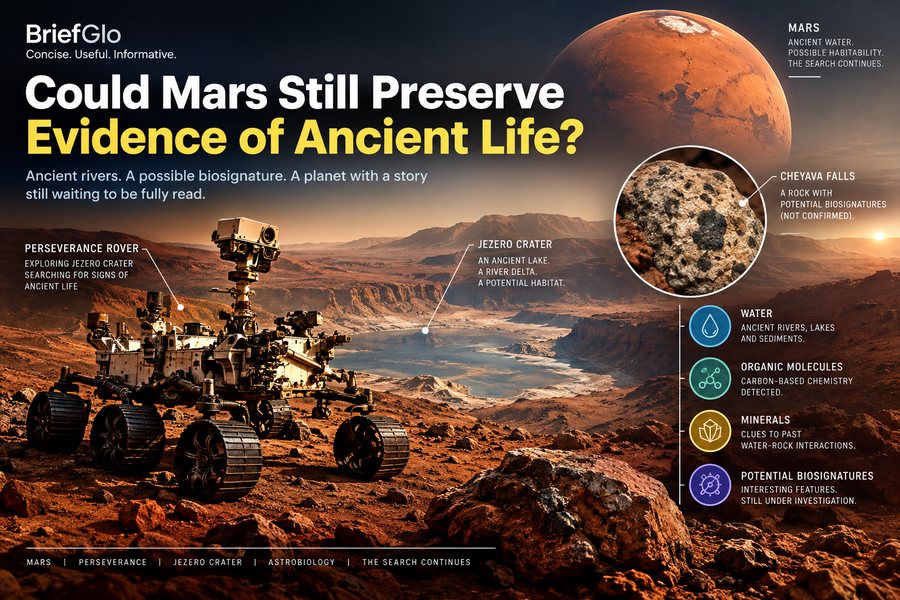
NASA's Perseverance rover has made that question even more intriguing. In Jezero Crater, it has examined ancient sediments and collected a rock sample containing features scientists describe as potential biosignatures.
The finding is significant, but it is not proof of Martian life.
So what has Perseverance actually discovered, and could Mars still preserve evidence of organisms that lived billions of years ago?
What Was Ancient Mars Like?
Modern Mars has an average surface temperature far below freezing, a thin atmosphere and a landscape shaped by dust, wind and ancient geological activity.
Evidence from orbiters and robotic explorers shows that the planet's distant past was considerably wetter.
Scientists have identified dried river valleys, sedimentary deposits, minerals formed through interactions with water and geological formations consistent with ancient lakes.
These observations suggest that liquid water existed in some Martian environments for extended periods.
That matters because water is essential to every known form of life on Earth.
However, finding evidence of ancient water does not establish that Mars was inhabited.
A planet can possess environments capable of supporting microorganisms without life ever emerging there.
Scientists therefore distinguish between evidence of habitability and evidence of actual biological activity.
Mars has provided substantial evidence of the former. The latter remains an open question.
Why Jezero Crater Matters
Jezero Crater was selected as the landing site for NASA's Perseverance rover partly because of its geological history.
Billions of years ago, a river flowed into the crater and deposited sediments in a fan-shaped delta.
On Earth, river deltas can preserve organic material and traces of past environments within layers of sediment.
Similar processes may have occurred on Mars.
Perseverance landed in Jezero in February 2021 and began investigating rocks that could reveal how water shaped the region.
Its instruments examine mineral composition, rock textures and evidence of past chemical reactions.
Some rocks show signs of having formed or changed in the presence of water.
Others preserve layers that can help researchers reconstruct the sequence of events in the crater.
These geological records make Jezero an important location for searching for ancient microbial life.
If microorganisms ever lived in its waters or sediments, certain rocks might still preserve chemical or structural clues.
What Did Perseverance Find at Cheyava Falls?
One of Perseverance's most closely studied discoveries came in July 2024, when the rover examined an arrowhead-shaped rock nicknamed Cheyava Falls.
The rock was found in the Bright Angel region, part of an ancient river valley associated with Jezero Crater.
Scientists noticed several unusual features.
The rock contained evidence of organic compounds, mineral veins associated with past water activity and small, distinctive markings that researchers called leopard spots.
Perseverance collected a core sample from the rock, naming it Sapphire Canyon.
The discovery attracted considerable attention because some of the observed chemical and mineral patterns could be consistent with processes involving microorganisms.
In September 2025, NASA highlighted peer-reviewed research describing the sample as containing potential biosignatures.
The wording is important.
A potential biosignature is a feature that might have a biological origin but requires further investigation before scientists can determine what produced it.
The findings have made Cheyava Falls an especially interesting scientific target, but they have not established that life once existed on Mars.
Why Are the Leopard Spots So Interesting?
The leopard spots are small markings with contrasting colours and mineral compositions.
Detailed measurements identified minerals including vivianite, an iron phosphate, and greigite, an iron sulphide.
On Earth, similar minerals can occur in environments where microorganisms influence chemical reactions.
Certain microbes obtain energy through reactions involving iron, sulphur and other substances in their surroundings.
Researchers are therefore interested in whether the mineral patterns in Cheyava Falls could preserve evidence of comparable processes.
But there is a complication.
Vivianite and greigite can also form without biological activity.
Chemical reactions involving water, minerals and organic matter may produce features that resemble biological traces.
This is why the geological context matters as much as the appearance of the spots themselves.
Scientists need to understand how the rock formed, how its minerals changed and whether non-biological processes could explain the observed patterns.
The leopard spots are intriguing because they raise a testable scientific question, not because their origin has already been established.
Organic Molecules Are Not Proof of Life
The discovery of organic material on Mars often produces excitement.
Organic molecules contain carbon and are important components of living organisms on Earth.
However, organic chemistry is not exclusive to biology.
Organic compounds can form through geological reactions and other non-biological processes. Some may also arrive on planets through meteorites.
Finding them on Mars therefore tells scientists something important about the planet's chemistry, but it does not automatically indicate past life.
The same caution applies to possible biosignatures.
A chemical or mineral pattern becomes more convincing when several independent observations support a biological explanation and plausible non-biological alternatives have been carefully examined.
For Cheyava Falls, scientists have an unusually interesting combination of observations.
What they do not yet have is sufficient evidence to identify the processes responsible with confidence.
Could Ancient Martian Rocks Preserve Microbial Fossils?
If life existed on ancient Mars, it may have been microscopic.
Scientists are not expecting Perseverance to discover the remains of large animals or plants.
Instead, they are looking for subtle evidence that might survive in rocks over billions of years.
On Earth, sedimentary rocks can preserve microscopic structures, organic compounds and chemical patterns associated with ancient biological activity.
Some of these traces are difficult to interpret even when researchers can examine samples directly in laboratories.
The challenge becomes much greater on Mars.
Radiation, oxidation and geological alteration can damage or transform possible biological material.
A promising rock must therefore have experienced conditions favourable not only to life but also to the preservation of evidence.
Fine-grained sediments can be particularly interesting because they may trap material as they accumulate.
Perseverance's investigation of Jezero is partly an effort to identify precisely these kinds of geological environments.
Why Returning Samples to Earth Could Matter
Perseverance carries sophisticated instruments, but a rover cannot perform every analysis available in a modern laboratory.
Scientists on Earth can use highly specialised equipment to investigate microscopic structures, measure chemical compositions and test competing explanations.
They can also repeat measurements using different methods and allow independent research teams to examine the same material.
This makes the samples collected by Perseverance scientifically valuable.
The Sapphire Canyon core is especially important because it contains the material associated with the Cheyava Falls observations.
Returning such samples would not guarantee the discovery of life.
It could, however, allow researchers to investigate whether the unusual mineral and chemical features formed through biological or non-biological processes.
The timetable and architecture of any future sample-return mission remain dependent on programme decisions, funding and technical development.
For now, the samples preserve opportunities for investigations that cannot be completed entirely on the Martian surface.
Could Life Still Exist Beneath Mars Today?
The search for ancient life is different from the search for organisms that might survive on Mars today.
The planet's exposed surface is harsh, with intense ultraviolet radiation, low pressure and limited access to stable liquid water.
Subsurface environments may offer different conditions.
Rock and soil can provide some protection from radiation, while underground ice and possible local sources of heat raise questions about whether liquid water could exist in certain settings.
However, the existence of a potentially suitable underground environment does not establish that organisms inhabit it.
Scientists have not confirmed present-day life beneath the Martian surface.
The possibility remains a subject for research rather than an established discovery.
Perseverance's principal astrobiological objective is to investigate signs of ancient microbial life, not to demonstrate that living organisms currently occupy Mars.
How Mars Compares With Europa and Enceladus
Mars is not the only place in the Solar System where scientists are searching for potentially habitable environments.
Jupiter's moon Europa is thought to contain an ocean beneath its icy exterior.
Saturn's moon Enceladus also has a subsurface ocean and releases water-rich material into space through plumes.
These worlds present a different scientific opportunity.
Mars offers ancient rocks that may preserve evidence of environments that existed billions of years ago.
Europa and Enceladus may contain liquid-water environments today, although neither has provided confirmed evidence of life.
Together, they show why astrobiology cannot rely on a single type of planet or moon.
The environments worth investigating may look very different from Earth's surface.
What Would Count as Convincing Evidence of Ancient Life?
A convincing discovery would require more than an unusual rock formation or the presence of organic molecules.
Researchers would need to demonstrate that the observed features are consistent with biological activity and difficult to explain through known non-biological processes.
That could involve multiple kinds of evidence.
Microscopic structures, chemical distributions, mineral associations and geological context might all contribute to an interpretation.
Independent analysis would be essential.
Scientists would also need to investigate contamination and consider whether later geological processes altered the original evidence.
Even a particularly promising result could remain uncertain if several explanations fit the available data.
This cautious approach is not a weakness.
It is what allows researchers to distinguish a genuinely extraordinary discovery from an interesting but misunderstood geological process.
So, Could Mars Still Preserve Evidence of Ancient Life?
Yes. Ancient Martian rocks may still contain chemical or structural traces of environments where microbial life could have existed.
Perseverance has strengthened the scientific case for investigating that possibility.
Its observations in Jezero Crater show that the region experienced a complex history involving water, sediments and chemical reactions.
The Cheyava Falls discovery adds a particularly intriguing piece of evidence.
Yet the distinction remains clear: a potential biosignature is not a confirmed fossil, and a once-habitable environment is not proof that life developed there.
As of October 2026, no discovery has established that Mars was once inhabited.
What scientists have found is a growing collection of clues that can be examined, challenged and tested.
That is already an important achievement.
The search for life beyond Earth may eventually reveal that biology emerged on more than one world. It may also teach us that suitable conditions do not always lead to living organisms.
Either outcome would change how we understand our place in the universe.
And the question extends far beyond Mars. Astronomers are now identifying planets around other stars and investigating which environments might offer similar opportunities for life.
Sources and Further Reading
NASA Science — Perseverance Rover Mission
Official information about Perseverance's mission, discoveries and search for ancient microbial life.
NASA Science — Perseverance Science Highlights
Research findings concerning ancient water, sedimentary rocks and potentially habitable environments in Jezero Crater.
NASA Science — The Mars Report: September 2025 Special Edition
NASA's explanation of the Cheyava Falls discovery and the scientific meaning of a potential biosignature.
NASA Science — Perseverance's PIXL Finds Vivianite and Greigite in Cheyava Falls
Details of the minerals associated with the leopard spots and their possible origins.
NASA Science — The Hunt for Life on Mars and Elsewhere in the Solar System
An overview of the scientific search for life on Mars and other worlds.