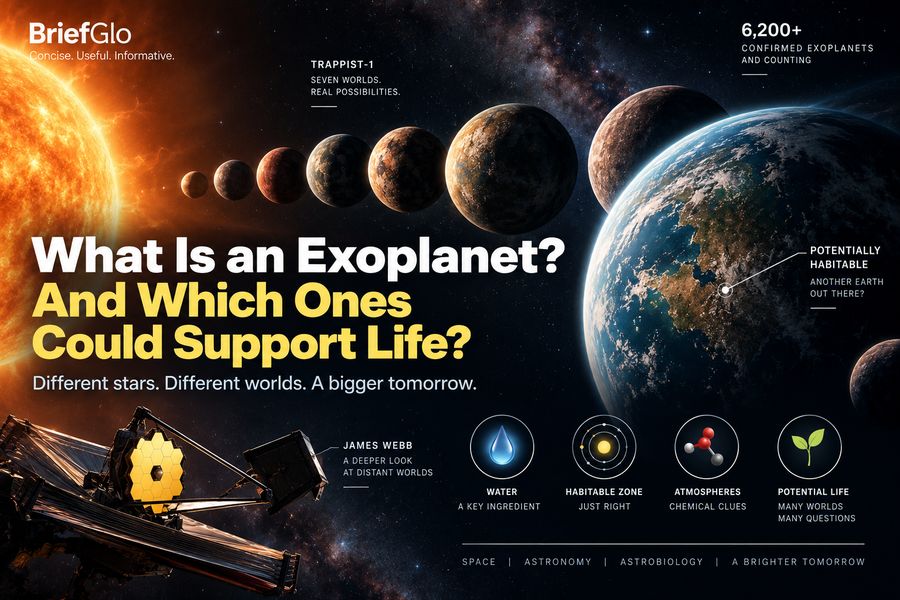
For most of human history, the planets of our Solar System were the only worlds we knew. Astronomers could observe Jupiter, Saturn, Mars and Venus, but whether planets existed around other stars remained an unanswered question.
Today, that picture has changed completely.
Scientists have confirmed more than 6,000 planets beyond our Solar System. Some are enormous gas giants orbiting dangerously close to their stars. Others are small, rocky worlds that may have more in common with Earth.
These distant planets are called exoplanets.
Their discovery has revealed that our Solar System is only one example of a much larger and more varied planetary universe.
What Is an Exoplanet?
An exoplanet, short for extrasolar planet, is a planet located outside our Solar System.
Most known exoplanets orbit stars other than the Sun, although astronomers also study planets that travel through space without orbiting a star. These are sometimes called rogue planets.
Exoplanets can differ enormously in size, temperature, composition and orbital behaviour.
Some complete an orbit in just a few days. Others take years to travel around their stars.
A planet may be larger than Jupiter, smaller than Earth or somewhere in between.
The defining feature is not whether it resembles a familiar planet, but that it exists beyond our own planetary system.
By studying these worlds, astronomers can investigate how planets form, how planetary systems evolve and whether environments similar to Earth's might exist elsewhere.
How Many Exoplanets Have Scientists Discovered?
The number of confirmed exoplanets has grown dramatically since the 1990s.
In 1992, astronomers reported planets orbiting a pulsar, a rapidly rotating neutron star.
Three years later, researchers announced the discovery of 51 Pegasi b, the first widely recognised planet found orbiting a Sun-like star.
That discovery was especially surprising.
51 Pegasi b is a gas giant orbiting extremely close to its star, completing a year in just over four Earth days.
It challenged the assumption that planetary systems would necessarily resemble our own.
Since then, missions including Kepler and TESS have helped astronomers identify thousands of additional planets.
NASA's confirmed exoplanet count passed 6,000 in 2025, and the catalogue continues to grow.
However, this is not a complete census of the galaxy.
Many planets remain beyond the reach of current instruments, particularly smaller worlds with long orbital periods.
The Milky Way almost certainly contains vastly more planets than scientists have directly identified.
The Different Types of Exoplanets
Astronomers commonly divide exoplanets into four broad categories.
Gas Giants
Gas giants resemble Jupiter or Saturn, although some are considerably larger.
They have extensive atmospheres dominated by gases such as hydrogen and helium.
Some, known as hot Jupiters, orbit so close to their stars that they experience extremely high temperatures.
These planets were among the first exoplanets discovered around Sun-like stars because their large masses and sizes make them comparatively easy to detect.
Neptune-Like Planets
Neptune-like exoplanets are broadly comparable in size to Neptune or Uranus.
They may have thick atmospheres surrounding interiors containing heavier materials.
Astronomers have also discovered smaller versions, often called mini-Neptunes.
These worlds are particularly interesting because our Solar System contains no close equivalent to some of the sizes and compositions found elsewhere.
Super-Earths
A super-Earth is a planet more massive than Earth but less massive than Neptune.
Despite the name, a super-Earth is not necessarily a larger version of our home planet.
Some may have rocky surfaces, while others could possess thick gaseous envelopes.
The term describes a broad category rather than a promise of Earth-like conditions.
Terrestrial Planets
Terrestrial planets are rocky worlds, broadly comparable to Earth, Mars, Venus or Mercury.
They are especially important in research into planetary habitability.
However, being rocky does not automatically mean a planet has oceans, a breathable atmosphere or a suitable climate.
Determining those characteristics requires further observations.
How Do Scientists Find Planets They Cannot See?
Most exoplanets are too distant and too faint to observe directly.
A planet reflects or emits far less light than its host star, making it difficult to distinguish from the much brighter object nearby.
Astronomers therefore often detect exoplanets indirectly.
Instead of photographing the planet itself, they measure its effects on the star it orbits.
Two methods have been particularly successful: the transit method and the radial velocity method.
The Transit Method: Watching a Star Become Dimmer
Imagine watching a distant star while a planet passes directly in front of it.
For a short time, the planet blocks a small fraction of the starlight reaching Earth.
A sufficiently sensitive telescope can measure this tiny decrease in brightness.
The event is called a transit.
By observing repeated transits, scientists can estimate how long the planet takes to orbit its star.
The depth of the brightness decrease also helps determine the planet's size relative to its star.
NASA's Kepler mission used this technique to discover thousands of planets and candidates.
TESS continues searching for planets around relatively nearby, bright stars.
However, the transit method has a limitation: the planet's orbit must be aligned so that it crosses its star from our viewpoint.
Many planets never produce an observable transit, even though they may be present.
The Radial Velocity Method: Detecting a Star's Wobble
A planet does not simply move around a perfectly stationary star.
Both objects respond to their mutual gravitational attraction.
As a planet orbits, its gravity causes the star to move slightly around their shared centre of mass.
Astronomers can detect some of this movement through changes in the star's spectrum.
When the star moves towards Earth, its light shifts slightly towards shorter wavelengths. When it moves away, the light shifts towards longer wavelengths.
This is related to the Doppler effect.
The resulting measurements can reveal the presence of an unseen planet and help estimate its minimum mass.
Combining radial velocity measurements with transit observations can be especially useful.
Together, they allow scientists to estimate a planet's mass, radius and average density, providing clues about its possible composition.
Can Astronomers Photograph an Exoplanet?
Yes, but direct imaging remains difficult.
A star can be millions or billions of times brighter than a nearby planet, depending on the observing wavelength and the system.
Specialised instruments can block or reduce some of the starlight, allowing astronomers to search for faint planetary light.
Direct imaging generally works best for large, young planets orbiting relatively far from their stars.
These planets may still be warm enough to emit detectable infrared radiation.
Most known exoplanets, however, have been discovered using indirect methods.
Even when scientists obtain a direct image, it rarely resembles the detailed photographs we have of planets in our Solar System.
The image may show only a faint point of light.
Yet that light can still provide valuable information about a planet's temperature and atmospheric properties.
What Makes an Exoplanet Potentially Habitable?
One of the most compelling questions is whether any exoplanet could support life.
Astronomers often begin by examining whether a planet lies within its star's habitable zone.
This is the region where liquid water could potentially exist on a planet's surface, assuming suitable atmospheric conditions.
Our guide to what the habitable zone really means explains why being the right distance from a star is only part of the story.
A planet also needs an appropriate environment.
Its atmosphere, surface pressure, temperature, chemistry and geological history can all influence habitability.
Venus and Earth illustrate the problem.
They are relatively similar in size, yet their surface conditions are dramatically different.
A distant planet may therefore appear Earth-like in a catalogue while being completely unsuitable for life as we know it.
The term potentially habitable should be treated as a scientific possibility, not evidence that life exists there.
TRAPPIST-1: Seven Rocky Worlds Around One Star
One of the most closely studied exoplanet systems is TRAPPIST-1, approximately 40 light-years from Earth.
It contains seven roughly Earth-sized rocky planets orbiting a small red dwarf star.
Three of the planets — TRAPPIST-1 e, f and g — lie within the star's commonly defined habitable zone.
That makes the system an important target for atmospheric research.
However, scientists have not confirmed life on any TRAPPIST-1 planet.
Observations with the James Webb Space Telescope have placed limits on the possible atmospheres of several planets.
The available results suggest that TRAPPIST-1 b and c do not possess thick atmospheres, while important uncertainties remain for other members of the system.
The star itself also complicates observations.
Stellar flares and changes on its surface can interfere with the faint signals that astronomers are trying to measure.
TRAPPIST-1 demonstrates both the possibilities and the difficulties of studying rocky planets around distant stars.
Can Scientists Study an Exoplanet's Atmosphere?
Although astronomers cannot visit these planets, they can sometimes investigate the gases surrounding them.
One technique involves analysing starlight that passes through a planet's atmosphere during a transit.
Different molecules absorb particular wavelengths of light, producing patterns that scientists can compare with laboratory measurements and atmospheric models.
This method is called transmission spectroscopy.
The James Webb Space Telescope has made particularly valuable contributions because its infrared instruments can detect features associated with atmospheric molecules.
Our detailed guide to how scientists study exoplanet atmospheres explains the method and its limitations.
Scientists have identified atmospheric features associated with molecules such as water vapour and carbon dioxide on certain exoplanets.
But investigating a large gas giant is very different from studying a small rocky planet.
The atmospheric signals of Earth-sized worlds are often much weaker, and clouds or stellar activity can make interpretation difficult.
Could Exoplanets Reveal Signs of Life?
Scientists are interested in identifying possible biosignatures: observable characteristics that might be associated with biological activity.
On Earth, living organisms influence atmospheric chemistry.
Oxygen, methane and other gases may therefore be interesting targets when studying distant planets.
However, these molecules can also arise through non-biological processes.
A single gas detection cannot establish that life exists.
Researchers must examine the planet's wider environment, the behaviour of its star and whether alternative chemical or geological explanations are possible.
Our article on biosignatures and the search for life explores why these clues require careful interpretation.
At present, no exoplanet has been scientifically confirmed to host extraterrestrial life.
That uncertainty is not a failure.
It reflects the extraordinary difficulty of investigating worlds that may be dozens, hundreds or thousands of light-years away.
Why Exoplanet Research Matters
Exoplanets have fundamentally changed our understanding of planetary systems.
Before the first discoveries, scientists could only compare theories of planet formation with the relatively small collection of worlds orbiting the Sun.
Today, astronomers can study systems containing hot gas giants, compact groups of rocky planets and worlds unlike anything in our own neighbourhood.
These discoveries help researchers test how planets form and migrate, how stars influence their environments and why planetary systems develop in different ways.
They also give the search for life a clearer scientific direction.
Instead of asking only whether other planets exist, astronomers can investigate which worlds have atmospheres, which might contain water and which deserve closer observation.
The next major discoveries may not involve finding another Earth immediately.
They may come from understanding why two apparently similar planets evolved into entirely different environments.
For now, every confirmed exoplanet adds another piece to a much larger picture: the universe contains an extraordinary variety of worlds, and we are only beginning to understand them.
Frequently Asked Questions
Is an exoplanet the same as an Earth-like planet?
No. An exoplanet is any planet outside our Solar System. It may be rocky, gaseous, extremely hot or permanently frozen.
What is the closest known exoplanet to Earth?
Proxima Centauri b is one of the closest known exoplanets, orbiting the nearest star to the Sun at a distance of approximately 4.2 light-years.
Can humans travel to an exoplanet?
No spacecraft has travelled to an exoplanet. Even the nearest known systems are far beyond the practical reach of current human spaceflight technology.
Have scientists discovered life on an exoplanet?
No. Scientists have identified potentially interesting planets and atmospheric chemistry, but there is no scientifically confirmed discovery of extraterrestrial life on an exoplanet.
How do scientists know an exoplanet exists?
They often detect a planet's effects on its star, such as a repeated dip in brightness during a transit or a slight stellar wobble caused by gravity.
Sources and Further Reading
NASA Science — Exoplanet Types
An overview of the major categories of planets discovered beyond our Solar System.
NASA Science — Exoplanet Catalog
NASA's catalogue of confirmed exoplanets, including their characteristics and discovery methods.
NASA Science — What's a Transit?
An explanation of how astronomers discover planets by measuring changes in starlight.
NASA Science — Webb's Impact on Exoplanet Research
How the James Webb Space Telescope is advancing atmospheric studies of distant planets.
NASA Science — What Is Webb Revealing About the TRAPPIST-1 System?
An overview of atmospheric observations and remaining uncertainties in the TRAPPIST-1 system.