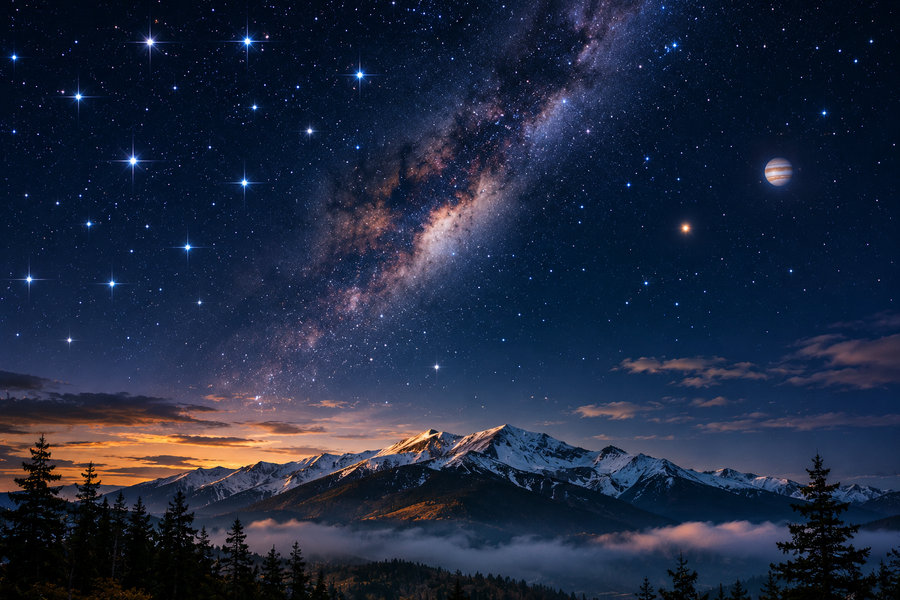
Look up on a clear night and you may notice something curious. Some points of light shimmer, flicker or briefly change colour, while others seem to shine with a remarkably steady glow. The difference is not random, and it can help you distinguish a distant star from a planet without using a telescope.
The familiar twinkling of stars is caused mainly by Earth's atmosphere. As light travels through moving layers of air, its path changes slightly before reaching our eyes. The effect is subtle, but over astronomical distances, it creates one of the night sky's most recognisable features.
Understanding why stars twinkle also reveals something fascinating about the relationship between light, distance and the atmosphere surrounding our planet.
What Makes Stars Twinkle?
Stars produce their own light through nuclear fusion occurring deep within their interiors. That light travels across enormous distances before eventually reaching Earth.
Although stars are physically immense, most are so far away that they appear as tiny points of light to the unaided eye.
Before reaching an observer on the ground, their light must pass through Earth's atmosphere.
The atmosphere is not a perfectly still or uniform layer. It contains regions of air with different temperatures, pressures and densities. These regions are constantly moving and mixing.
As starlight travels through them, it undergoes small changes in direction through a process called atmospheric refraction.
Because the atmosphere is continually changing, the light arriving at our eyes also fluctuates.
The result is a star that appears to brighten, dim, shift slightly or even change colour from moment to moment.
Scientists call this phenomenon atmospheric scintillation.
The star itself is not necessarily changing its brightness. Instead, the atmosphere alters how its light reaches us.
For a deeper explanation of how stars produce energy, read our guide to what a star is and how stars work.
Why Don't Planets Twinkle as Much?
Planets can appear similar to stars when viewed from Earth. Both may look like bright points against the darkness of space.
However, there is an important difference.
Stars are generally so distant that their light arrives from an extremely small apparent area. Most planets visible to the naked eye are much closer and have a larger apparent angular diameter.
Even when a planet looks like a single point, its light comes from a tiny disc rather than an almost point-like source.
Different parts of that disc send light through slightly different paths in Earth's atmosphere.
Atmospheric disturbances may affect those paths differently, but the fluctuations tend to average out when the light reaches our eyes.
This makes the planet's overall brightness appear more stable.
It is similar to the difference between observing a single tiny light through disturbed air and observing a broader illuminated surface.
The broader source is generally less affected by momentary fluctuations along any one path.
That is why Venus, Jupiter and Saturn often shine with a steadier glow than nearby stars.
However, planets are not completely immune to twinkling. Under certain atmospheric conditions, especially when they are low in the sky, they can flicker noticeably too.
Why Do Stars Twinkle More Near the Horizon?
You may have noticed that stars close to the horizon often shimmer more dramatically than stars high overhead.
This happens because their light must travel through a longer path in Earth's atmosphere before reaching an observer.
When a star is directly overhead, its light passes through a comparatively shorter column of air.
Near the horizon, the light travels at a shallow angle through a much greater thickness of atmosphere.
Along that path, it encounters more variations in temperature, density and air movement.
These disturbances increase the opportunity for atmospheric scintillation.
The effect can become especially noticeable on nights when the air is turbulent.
A bright star near the horizon may appear to flash between red, blue, green and white.
Although this display can look extraordinary, it is usually a natural optical effect rather than evidence of an unusual object in the sky.
Why Do Some Stars Appear to Change Colour?
Twinkling is not limited to changes in brightness. Under certain conditions, stars can also seem to flash different colours.
White starlight contains a range of wavelengths. When light passes through Earth's atmosphere, different wavelengths can be refracted by slightly different amounts.
Atmospheric turbulence causes the light's path to fluctuate, and the colour components may not always reach an observer in exactly the same way.
This can produce brief flashes of red, blue or green, particularly when a bright star is low above the horizon.
One familiar example is Sirius, the brightest star in Earth's night sky.
When Sirius appears low in the sky, it can seem to sparkle with rapidly changing colours.
Its intense brightness makes the effect especially noticeable.
The changing colours do not mean Sirius is rapidly altering its physical temperature or chemical composition.
They are largely produced by the atmosphere between the star and the observer.
Can You Tell a Star from a Planet by Watching It?
Twinkling provides a useful clue when identifying objects in the night sky, although it is not a perfect test.
On a relatively clear and stable night, a bright object that flickers rapidly is more likely to be a star.
An equally bright object that shines steadily may be a planet.
Venus and Jupiter are particularly good examples because they can become extremely bright and easy to recognise.
However, several factors can complicate the comparison.
A planet close to the horizon may twinkle because its light passes through a long, turbulent atmospheric path.
A star high overhead may appear relatively steady when atmospheric conditions are calm.
Brightness alone is not enough to identify an object reliably.
Its position, movement over successive nights and relationship to nearby constellations provide additional clues.
A sky map or astronomy application can help confirm whether you are observing a planet or a star.
For example, Proxima Centauri is the closest known star to the Sun, yet it is too faint to be seen with the unaided eye. Its proximity compared with other stars does not make it appear as a bright planet-like disc.
Why Do Stars Look Different from Space?
Astronauts observing stars from space do not experience the same atmospheric twinkling that people see from Earth's surface.
Outside the atmosphere, starlight does not have to travel through turbulent air before reaching an observer.
As a result, stars can appear much steadier.
This is one reason space telescopes are valuable for astronomy.
Ground-based telescopes must contend with atmospheric turbulence, which can blur images and reduce the sharpness of fine details.
Space telescopes operate above the atmosphere, avoiding this particular source of image distortion.
However, modern observatories on Earth have developed sophisticated methods to compensate for atmospheric effects.
One of the most important is adaptive optics.
These systems monitor distortions in incoming light and rapidly adjust optical components, often using deformable mirrors.
By correcting for atmospheric turbulence, astronomers can produce much sharper images of distant objects.
Adaptive optics does not eliminate every limitation of ground-based observation, but it has transformed what terrestrial telescopes can achieve.
What Is the Difference Between Twinkling and a Star's Real Brightness Changes?
Not every variation in a star's brightness is caused by Earth's atmosphere.
Some stars genuinely change in brightness over time.
Astronomers call these objects variable stars.
Their brightness can vary because of processes occurring within the star or because another object periodically blocks some of its light.
For example, certain stars expand and contract in regular cycles, causing measurable changes in their luminosity.
Other systems contain two stars orbiting one another. If one passes in front of the other from our viewpoint, the combined brightness can temporarily decrease.
These genuine variations are different from atmospheric scintillation.
Twinkling generally produces rapid, irregular fluctuations caused by the air above the observer.
Intrinsic or orbital brightness variations can follow measurable patterns over much longer periods.
Astronomers use repeated observations and precise measurements to distinguish between these effects.
This distinction matters because changes in stellar brightness can reveal valuable information about stellar structure, binary systems and other astronomical phenomena.
A Simple Night Sky Experiment
You can explore atmospheric scintillation without any specialist equipment.
Begin by choosing a clear evening when several bright stars and at least one visible planet are above the horizon.
First, find a bright star and watch it carefully for approximately thirty seconds.
Notice whether its brightness appears to fluctuate.
Next, observe a bright planet such as Jupiter or Venus, if one is visible.
Compare how steadily the two objects shine.
Then look for a bright star closer to the horizon and compare its appearance with a star positioned higher in the sky.
You may find that the lower star twinkles more noticeably.
Try repeating the experiment on different evenings.
Atmospheric conditions change from night to night, so the strength of the effect may vary.
For a more reliable comparison, avoid looking through windows, above hot rooftops or directly over sources of rising warm air.
These can introduce additional optical disturbances.
The experiment offers a simple demonstration of how Earth's atmosphere influences astronomical observations.
Why Twinkling Matters to Astronomers
To most people, twinkling is part of the beauty of the night sky.
For astronomers, however, atmospheric scintillation and related turbulence effects present practical challenges.
Rapid changes in the path of incoming light can make precise observations more difficult.
They can affect image sharpness, measurements of stellar brightness and observations of faint astronomical targets.
Professional observatories therefore pay close attention to atmospheric conditions.
Many are built at high elevations, where the atmosphere above the telescope is thinner and certain sources of turbulence can be reduced.
Astronomers also use specialised imaging techniques, adaptive optics and space-based instruments to improve observational accuracy.
The same atmospheric processes that make stars sparkle can therefore influence where observatories are built and how their instruments are designed.
The Science Behind a Familiar Sight
The next time you notice a star flickering in the night sky, remember that the star itself may be shining steadily.
The apparent fluctuations are often created during the final part of its light's journey, as it passes through Earth's moving atmosphere.
Planets generally appear steadier because their larger apparent discs allow atmospheric fluctuations to average out.
Yet the difference is not absolute. Atmospheric conditions, viewing angle and the apparent size of the object all play a role.
What seems like a simple visual detail reveals a surprisingly rich connection between astronomy, optics and the physical behaviour of our atmosphere.
Sometimes, one of the most interesting things about the universe is not what happens far away, but what happens to its light just before it reaches us.