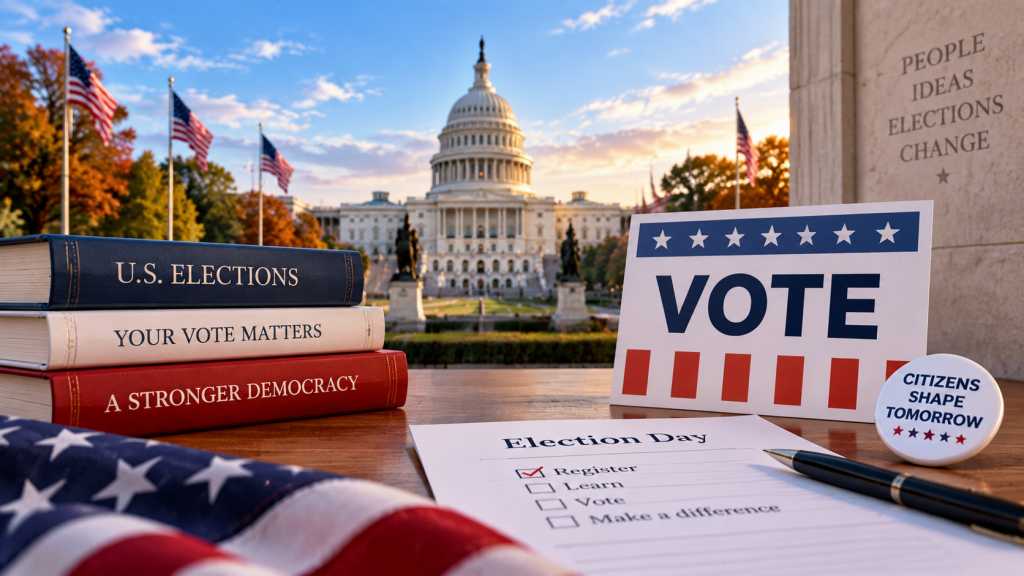
American elections can appear complicated, particularly to people who are unfamiliar with the country's political system.
Unlike countries where a single national election determines the government, the United States holds elections at federal, state and local levels. Voters choose a president, members of Congress, governors, state legislators and many other public officials.
The presidential election attracts the most international attention, but it operates differently from elections for Congress.
One reason is the Electoral College, a constitutional system in which the president is formally elected through votes cast by electors rather than directly by the nationwide popular vote.
Understanding American elections means looking at how candidates are nominated, how citizens vote and how the results become official.
How Do U.S. Elections Work?
The United States uses a system of representative democracy in which eligible voters elect people to hold public office.
However, there is no single election process that applies identically to every office.
Federal elections are governed by the Constitution and federal law, while states have substantial responsibility for election administration.
Local governments also conduct elections under their respective state laws.
The main types of elections are:
| Election | What voters choose | Typical schedule |
|---|---|---|
| Presidential | President and vice president through the Electoral College process | Every four years |
| House of Representatives | Members of the U.S. House | Every two years |
| Senate | U.S. senators | Six-year terms, with elections staggered |
| State | Governors, legislators and other state officials | Varies by state |
| Local | Mayors, councils and other local officials | Varies by jurisdiction |
The system reflects the constitutional division of authority between federal and state governments.
Our guide to the U.S. Constitution explains the foundations of this arrangement.
How Is the U.S. President Elected?
A presidential election takes place every four years.
Candidates generally begin campaigning well before Election Day, seeking support within their political parties and among voters.
The process involves several stages, including primaries, party conventions, the general election and the Electoral College.
Although voters see presidential candidates' names on their ballots, they are participating in a process that selects electors.
Those electors formally cast votes for president and vice president.
The winning candidate must normally secure a majority of the Electoral College votes.
This makes presidential elections different from most other American elections.
What Are Primaries and Caucuses?
Before the general election, political parties must select their candidates.
Primary elections and caucuses help determine who will receive a party's nomination.
In a primary, voters cast ballots according to the rules established by the state and political party.
Some states allow broader participation, while others restrict voting in certain primaries based on party affiliation.
Caucuses are generally organised by political parties and may involve meetings or other procedures for expressing candidate preferences.
During presidential nomination contests, candidates compete for delegates who participate in national party conventions.
The exact rules vary between parties and states.
Winning a primary does not automatically make someone president. It is part of the process of becoming a party's nominee.
What Happens at a National Party Convention?
Major political parties hold national conventions to formally nominate their presidential and vice-presidential candidates.
Delegates participate according to party rules.
By the time a convention begins, the outcome of the nomination contest is often already clear.
Conventions also allow parties to present their policy priorities and organise support for the general election.
Independent candidates and smaller political parties may follow different nomination procedures.
Their ability to appear on ballots depends on applicable state requirements.
What Is the Electoral College?
The Electoral College is the constitutional process used to elect the American president and vice president.
It is not a building or a permanent assembly that meets throughout the year.
Each state receives a number of electors equal to its total representation in Congress.
That means the number is based on the state's members of the House of Representatives plus its two senators.
The District of Columbia also receives three electoral votes under the Twenty-Third Amendment.
There are currently 538 electoral votes in total.
A candidate normally needs at least 270 to win.
<escape>| Electoral College | Number |
|---|---:|
| Total electoral votes | 538 |
| Majority required to win | 270 |
| Electoral votes for Washington, D.C. | 3 |</escape>
In most states, the presidential candidate who wins the statewide popular vote receives all of that state's electoral votes.
Maine and Nebraska use a different allocation system, awarding some electoral votes according to congressional district results.
This means the distribution of votes across states matters greatly in a presidential campaign.
Popular Vote vs. Electoral Vote: What's the Difference?
The popular vote is the total number of individual votes cast for a candidate.
The electoral vote is the number of votes received through the Electoral College.
These totals measure different things.
A presidential candidate can receive more votes nationwide but still lose the election if another candidate wins enough electoral votes.
This has happened several times in American history, including in 2000 and 2016.
For example, imagine Candidate A wins several states by very large margins, while Candidate B narrowly wins enough other states to secure 270 electoral votes.
Candidate A might have more votes nationwide, but Candidate B would win the presidency.
This is why presidential campaigns devote considerable attention to states where the outcome is uncertain.
The system remains controversial, with supporters and critics disagreeing over how presidential representation should work.
What Happens on Election Day?
Federal general elections take place on the Tuesday following the first Monday in November of even-numbered years.
Presidential elections occur every four years.
On Election Day, eligible voters cast ballots for the offices and candidates appearing in their jurisdiction.
Depending on state law, voters may also have opportunities to vote before Election Day.
These can include early in-person voting and absentee or mail voting.
The procedures differ between states, including registration deadlines, identification requirements and ballot-processing rules.
Voters should check official state or local election information rather than assume that rules are identical nationwide.
Who Can Vote in U.S. Elections?
Eligibility depends on the type of election and applicable law.
For federal elections, voters generally must be U.S. citizens, meet the minimum voting age and satisfy state residency and registration requirements.
The Twenty-Sixth Amendment prohibits denying or abridging the right to vote on account of age for citizens aged 18 or older.
Other eligibility rules, including those involving certain criminal convictions, vary by state.
Most states require voter registration, although North Dakota does not use conventional voter registration.
Some states permit same-day registration, while others require voters to register before a deadline.
Because these rules can change, official election offices are the most reliable source for individual voting requirements.
How Are Votes Counted and Results Certified?
After voting ends, election officials count ballots according to state procedures.
The process may include checking ballot eligibility, processing mail ballots and reviewing provisional ballots.
Unofficial results are often available on election night.
News organisations may project winners based on reported results and statistical analysis.
However, a media projection is not an official certification.
Election authorities must complete the required canvassing and verification procedures before results become final under applicable law.
Close elections may involve recounts or legal challenges.
These procedures exist to verify results and resolve disputes.
A delay in counting does not, by itself, establish that an election has been conducted improperly.
What Happens After the Presidential Election?
The presidential election continues after November.
States complete their procedures for appointing electors based on the election results.
In December, the electors meet in their respective states to cast votes for president and vice president.
Congress then meets in a joint session in January to count the electoral votes.
Under the current statutory framework, the vice president's role while presiding over the count is ministerial rather than a power to determine the result independently.
The newly elected president and vice president are inaugurated on 20 January.
If no presidential candidate receives an Electoral College majority, the Twelfth Amendment provides for a contingent election in the House of Representatives.
In that situation, the House votes by state delegation, with each state receiving one vote.
This is an unusual procedure rather than the normal method of electing a president.
How Do Congressional Elections Work?
Congress consists of two chambers: the House of Representatives and the Senate.
Voters elect House members to represent congressional districts.
Every House seat is contested every two years.
Senators represent entire states and serve six-year terms.
Senate elections are staggered so that approximately one-third of seats are normally contested every two years.
Unlike the presidential election, these contests do not use the Electoral College.
The winners are determined under the applicable popular-vote election rules.
The distinction between the chambers matters because both must generally approve federal legislation.
Read our comparison of the House of Representatives and Senate for more detail.
What Are Midterm Elections?
Midterm elections take place halfway through a president's four-year term.
They do not include a presidential election, but they determine all House seats and the Senate seats scheduled for that election cycle.
Many states also hold gubernatorial, legislative and local elections at the same time.
Midterms can change which political party controls the House or Senate.
That matters because Congress plays a central role in legislation, federal spending and oversight.
A president whose party does not control Congress may need to negotiate more extensively to pass major legislation.
The next regularly scheduled federal midterm elections are on 3 November 2026.
For context on congressional authority, see why the U.S. government has three branches.
Why Do Election Rules Vary Between States?
American elections are decentralised.
The Constitution gives states significant responsibilities in election administration, while federal law establishes important nationwide requirements.
States and local authorities organise polling places, maintain voter records, prepare ballots and administer counting procedures.
This produces differences in early voting, registration, identification requirements and recount rules.
The variation reflects the broader principle of federalism.
States retain important powers, but they must operate within applicable federal constitutional and statutory limits.
Our article on federal versus state government explains how these responsibilities are divided.
Why Are Some States Called Swing States?
A swing state, sometimes called a battleground state, is one where the presidential result is considered competitive.
Campaigns often concentrate resources in these states because winning them could change the Electoral College outcome.
States that consistently favour one party may receive less campaign attention during a particular election.
However, political preferences can change over time.
A state considered safe for one party in one election may become more competitive in a later cycle.
The term swing state is a political description, not an official constitutional category.
Frequently Asked Questions
How often are U.S. presidential elections held?
Presidential elections take place every four years, on the Tuesday after the first Monday in November.
How many electoral votes are needed to become president?
A candidate normally needs at least 270 of the 538 Electoral College votes.
Can a candidate win the popular vote but lose the presidency?
Yes. The Electoral College determines the presidency, so the national popular-vote winner does not always win.
What is the difference between a primary and a general election?
A primary helps select a party's nominee. The general election determines who wins the office.
Who runs elections in the United States?
State and local election authorities administer most elections under applicable state and federal laws.
When are the next U.S. midterm elections?
The next regularly scheduled federal midterm elections take place on 3 November 2026.
Final Thoughts
U.S. elections are not one uniform national process.
They combine federal constitutional requirements with state and local election administration.
Voters elect members of Congress, state officials and local representatives through different electoral arrangements.
Presidential elections are distinctive because the final result is determined through the Electoral College.
Primaries help select nominees, general elections determine winners and official procedures establish the certified results.
Understanding these stages makes American politics easier to follow, particularly during presidential campaigns and congressional midterms.
It also explains why voting rules, election timelines and campaign strategies can differ so substantially across the country.
Sources and Further Reading
USAGov — Overview of the Presidential Election Process
Official explanation of primaries, conventions, the general election and inauguration.
USAGov — Electoral College
Explanation of electoral votes, the 270-vote majority and state allocation rules.
USAGov — Presidential General Election
Information on voting and the presidential general election.
USAGov — Voting and Elections
Official guidance on registration, voting procedures and election offices.
National Archives — What Is the Electoral College?
Historical and constitutional background on the Electoral College.
National Archives — Electoral College Results
Official historical Electoral College records and election results.