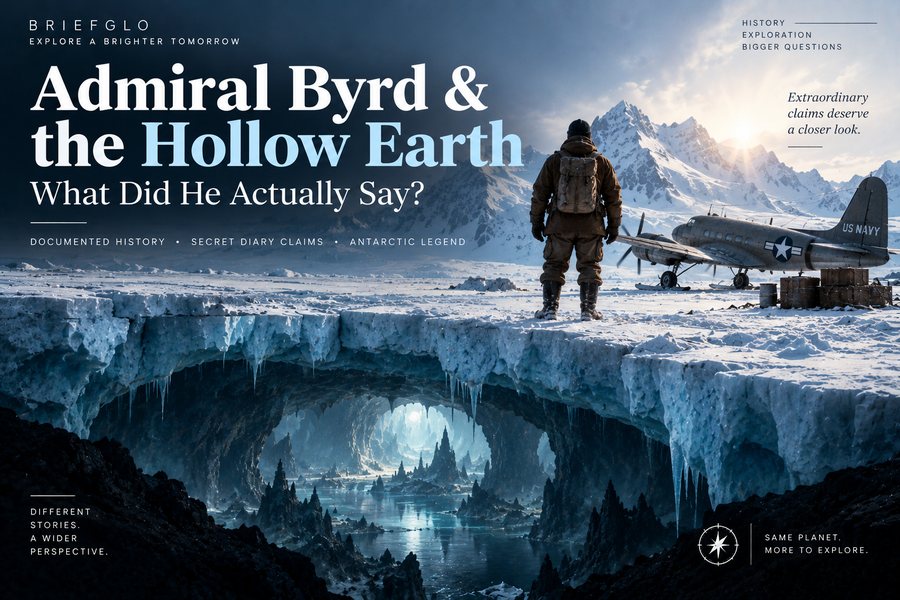
Few names appear as often in Antarctica Hollow Earth stories as Admiral Richard E. Byrd.
According to one version of the legend, Byrd flew beyond the polar ice and entered a hidden region with mountains, vegetation and an advanced civilisation. In other versions, he discovered an entrance to the interior of Earth and was warned by mysterious inhabitants about humanity's technological future.
The story is dramatic, detailed and endlessly repeated online.
Byrd himself was certainly real. So were his Antarctic expeditions, his aircraft and his role in twentieth-century polar exploration.
His papers, photographs, correspondence and expedition records are preserved in major archives.
The difficult question is not whether Byrd explored Antarctica.
It is whether the extraordinary Admiral Byrd Hollow Earth story can be traced to the same historical record.
That requires separating three things that are frequently blended together: Byrd's documented expeditions, genuine archival material and later texts attributed to him.
Who Was Admiral Richard E. Byrd?
Richard Evelyn Byrd was an American naval officer, aviator and polar explorer who became one of the best-known figures in twentieth-century exploration.
His career included expeditions to both polar regions and extensive work in Antarctica.
During his first Antarctic expedition of 1928–30, Byrd established a base known as Little America and used aircraft, radio and motorised transport to support exploration and scientific work.
On 29 November 1929, Byrd and his crew completed their famous flight over the South Pole.
The expedition also helped map previously poorly documented areas of Antarctica.
Ohio State University's Polar Archives, which preserves the Richard E. Byrd Papers, describes his expeditions as important in moving Antarctic exploration into a new technological era using aircraft, radio communication and motorised vehicles.
None of this is obscure history.
Byrd's Antarctic career generated books, photographs, films, correspondence and extensive expedition documentation.
That makes the later mystery particularly interesting.
What Is the Admiral Byrd Hollow Earth Story?
The popular version usually begins with a supposed flight into unknown territory.
Byrd allegedly travels beyond the expected polar landscape and begins seeing conditions that should not exist there.
Depending on the version, descriptions may include green land, animals, unusual atmospheric conditions or advanced flying craft.
Eventually, Byrd supposedly encounters an advanced civilisation living inside Earth.
A text commonly presented as Admiral Byrd's secret diary is often cited as the source.
It describes an extraordinary journey and a meeting with beings possessing technology far beyond that of surface civilisation.
This narrative has become deeply connected with modern Hollow Earth culture.
It is also frequently combined with Agartha, polar openings, UFOs and secret Antarctic bases. The wider mythology is explored in our article on Agartha and Antarctica, which traces how stories of an underground civilisation became associated with the polar regions.
But repeating a document under a famous person's name is not the same thing as establishing its provenance.
Did Admiral Byrd Really Keep Diaries?
Yes.
This is where the subject can become confusing.
Authentic Byrd diaries and notebooks exist.
Ohio State University holds the Richard E. Byrd Papers, a major archival collection containing historical records associated with the explorer. Its Polar Archives specifically collects material including letters, diaries, photographs and expedition records.
In 1996, Ohio State announced the discovery of an important Byrd diary within its archives.
The notebook contained material connected with Byrd's 1926 North Pole flight and later Antarctic activities.
Its discovery attracted scholarly attention because historians could examine the physical notebook, its context and Byrd's navigation records.
That is what archival provenance looks like.
A document can be physically examined, placed within a collection and compared with related historical material.
The existence of genuine Byrd diaries, however, does not mean every text labelled “The Secret Diary of Admiral Byrd” has the same provenance.
That distinction is essential.
What About the Famous “Secret Diary”?
The alleged Hollow Earth diary should be distinguished from Admiral Byrd's authenticated notebooks preserved in university archives.
The widely circulated text describes a supposed flight over the North Pole on 19 February 1947, during which Byrd allegedly encountered a warm landscape, unusual aircraft and an advanced civilisation inside Earth.
However, the document has no established archival provenance linking it to Byrd. One organisation distributing the text, the Hollow Earth Research Society, states that its director received a copy from an unidentified intermediary in 1984.
There is also a significant chronological problem. During February 1947, Byrd was involved in Operation Highjump in Antarctica. Official US Navy records describe the evacuation of his expedition party from Little America later that month.
These facts do not establish the diary's precise author, but they provide strong reasons to question its attribution and the events it describes.
A genuine historical diary can be traced through identifiable records, manuscript evidence and a credible chain of custody. Until those requirements are met, the alleged 1947 Hollow Earth diary should be treated as an unverified text rather than proof of an extraordinary polar discovery.
Did Byrd Discover Warm Land Beyond Antarctica?
Another quotation frequently associated with Byrd claims that he discovered a mysterious land beyond the pole.
Versions of the story sometimes describe a huge unexplored region with a warmer climate or conditions unlike the Antarctic environment.
Here again, wording and context matter.
Polar explorers genuinely did fly over previously uncharted or poorly mapped territory.
From the perspective of early twentieth-century exploration, finding landscapes that were absent from existing maps was not unusual.
Byrd's expeditions contributed to mapping large areas of Antarctica, and his archival record contains extensive material documenting that exploration.
But “previously unexplored land” and “land inside the Earth” are not interchangeable descriptions.
The first belongs to the history of geographical exploration.
The second is an extraordinary geological claim.
Moving from one to the other requires evidence that the historical record does not automatically provide.
Was Byrd Talking About the North Pole or Antarctica?
This is another source of confusion in online retellings.
Byrd's career involved both Arctic and Antarctic exploration.
His controversial 1926 flight concerned the North Pole, while his famous 1929 flight concerned the South Pole.
The two events are sometimes mixed together in modern Hollow Earth discussions.
The 1926 North Pole flight itself has generated a genuine historical debate over whether Byrd and pilot Floyd Bennett actually reached the pole.
The authentic diary discovered in Ohio State's archives became important evidence in that debate.
Ohio State reported that the notebook indicated Byrd believed he had reached the pole, while subsequent analysis questioned whether the aircraft had actually travelled far enough to do so.
That controversy is interesting precisely because researchers can inspect authentic evidence and debate its interpretation.
It should not be confused with evidence for Hollow Earth.
Where Does Operation Highjump Fit In?
Byrd returned to Antarctica in connection with Operation Highjump, the large U.S. Navy Antarctic expedition of 1946–47.
This operation has become one of the most important foundations of modern Antarctic conspiracy stories.
In the alternative narrative, Highjump is sometimes portrayed as a military mission against unknown flying craft or a hidden Antarctic civilisation.
Byrd's involvement then becomes connected with his supposed knowledge of Hollow Earth.
The historical operation certainly involved military personnel, ships and aircraft.
That alone does not establish the more extraordinary version of events.
Large government operations naturally produce documents, logistics, unusual equipment and incomplete public understanding — exactly the conditions in which later legends can flourish.
Operation Highjump therefore deserves to be examined using its own surviving records rather than treated as proof simply because Byrd participated in it.
That will be the next stage of this series. For a closer look at the historical records, our investigation into Operation Highjump and UFO claims examines what the US Navy expedition actually involved and how later stories became associated with it.
Did Byrd Encounter UFOs?
There is no authenticated evidence in the archival material cited here establishing that Byrd encountered extraterrestrial spacecraft or entered an advanced underground civilisation.
This does not mean every unusual observation reported during polar exploration can automatically be explained. The same distinction between an unidentified observation and evidence of extraterrestrial technology is important throughout the wider UFO debate.
It means the specific claim requires evidence appropriate to its scale.
UFO stories associated with Byrd often emerge through the same network of later material that connects him with the Hollow Earth diary.
Once several uncertain claims are repeated together, they can appear to corroborate one another.
But multiple retellings of a story do not necessarily represent multiple independent sources.
For historical investigation, independence of evidence matters.
Why Is the Byrd Story So Convincing?
Part of its power comes from the fact that it begins with a real person whose life was already extraordinary.
Byrd really flew aircraft across polar regions.
He really explored Antarctica.
He really kept diaries.
He really participated in major expeditions.
And his papers really are preserved in an extensive archive.
That creates a strong factual foundation.
The legend then adds increasingly extraordinary layers to it.
A hidden diary sounds plausible because Byrd kept genuine diaries.
A mysterious Antarctic flight sounds plausible because Byrd conducted genuine Antarctic flights.
A secret polar discovery sounds plausible because much of Antarctica genuinely remained poorly mapped during his era.
The story therefore does not need to invent everything.
It only needs to attach extraordinary claims to authentic history.
That is one reason it has survived for so long.
What Do Byrd's Real Archives Contain?
Ohio State University's Polar Archives preserves one of the world's major collections relating to Byrd and polar exploration.
The institution states that the collection contains Byrd's papers and other documentation relating to his expeditions.
Its published bibliography points researchers towards Byrd's own works including Little America, Exploring with Byrd and articles about his Antarctic exploration.
The archives continue to acquire material connected with Byrd.
In 2024, Ohio State announced the acquisition of additional documents relating to Byrd's time alone at Advance Base during his second Antarctic expedition.
The collection included more than 1,200 pages of manuscript and typescript drafts connected with the book Alone, providing researchers with insight into how Byrd's published account was developed.
This is useful because it demonstrates that Byrd's historical record is not inaccessible.
There is a substantial body of material available for serious research.
History Is More Interesting When the Sources Remain Visible
Admiral Byrd does not need a secret civilisation to be an extraordinary historical figure.
His expeditions took aviation into environments where mechanical failure could quickly become fatal. His teams helped map parts of Antarctica during an era when enormous areas remained poorly documented.
Those achievements are supported by surviving records.
The Admiral Byrd Hollow Earth story belongs to a different evidential category.
A famous text attributed to Byrd describes an extraordinary hidden world, but attribution alone is not enough to establish that Byrd wrote it or experienced the events it describes.
That distinction does not destroy the mystery.
It tells us where the mystery actually is.
The most useful question is therefore not simply whether we believe Byrd entered the Hollow Earth.
It is:
Can the extraordinary story be traced through authenticated historical evidence?
Byrd's historical legacy remains remarkable without the addition of an unverified hidden-world narrative. His documented expeditions deserve attention in their own right, while the alleged secret diary remains a useful example of why extraordinary historical claims require authenticated evidence.
Sources and Further Reading
- Ohio State University Libraries — Byrd Polar and Climate Research Center Archival Program
- Ohio State University Libraries — Admiral Richard E. Byrd Papers
- Ohio State University — Byrd Diary Found in Archives (1996)
- Ohio State University Libraries — Explore the Polar Archives
- Ohio State University Libraries — Polar Archives Acquires New Collection (2024)