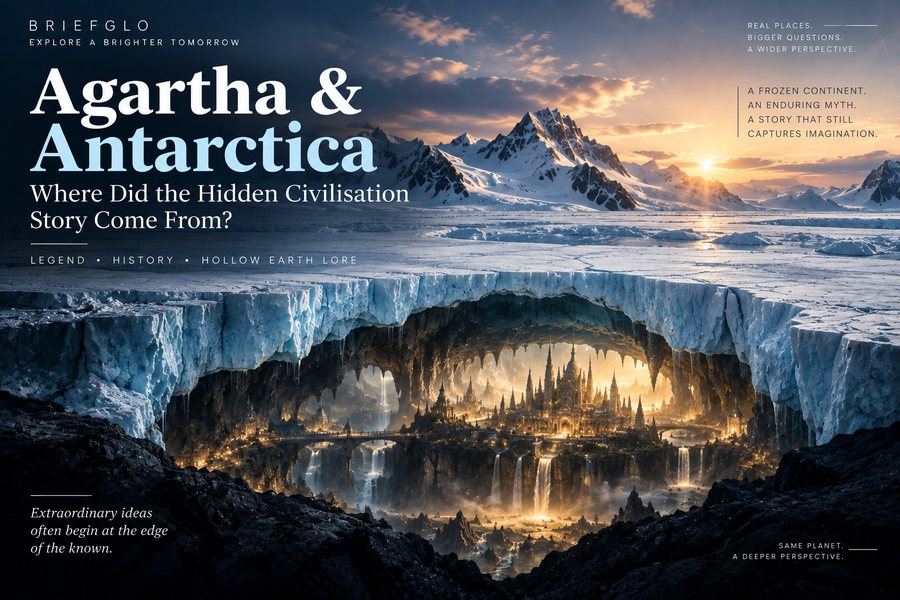
Search for Agartha Antarctica today and you enter one of the internet's strangest geographical mysteries.
Some versions describe an enormous civilisation beneath Antarctica. Others speak of tunnels stretching through the planet, technologically advanced inhabitants, entrances hidden beneath the polar ice or a secret kingdom connected with the wider Hollow Earth.
The imagery is powerful: an ancient city glowing beneath kilometres of Antarctic ice, isolated from surface civilisation for thousands of years.
There is only one problem.
The historical story of Agartha did not begin as a documented discovery beneath Antarctica.
Its path into modern Hollow Earth culture is far more complicated — passing through nineteenth-century esoteric writing, Central Asian legends, later occult literature and eventually the internet.
Understanding that history does not make the story less fascinating.
It reveals how a mysterious kingdom associated with Asia became, generations later, a supposed civilisation beneath the most remote continent on Earth.
What Is Agartha?
Agartha — also written Agarttha, Agharta or Agartha — is the name given to a mysterious hidden realm in several strands of modern esoteric literature. The idea belongs to a much wider tradition of stories about hidden civilisations beneath the Earth's surface.
One of the most influential Western descriptions appeared in the work of French esoteric writer Alexandre Saint-Yves d'Alveydre.
His Mission de l'Inde en Europe described Agarttha as an extraordinary subterranean centre with its own social, intellectual and spiritual order.
Modern editions of the work describe Saint-Yves's Agarttha as existing beneath the Himalayan region rather than Antarctica.
That detail matters.
The Agartha Antarctica connection familiar from social media is therefore not simply the original story transplanted unchanged from an ancient map.
It is the result of different traditions gradually being combined.
Where Did the Agartha Story Come From?
The history becomes difficult because there is no single Agartha narrative.
Saint-Yves was writing within a nineteenth-century European esoteric environment fascinated by hidden knowledge, ancient civilisations and alternative interpretations of history.
His account became influential in later occult literature.
Other writers subsequently developed related ideas.
An earlier figure worth mentioning is Louis Jacolliot, a French writer whose 1873 book Les Fils de Dieu referred to a legendary place called Asgartha. His account was not identical to the underground kingdom later described by Saint-Yves, but it helps trace how the name and associated ideas entered nineteenth-century European literature.
Saint-Yves subsequently developed a far more elaborate vision of Agarttha, presenting it as a hidden centre of spiritual and political authority. His manuscript was written in the nineteenth century but published posthumously in 1910.One particularly important figure was Ferdinand Ossendowski, a Polish writer and traveller whose 1922 book Beasts, Men and Gods described stories he said he encountered while travelling through Mongolia and Central Asia.
The book included accounts of a subterranean kingdom and a mysterious ruler often translated as the King of the World.
French intellectual René Guénon later discussed similarities between Ossendowski's account and Saint-Yves's Agarttha in The King of the World.
By this stage, the idea was already evolving.
Rather than representing a single archaeological tradition, Agartha had become part of a broader network of stories about hidden centres of civilisation, spiritual authority and inaccessible underground realms.
Is Agartha the Same as Shambhala?
They are often treated as the same place online, but that can oversimplify very different traditions.
Shambhala has roots in Tibetan Buddhist tradition and is particularly associated with the Kalachakra teachings.
Agartha, as it became known in Western esoteric literature, developed through a different historical route.
Later writers sometimes connected or identified the two.
That does not mean every traditional account of Shambhala describes a literal underground city called Agartha.
This distinction is especially important when discussing religious and cultural traditions.
Modern Hollow Earth imagery can borrow names and concepts from older traditions while substantially changing their original meanings.
The result may be compelling mythology, but it should not be presented as straightforward historical evidence.
How Did Agartha Become Connected With the Hollow Earth?
The connection becomes easier to understand when Agartha is placed beside the wider history of Hollow Earth theories.
Long before modern internet discussions, writers had proposed various models in which the interior of Earth contained enormous spaces or even inhabited regions.
John Cleves Symmes Jr., for example, promoted a nineteenth-century model of a hollow and habitable Earth with openings around the polar regions.
Other authors later produced their own versions.
The Library of Congress records an extensive history of books both advocating and criticising Hollow Earth concepts.
Once stories of underground kingdoms met theories of an inhabited planetary interior, the combination was almost inevitable.
Agartha could now be imagined not merely as a hidden spiritual centre, but as an actual civilisation somewhere inside Earth.
From there, another question appeared:
Where was the entrance?
Why Did Antarctica Enter the Story?
Antarctica offered an almost perfect setting.
It was remote, poorly understood by earlier generations and covered by an immense ice sheet.
Meanwhile, some versions of Hollow Earth theory already placed entrances near Earth's poles.
As Antarctic exploration expanded during the twentieth century, the continent accumulated another layer of mystery.
Explorers travelled into regions few people would ever see.
Military expeditions operated there.
Aircraft mapped previously poorly documented terrain.
And scientists gradually discovered mountains, valleys and lakes beneath the ice.
None of those facts demonstrate the existence of Agartha.
But together they created an environment in which older Hollow Earth stories could acquire a new geographical home.
The transition from Agartha beneath Asia to Agartha beneath Antarctica appears far more clearly in modern speculative culture than in the influential nineteenth-century description associated with Saint-Yves.
Did Explorers Find an Entrance to Agartha in Antarctica?
There is no verified evidence that an Antarctic expedition discovered an entrance to Agartha.
This is where Admiral Richard E. Byrd frequently enters the story.
Byrd was a genuine polar explorer whose Antarctic career is extensively documented.
He was also involved in the U.S. Navy's Operation Highjump expedition of 1946–47.
Later Hollow Earth narratives attributed much more extraordinary experiences to him, including journeys into a warm land beyond the pole and encounters with an advanced civilisation.
These claims are often linked to texts presented online as Byrd's secret diary.
The existence of Byrd, his flights and his Antarctic expeditions is historical fact.
That does not automatically authenticate every document or quotation subsequently attributed to him.
The distinction is explored in our article on Admiral Byrd and the Hollow Earth, which examines his documented expeditions and the disputed secret diary attributed to him.
What Is Actually Beneath Antarctica?
Something genuinely remarkable.
Antarctica is not simply a flat block of ice.
Beneath its ice sheet are mountain ranges, valleys, basins, lakes and complex geological structures.
Modern radar, seismic observations, gravity measurements and satellite data allow scientists to investigate terrain that cannot normally be seen from the surface.
This hidden geography can sometimes sound surprisingly similar to the language of old underground-world stories.
But there is an important distinction.
A landscape hidden beneath ice is not the same thing as a civilisation hidden inside Earth.
No accepted geological or archaeological evidence currently demonstrates the existence of a vast technologically advanced city beneath Antarctica.
The continent still contains scientific unknowns, but an unanswered question should not automatically be converted into evidence for a particular explanation. Our guide to what lies beneath Antarctica's ice looks more closely at the lakes, mountains and geological structures scientists have actually identified beneath the frozen surface.
Why Do Images of “Agartha Entrances” Keep Appearing?
Satellite imagery has transformed the way modern myths spread.
Antarctica contains enormous crevasses, exposed rock formations, unusual mountains, ice caves and shadows that can appear dramatically different depending on lighting and viewing angle.
A single screenshot can therefore look like an entrance, doorway or artificial structure.
Once such an image receives a caption claiming it shows the entrance to Agartha in Antarctica, the interpretation can travel much farther than the original geographical context.
The problem is that visual resemblance alone does not identify a geological feature.
Researchers need coordinates, imagery from different dates and angles, geological information and preferably independent observations before determining what a feature actually represents.
A mysterious-looking photograph can be interesting.
It is not automatically archaeological evidence. Similar claims are examined in our investigation into alleged alien bases in Antarctica, including how unusual satellite images can be mistaken for artificial structures.
Are There Ancient Cities Under Antarctic Ice?
No confirmed ancient city beneath the Antarctic ice sheet has been discovered.
That does not mean Antarctica has always looked exactly as it does today.
The continent has experienced dramatically different climates across geological time. Fossils and geological evidence show that Antarctica once supported environments very different from its modern frozen landscape.
But geological evidence for warmer ancient Antarctica is not evidence for an advanced lost civilisation.
The two claims require completely different forms of proof.
Discovering fossil forests, ancient sediments or buried landscapes can tell scientists about Earth's climatic and geological past.
Discovering a civilisation would require archaeological evidence: structures, artefacts or other material traces that could be independently examined and dated.
So far, the evidence does not establish an Antarctic Agartha.
Why Does the Agartha Antarctica Story Remain So Popular?
Because it combines several powerful ideas.
There is the appeal of a lost civilisation.
There is the mystery of unexplored territory.
There is the possibility of knowledge hidden from the surface world. Modern speculation about unknown intelligent societies surviving unnoticed on Earth has even produced ideas such as the cryptoterrestrial hypothesis.
And then there is Antarctica itself — distant enough from everyday experience that extraordinary stories can feel difficult to disprove simply by looking outside.
Modern social media adds another ingredient.
A nineteenth-century esoteric text, a twentieth-century polar expedition, a satellite image and a modern UFO story can be placed beside one another within seconds.
The result looks like one continuous historical narrative.
Often, it is not.
The individual pieces may come from completely different periods and sources.
Legend, History and Evidence
Agartha remains an intriguing part of the history of esoteric and Hollow Earth literature.
Its development also demonstrates how myths evolve.
Saint-Yves's underground kingdom became entangled with later accounts of Central Asian hidden realms. Hollow Earth writers supplied planetary interiors and polar openings. Antarctica supplied an extraordinary real-world landscape. Later conspiracy culture added Admiral Byrd, Operation Highjump, UFOs and secret technology.
The modern Agartha Antarctica story emerged from that mixture.
There is currently no verified evidence that a hidden civilisation called Agartha exists beneath Antarctica.
But tracing how the idea developed reveals something equally interesting: extraordinary stories do not need to remain unchanged in order to survive.
They adapt to new discoveries, new technologies and new mysteries.
And in the Antarctic version of this story, one historical figure appears again and again.
What did Admiral Byrd actually say about Antarctica — and where did the story of his supposed journey into the Hollow Earth come from?
Sources and Further Reading
- Theosophical Society in America — The Kingdom of Agarttha: A Journey into the Hollow Earth
- René Guénon — The King of the World, Chapter I: Western Ideas About Agarttha
- Library of Congress — Hollow Earth Theories: A List of References
- Library of Congress — Works by Proponents and Opponents of Hollow Earth Theories
- British Antarctic Survey — Bedmap3: Bed Topography of Antarctica