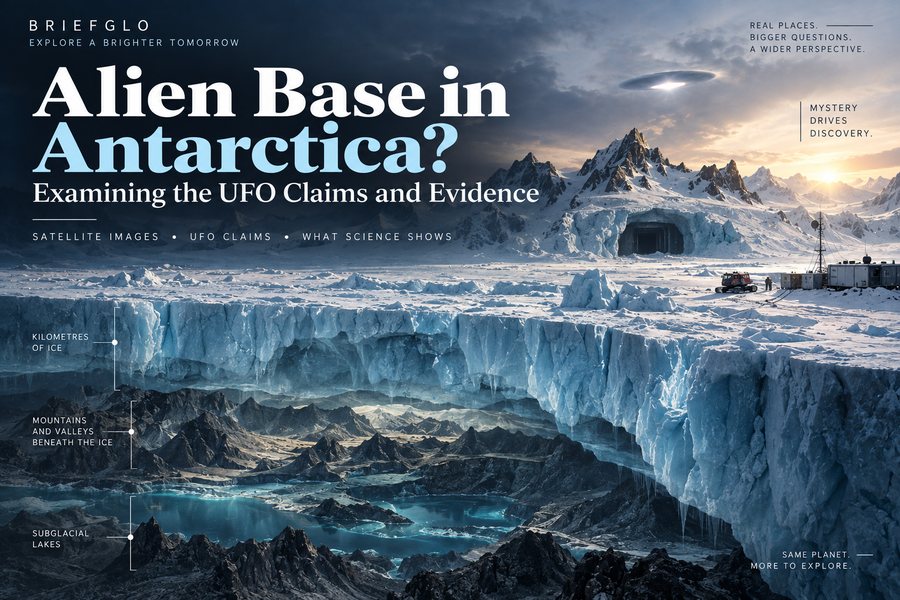
Is There an Alien Base in Antarctica? Examining the UFO Claims and Evidence
Antarctica remains one of the few places on Earth where the landscape still feels genuinely unfamiliar. Vast ice sheets cover mountain ranges, research teams work in extreme isolation, and satellite images occasionally reveal formations that seem difficult to explain at first glance.
That isolation has helped fuel a persistent question: could an alien base exist somewhere beneath the Antarctic ice?
Online theories point to dark openings in mountains, pyramid-shaped peaks and unusual objects visible on satellite maps. Some accounts also connect these features to military expeditions and stories about underground civilisations.
Yet an unusual image is not necessarily evidence of an extraordinary discovery. Understanding the Antarctica alien base theory requires looking closely at what the images show, how the landscape behaves and what scientists can actually verify.
Why Do People Believe There Is an Alien Base in Antarctica?
Antarctica provides an unusually convincing setting for stories about hidden structures.
Most of the continent is covered by ice, while its interior remains difficult and expensive to access. Even experienced researchers depend on satellite observations, aircraft surveys and specialised instruments to investigate large areas.
This creates a gap between what people can see and what they can confidently explain.
A dark shape on a mountain may resemble a tunnel entrance. A sharply pointed summit might look like a constructed pyramid. A partially buried object can appear to have an artificial outline.
These observations are worth examining, but their appearance alone cannot establish their origin.
The difficulty is not that Antarctica lacks mysteries. It is that its natural environment can produce features that are easily misinterpreted.
What Do the Satellite Images Actually Show?
Many Antarctica UFO theories begin with screenshots from digital mapping platforms.
Some images appear to show enormous openings in the ice. Others highlight geometric shapes, unusual shadows or features that resemble aircraft.
The problem is that a screenshot often provides too little information for a reliable identification.
Researchers need to know the precise coordinates, image date, resolution and viewing conditions. They also need access to the original imagery rather than a cropped or heavily enhanced version.
Without that information, an apparent structure might be a rock formation, a crevasse, a shadow or an image-processing artefact.
Satellite images are valuable scientific tools, but they are not always straightforward photographs. Different datasets may be combined, and image processing can change how terrain appears.
A convincing investigation should therefore begin with the original location and independent observations, not the most dramatic interpretation of a viral picture.
Are There Really Giant Entrances Beneath Antarctic Mountains?
Antarctica contains genuine caves, fractures and openings formed through natural processes.
Glaciers are constantly moving, even when their movement is almost impossible to notice from the surface. As ice flows over uneven terrain, stress can produce deep crevasses.
Rock faces, wind erosion and changing snow cover can also create striking visual patterns.
In volcanic regions, geothermal activity may influence the surrounding ice and produce unusual environments.
From a satellite's perspective, a deep shadow surrounded by bright snow can look like an entrance into a much larger structure.
The appearance becomes even more misleading when the image lacks a clear reference for scale.
This does not mean every unusual formation has been conclusively explained. It means that identifying an opening is only the beginning of an investigation, not proof of a constructed facility.
The Real Hidden Landscape Beneath Antarctica
The most extraordinary features of Antarctica are not necessarily visible on its surface.
Scientific surveys have revealed mountains, valleys, deep basins and lakes beneath the Antarctic Ice Sheet.
Researchers use radar, seismic measurements and satellite observations to reconstruct this buried landscape.
One example is the Gamburtsev Subglacial Mountains, a mountain system concealed beneath the East Antarctic Ice Sheet.
Their existence demonstrates how much geological complexity can remain hidden beneath kilometres of ice.
Mapping projects such as Bedmap2 have helped scientists build more detailed pictures of the continent's underlying terrain.
These discoveries explain why Antarctica attracts speculation, but they also show the difference between a measurable scientific finding and an unsupported claim.
A mountain buried beneath the ice is remarkable. It is not, by itself, evidence of an underground civilisation. For a broader look at the continent's geology, see our guide to what lies beneath Antarctica's ice, including subglacial lakes, buried mountains and unusual satellite imagery.
What About Antarctica's Mysterious Pyramid?
One of the most widely shared Antarctic images shows a mountain with steep, relatively symmetrical faces.
Its shape has encouraged claims that it could be an ancient pyramid or a structure built by an unknown civilisation.
However, natural mountains can develop surprisingly geometric appearances.
Erosion, glacial activity and weathering can produce sharp ridges and angular peaks. Similar formations exist in other mountainous regions around the world.
The Antarctic formation commonly featured in these stories belongs to the Ellsworth Mountains.
There is no verified archaeological evidence establishing that the mountain was constructed by humans or extraterrestrial beings.
Its unusual shape is a reason to examine the geology, not a sufficient reason to declare it artificial.
Could a Secret Base Remain Hidden Beneath the Ice?
Antarctica already contains human-built research stations, temporary camps and scientific infrastructure.
Some facilities operate throughout the year, while others support seasonal expeditions.
Consequently, finding an artificial structure in Antarctica would not automatically be surprising.
A claim about an extraterrestrial base, however, requires a completely different level of evidence.
Investigators would need reliable observations showing that a structure exists, measurements demonstrating that it is artificial, and evidence distinguishing it from known human facilities.
Ideally, those findings would be independently confirmed through multiple methods.
Radar surveys, repeated satellite observations and direct field investigations could help establish the nature of a suspected site.
A single unexplained image would not be enough.
The key question is not whether Antarctica could conceal something unfamiliar. It is whether the available evidence supports the particular explanation being proposed.
How Did Operation Highjump and Admiral Byrd Become Part of the Story?
Operation Highjump and Rear Admiral Richard E. Byrd frequently appear in stories about alleged alien bases beneath Antarctica.
Operation Highjump was a real US Navy expedition conducted in 1946–47. Its documented activities included polar training, aerial photography, geographical surveys and establishing a research presence on the continent.
Over time, conspiracy narratives transformed the expedition into a supposed military confrontation with secret installations or advanced flying craft.
A historical study published in Polar Record examined these claims against expedition records and concluded that the alleged secret German base and supposed military attack were unsupported by the evidence.
The distinction is important: the expedition itself is well documented, but the extraordinary stories attached to it are not established historical facts.
For a closer examination of the expedition, see our article on Operation Highjump and UFO claims.
For a closer look at those claims, read our articles on Operation Highjump and UFOs and Admiral Byrd and the Hollow Earth.
What Evidence Would Actually Confirm an Alien Base?
Extraordinary claims become scientifically useful when they can be tested.
A serious investigation of an alleged Antarctic base would need several elements:
- A verifiable location: precise coordinates and original observations.
- Independent confirmation: evidence collected by more than one reliable source or method.
- Physical measurements: information capable of distinguishing natural terrain from artificial construction.
- A credible chain of evidence: records showing where the material came from and whether it has been altered.
- Alternative explanations: careful consideration of geology, ice movement, human infrastructure and imaging errors.
Even evidence of an unknown artificial structure would not immediately prove extraterrestrial involvement.
That conclusion would require additional evidence identifying its origin.
This distinction matters because unexplained does not mean extraterrestrial. The same principle applies to aerial mysteries. Our guide to credible UAP evidence explains why independent measurements and verifiable records matter when evaluating extraordinary claims.
Why the Antarctica Alien Base Theory Persists
Antarctica combines genuine scientific discoveries with an environment that most people will never experience directly.
Its hidden mountains, subglacial lakes and enormous ice fields are extraordinary enough to inspire speculation.
Satellite mapping has also made remote landscapes accessible to millions of people, allowing unusual formations to spread rapidly across social media.
The problem begins when an intriguing observation becomes a definitive claim without the necessary investigation.
A mysterious image can raise a question. It cannot answer that question on its own.
Final Thoughts: Mystery Is Not the Same as Evidence
There is currently no independently verified evidence establishing the existence of an extraterrestrial base in Antarctica.
What scientists have documented is already remarkable: a continent containing buried mountain systems, subglacial lakes, complex ice formations and environments that remain challenging to explore.
The Antarctica UFO stories reflect a genuine fascination with the unknown, but they should be distinguished from established discoveries.
The most useful question is not simply whether something extraordinary could be hidden beneath the ice.
It is what evidence would allow us to recognise it.
That is where speculation becomes investigation.