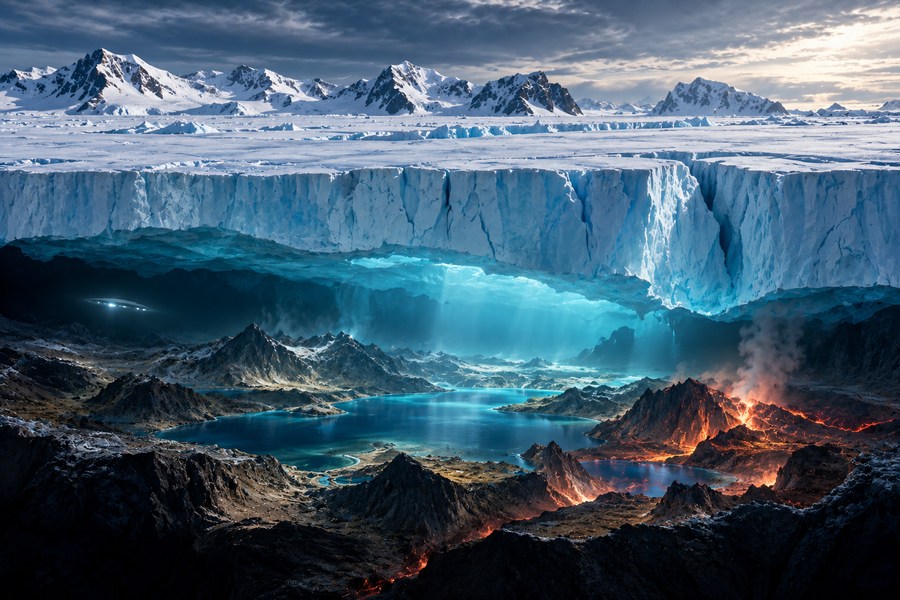
From the surface, Antarctica can look deceptively simple: an enormous white wilderness stretching towards the horizon.
What lies underneath is considerably more complicated.
Beneath kilometres of ice are mountains, deep valleys, lakes, flowing water systems and areas influenced by heat from inside the Earth. Much of this hidden landscape cannot be seen directly from the surface.
That scientific reality has also provided fertile ground for a very different idea.
Could something else be hiding beneath Antarctica?
Stories involving underground civilisations, secret installations and UFO bases have circulated for decades. More recently, satellite images showing unusual shapes and apparently smoke-like plumes have given those theories new material.
There really is a hidden world beneath Antarctica.
The question is what the evidence actually tells us about it.
Antarctica Is Hiding an Entire Landscape
Antarctica is not simply a flat piece of land covered by snow.
The ice sheet sits over a complex continent containing mountain ranges, basins, valleys and ancient geological structures.
Scientists cannot simply remove the ice to examine them.
Instead, aircraft, satellites and ground surveys use techniques including ice-penetrating radar and seismic measurements to reconstruct the landscape underneath.
Radar signals can travel through ice and reflect from boundaries below it. Those reflections allow researchers to estimate ice thickness and identify features hidden beneath the surface.
The result is effectively a map of an invisible continent.
Some areas beneath Antarctica would look dramatically different if the ice disappeared: enormous depressions, rugged terrain and mountain systems exist below a surface that can appear almost featureless from above.
In other words, the idea of a “hidden Antarctica” is not fictional.
What is hidden there, however, is primarily geology.
There Is Liquid Water Beneath Antarctica
Perhaps the strangest confirmed feature beneath Antarctica is liquid water.
Hundreds of subglacial lakes have been identified beneath the Antarctic Ice Sheet.
One of the most famous is Lake Vostok, buried beneath roughly four kilometres of ice.
These lakes can remain liquid despite the extreme conditions above them because the thick ice acts as insulation while pressure and geothermal heat contribute to conditions beneath the ice sheet.
More importantly, these are not necessarily isolated pools.
Scientists have discovered evidence that some subglacial lakes form part of larger hydrological systems in which water can move beneath the ice. These underground water systems are not necessarily static. Some Antarctic subglacial lakes periodically fill and drain, transferring water beneath the ice sheet. Researchers have also drilled into selected lakes, including Mercer Subglacial Lake, to collect sediment and investigate the history of these environments. Such discoveries provide direct evidence of a complex natural landscape hidden beneath Antarctica's ice.
That water matters because it can influence how the ice sheet moves across the bedrock below.
But it also raises a fascinating biological question.
Could life survive there?
Could Life Exist Beneath the Antarctic Ice?
Potentially — but this does not mean alien life. Scientists have already discovered complex microbial communities beneath Antarctic ice, while recent research into viruses beneath Antarctica's ice is revealing how these hidden ecosystems function.
Microorganisms on Earth can survive in environments once considered almost impossible for life: extreme cold, intense pressure, darkness and environments with very limited nutrients.
Antarctic subglacial environments are therefore scientifically valuable.
If microbial ecosystems can persist beneath thick ice on Earth, similar principles could help scientists understand where life might survive elsewhere in the Solar System.
That is particularly relevant to icy worlds such as Europa and Enceladus.
Both are believed to contain oceans beneath frozen outer layers.
Antarctica therefore provides an interesting scientific bridge between Earth science and astrobiology.
The real question is not whether extraterrestrials are hiding beneath Antarctica.
It is whether studying environments beneath Earth's ice can teach us how life might survive beneath ice somewhere else.
There Is Also Heat Beneath Antarctica
Ice does not mean geological inactivity.
Earth continuously releases heat from its interior, and Antarctica is no exception.
The amount varies across the continent.
Some regions also contain volcanic systems.
Mount Erebus, for example, is an active volcano rising through the Antarctic landscape.
Other volcanic structures exist beneath or around the West Antarctic Ice Sheet.
This matters because heat beneath ice can contribute to melting at the base of a glacier and affect the movement of ice above it.
It also provides an important reality check whenever an unusual thermal feature is interpreted as evidence of something artificial.
A heat source beneath Antarctica is not automatically mysterious.
Before considering technology, investigators would need to eliminate geothermal activity, volcanic processes, water movement and other natural mechanisms.
What About the Glacier That Appears to Be Smoking?
This is where the recent mystery becomes particularly relevant.
Satellite imagery of Pine Island Glacier has shown striking white plumes around the Antarctic ice.
NASA Earth Observatory documented an especially clear example captured by Landsat 8 on 10 October 2024.
From a photograph alone, parts of the scene can resemble smoke or steam escaping from the glacier.
But NASA identified two natural processes in the imagery: blowing snow and sea smoke.
Sea smoke can develop when extremely cold air moves over comparatively warmer water. Moisture entering the frigid air rapidly condenses and forms tiny ice crystals, producing something that visually resembles steam.
Powerful winds can simultaneously carry snow across the landscape.
Together, the effects can produce an extraordinarily mysterious scene.
The unusual imagery and the UFO speculation surrounding it are examined in more detail in our separate report on smoke rising from an Antarctic glacier. The unusual imagery and the UFO speculation surrounding it are examined in more detail in our separate report on smoke rising from an Antarctic glacier.
The important point is that an image can genuinely be unusual without its explanation being extraordinary.
Why Satellite Images Can Look Artificial
Satellite imagery removes many of the visual references humans normally use to understand what they are seeing.
There may be no trees, roads or buildings to provide scale.
A dark line could be a small opening or an enormous fracture extending across the ice.
A triangular shadow can make a natural formation appear geometric.
Partially buried rock can resemble an artificial structure.
Ice fractures can even produce remarkably straight edges.
Then there is pareidolia — the human tendency to recognise familiar shapes in ambiguous visual information.
It is the same reason people see faces in clouds or objects in rock formations.
None of this means every unusual Antarctic image has already been explained.
It means appearance alone is weak evidence for determining what produced it.
How This Became Connected to UFOs
Antarctica already had a mythology long before satellite maps became available to everyone.
Stories involving hidden territories, underground worlds and secret military activity gradually became connected with UFO culture.
Operation Highjump, the large U.S. Navy Antarctic expedition of 1946–47, later became a major component of these stories.
Claims emerged that the expedition encountered unusual aircraft or even fought technologically advanced craft.
Historical documentation supports the existence of the expedition.
It does not establish the later UFO battle narrative.
We have examined the historical evidence and later legends in our separate article on Operation Highjump and UFO claims.
Similar stories developed around Admiral Richard E. Byrd and supposed journeys into a hidden inner world beneath the polar regions.
That eventually became connected with Agartha beneath Antarctica and the wider Antarctica Hollow Earth theory.
Over time, these separate narratives began reinforcing one another.
Could a UFO Base Actually Be Hidden Beneath Antarctica?
This is a more useful question when treated as a testable hypothesis rather than a conclusion.
Antarctica certainly offers concealment.
A structure buried beneath kilometres of ice would not necessarily be visible from the surface.
But hiding something physically does not make it scientifically undetectable.
A large technological installation would potentially require energy.
Energy production usually generates heat.
Transport might produce repeated activity around particular locations.
Artificial structures might create unusual radar signatures.
Communications could potentially generate detectable electromagnetic signals.
Material extraction or construction might leave physical traces.
No single anomaly would prove the existence of a hidden base.
But several independent forms of evidence consistently pointing towards the same location would make the hypothesis considerably more interesting.
At present, publicly available evidence has not demonstrated such a pattern.
The broader Antarctica UFO and alien base theory therefore remains speculative rather than established.
What Would Real Evidence Look Like?
Imagine researchers discovered a persistent thermal anomaly beneath several kilometres of Antarctic ice.
That would be interesting.
But the first step would be to test natural explanations.
Could geothermal heat explain it?
Is there volcanic activity?
Could liquid water be transporting heat?
Now imagine ice-penetrating radar also detected an apparently geometric structure in exactly the same location.
That would increase interest, but geometry alone would still not establish artificial construction.
Researchers would need independent observations.
Suppose several instruments then repeatedly detected unexplained objects entering or leaving that precise region.
The evidential picture would change substantially.
This illustrates the difference between an anomaly and evidence supporting a specific explanation.
Most viral Antarctica UFO claims begin with the anomaly and jump directly to the conclusion.
Antarctica Has Produced Famous Mysteries Before
The famous “Bloop” provides a useful example.
In 1997, underwater listening equipment detected an extraordinarily powerful sound across the Pacific.
Its source was initially mysterious.
The strange recording eventually became associated in popular culture with theories involving gigantic unknown sea creatures and other unexplained phenomena.
The eventual scientific explanation remained dramatic.
According to NOAA, the characteristics of the Bloop were consistent with an icequake — the sound of an iceberg cracking and breaking away from an Antarctic glacier.
The mystery was real.
The proposed exotic explanations were unnecessary.
That distinction is useful when approaching strange Antarctic imagery today.
Unknown Does Not Mean Extraterrestrial
This principle is also central to modern UFO research.
Something can remain unidentified because the available information is insufficient.
A photograph may lack scale.
A video may lack metadata.
A radar return may contain too little information to identify an object confidently.
None of those situations automatically makes an extraterrestrial explanation more probable.
The same reasoning applies beneath Antarctica.
Scientists have not physically inspected every location underneath kilometres of ice.
There will inevitably be geological structures, ecosystems and processes that remain poorly understood.
But:
“We do not know everything beneath Antarctica”
is not equivalent to:
“There may therefore be an alien base beneath Antarctica.”
The first statement describes a limitation in human knowledge.
The second introduces a specific hypothesis requiring its own evidence.
What Is Really Under Antarctica’s Ice?
The confirmed answer is already remarkable.
Mountains exist beneath it.
Deep valleys exist beneath it.
Liquid-water systems exist beneath it.
Geothermal heat exists beneath it.
Volcanic systems exist within Antarctica.
And environments isolated from the surface for extraordinarily long periods may still have much to teach scientists about geology, climate and the limits of life.
There is therefore a genuine hidden world beneath Antarctica.
We do not need to invent one.
Could future discoveries reveal something completely unexpected?
Certainly.
That is one reason scientists continue mapping and studying the continent.
But there is currently no credible public evidence demonstrating that the unknown world beneath Antarctic ice contains an extraterrestrial civilisation or hidden UFO installation.
The distinction is simple but important:
Antarctica contains mysteries. A mystery is the beginning of an investigation, not evidence for a predetermined answer.
Sources and Further Reading
NASA Earth Observatory — Streaming Snow and “Sea Smoke”
NASA Earth Observatory — The Wide View of a Shrinking Glacier: Retreat at Pine Island
NASA Earth Observatory — Lake Vostok
U.S. National Science Foundation — First-ever Layered Lake Sediment Sample Extracted From Subglacial Antarctica
NOAA Ocean Service — What Is the Bloop?