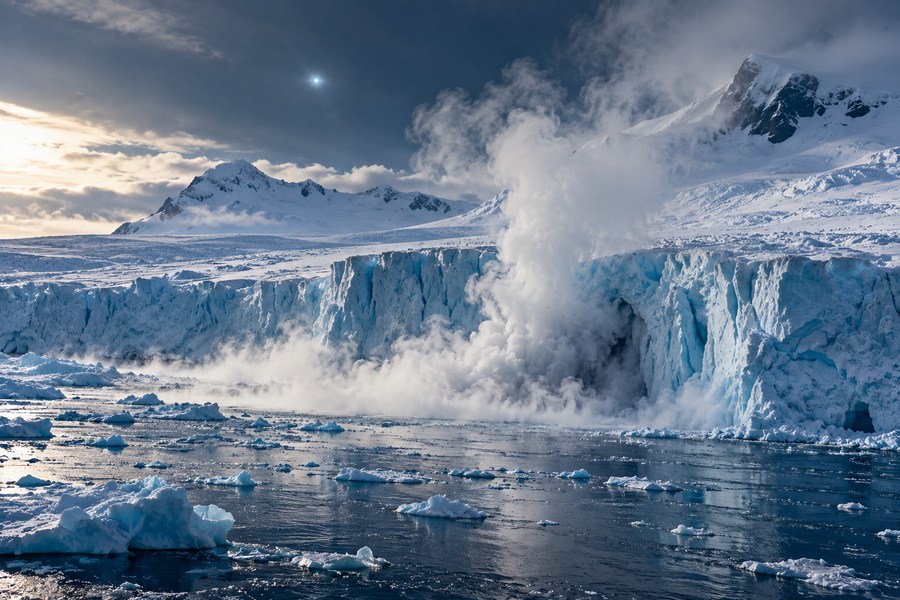
Antarctica is one of the easiest places on Earth for an unusual image to become a mystery.
A dark shape beneath the ice becomes a supposed entrance. A strange object in satellite imagery becomes a crashed spacecraft. And when something resembling smoke appears to rise from a glacier, the inevitable question follows: what is happening underneath the ice?
For UFO enthusiasts, the possibilities quickly become more exotic.
Could the plume reveal underground activity? Could heat be escaping from somewhere beneath the glacier? And could any of this connect with decades of stories about UFOs and hidden structures in Antarctica?
There is a genuine phenomenon behind some of these extraordinary-looking images.
But the evidence points towards something considerably more terrestrial.
Can “Smoke” Really Rise From a Glacier?
It certainly can look that way.
NASA Earth Observatory documented a striking example at Antarctica's Pine Island Glacier on 10 October 2024, when the Landsat 8 satellite captured white plumes drifting around the glacier and nearby ocean.
The image showed two distinct natural phenomena: sea smoke forming above comparatively warmer water and snow being lifted from the ice by strong winds.
Sea smoke develops when extremely cold air passes over warmer water, causing moisture to condense into a visible mist of tiny droplets or ice crystals. At the same time, powerful Antarctic winds can carry snow across the glacier, creating additional white streaks.
Although the resulting scene resembles smoke rising from the ice, NASA's observations do not indicate an underground fire, artificial heat source or hidden installation.
Why Does It Look as Though Something Is Under the Ice?
Perspective is part of the problem.
A satellite image compresses an enormous landscape into a relatively small frame. Without knowing precisely where a plume begins, something forming above nearby open water can appear to originate from the glacier itself.
Antarctica also lacks familiar visual references.
There are few buildings, roads or trees across most of the continent to provide an immediate sense of scale.
A strange patch visible in satellite imagery might therefore represent kilometres of terrain rather than a small object sitting on the surface.
That ambiguity creates perfect conditions for speculation.
And This Is Where the UFO Theory Begins
Antarctica already occupies an unusual place in UFO culture.
For decades, stories have claimed that remote areas of the continent could conceal underground installations, entrances beneath the ice or even technology belonging to an unknown civilisation.
Modern satellite imagery has given those stories new life.
Unusual formations are routinely discovered on mapping services and circulated online as possible spacecraft, entrances or artificial structures.
One Antarctic satellite-image claim that circulated again in 2026 involved a dark elongated feature interpreted by some observers as a UFO-like structure. The extraordinary interpretation was not independently established; natural ice formations and fractures remained possible explanations. iTechGuides
Smoke-like plumes add another ingredient to the story.
If something appears to be producing heat beneath a glacier, it is easy to construct a narrative around it:
What if something is operating beneath the Antarctic ice?
It is an intriguing question.
It is not evidence.
Could Heat Actually Exist Beneath Antarctic Ice?
Yes — and this is an important distinction.
Ice above does not mean the geology underneath is completely inactive. The landscape beneath Antarctica’s ice is far more complex than the frozen surface suggests, containing hidden terrain, water systems and sources of geothermal heat.
Earth produces geothermal heat, and Antarctica contains volcanic regions. Heat can therefore interact with ice without requiring any artificial source.
Glacier environments elsewhere on Earth demonstrate this dramatically.
At Mount St Helens in the United States, for example, glacier caves have developed in an environment where hot volcanic gases and fumaroles interact with ice. National Geographic
So if heat, vapour or unusual melting were discovered beneath an ice sheet, the first scientific questions would concern geology, geothermal activity and atmospheric processes.
A heat source alone would not indicate technology.
Why Antarctica Attracts So Many UFO Stories
Geography helps explain it.
Antarctica is enormous, remote and hostile to humans. Large areas are rarely visited directly by the public, while most people experience the continent through satellite photographs, scientific expeditions and documentaries.
That leaves enormous room for imagination.
The same environment has helped produce stories involving Agartha beneath Antarctica, supposed entrances into the Earth and claims surrounding Admiral Byrd and the Hollow Earth. These stories are explored in more detail in our article on Agartha and Antarctica, which traces the origins of the hidden civilisation narrative rather than treating it as established history.
Another strand connects Antarctica with Operation Highjump and UFO claims.
Over time, separate stories have gradually blended together.
A strange satellite image can therefore become connected to a decades-old military expedition even when no evidence establishes a relationship between them.
What About UFOs Actually Seen Around Antarctica?
Reports do exist.
In 2026, for example, a story circulated about a tourist allegedly filming a large elongated object above icy Antarctic waters.
But the case illustrates exactly why caution is necessary.
The account lacked independent institutional confirmation, radar evidence and sufficient information about the precise observation conditions. The interpretation remained based primarily on witness footage rather than independently corroborated data. Enigma Resolve
That does not demonstrate that the witness saw nothing unusual.
It means the available evidence cannot establish what the object was.
This distinction is fundamental to serious UAP investigation.
An unidentified object is unidentified — not automatically extraterrestrial.
Could a UFO Base Produce Heat Beneath a Glacier?
In principle, almost any hypothetical underground installation requiring significant energy might produce waste heat.
But there is a major difference between asking whether something is theoretically possible and showing that it actually exists.
To establish an artificial heat source beneath Antarctic ice, researchers would need measurable evidence. The same principle applies to extraordinary aerial observations: our guide to UAP evidence explains why independent measurements matter more than the appearance of an unusual image.
That might include unusual thermal signatures, repeatable observations, geological surveys inconsistent with natural explanations or physical evidence of artificial structures.
To connect that source specifically with UFOs would require another evidential step entirely.
At present, publicly available evidence does not establish an extraterrestrial installation beneath an Antarctic glacier. Similar claims about a hidden Antarctica UFO and alien base have also emerged from satellite imagery and decades of online speculation.
The “Smoke” May Actually Tell Us Something More Interesting
The scientific explanation does not make the phenomenon boring.
Quite the opposite.
NASA's Pine Island Glacier observation demonstrates how extreme the Antarctic environment can be.
Cold, dense air can rush from the continent's interior towards the coast as powerful katabatic winds. These winds can transport snow across the landscape while temperature differences between frigid air and relatively warmer water create sea smoke. NASA Science
From orbit, the resulting landscape can look almost alien.
And that may explain part of Antarctica's enduring relationship with UFO mythology.
The continent routinely produces landscapes and atmospheric phenomena that simply do not resemble everyday environments experienced by most people.
So Is Smoke Rising From an Antarctic Glacier Evidence of UFO Activity?
There is currently no credible evidence establishing that connection.
Smoke-like features around Antarctic glaciers can have documented natural explanations, including sea smoke, wind-blown snow, geothermal processes and interactions between extremely cold air and comparatively warmer water.
NASA has directly documented some of these processes. NASA Science
None of this proves that every unusual observation in Antarctica has already been explained.
Nor does it mean that people should stop investigating strange images.
It means the order of investigation matters.
First establish whether the plume is actually smoke.
Then determine where it originates.
Then test atmospheric, geological and human explanations.
Only after those possibilities fail should increasingly exotic hypotheses receive serious consideration.
Antarctica remains mysterious enough without inventing an answer.
For now, the most fascinating thing rising from its glaciers may not be evidence of a hidden UFO base, but a reminder of how easily one of Earth's most extreme environments can appear genuinely otherworldly.
Sources and Further Reading
NASA Earth Observatory — Streaming Snow and “Sea Smoke”
National Geographic — See the Eerie Ice Caves Carved by Mount St. Helens’ Fiery Breath
U.S. National Archives — Project BLUE BOOK: Unidentified Flying Objects