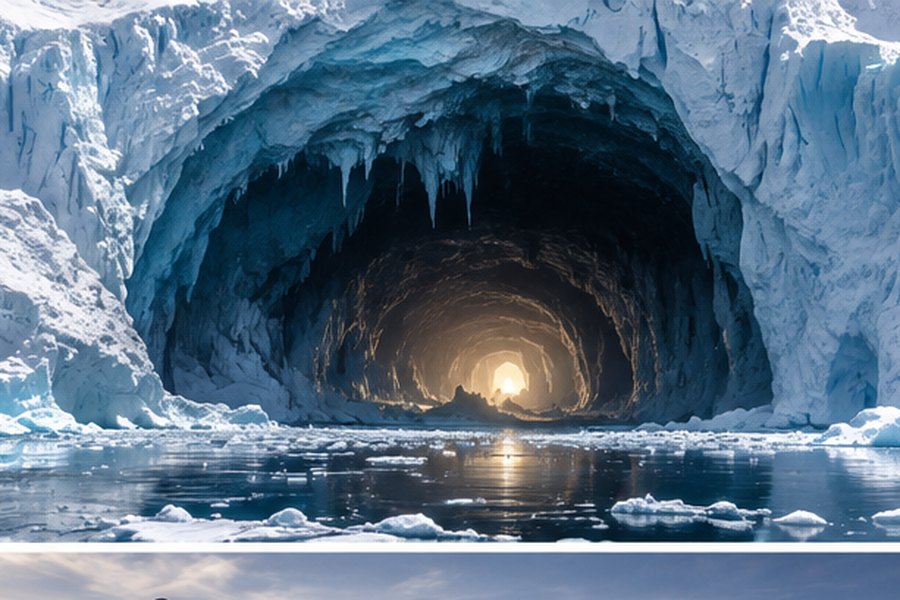
Antarctica is one of the few places on Earth where enormous landscapes can still remain completely hidden from human sight.
Beneath kilometres of ice lie mountains, valleys, lakes and geological structures that cannot be seen from the surface. For scientists, this makes Antarctica an extraordinary natural laboratory. For everyone else, it has also created the perfect setting for a much stranger story.
The Antarctica Hollow Earth theory proposes that somewhere across the frozen continent there is an entrance leading into a vast world beneath the Earth's surface.
Modern versions of the story sometimes add underground cities, unknown civilisations and even UFOs.
It is an irresistible mystery.
But how much of it comes from history, how much from internet culture, and what has science actually discovered beneath Antarctica?
Where Did the Hollow Earth Theory Come From?
The idea of hidden worlds beneath the surface is far older than the internet.
Different cultures have imagined underground realms for centuries, but versions resembling the modern Hollow Earth theory became particularly visible in Europe and North America during the seventeenth, eighteenth and nineteenth centuries.
One influential nineteenth-century version was associated with American John Cleves Symmes Jr., who argued that the Earth was hollow and accessible through openings near the poles.
It was a remarkable proposal for its time.
It was also developed before modern seismology gave scientists a much clearer way of studying the planet's interior.
Today, researchers can examine how earthquake waves travel through Earth. These observations reveal a layered planet consisting broadly of the crust, mantle and core.
That evidence does not support the enormous empty internal world required by the popular Hollow Earth model.
The scientific idea faded.
The story did not.
Why Did Antarctica Become the Supposed Entrance?
Antarctica has several qualities that make it unusually fertile ground for mystery.
It is remote, extremely difficult to explore and almost entirely covered by ice. Some areas lie beneath several kilometres of it.
From the surface, there is no obvious indication of everything underneath.
That absence of visibility leaves considerable room for imagination.
As polar exploration became better known, older stories about openings near Earth's poles gradually became associated with Antarctica.
Today, searches for terms such as “Hollow Earth entrance Antarctica” or “Antarctica hidden entrance” often lead to photographs and videos showing enormous ice caves, dark openings or unusual satellite formations.
There is an important distinction, however.
A real opening in Antarctic ice is not evidence of an opening into the Earth.
Glaciers fracture. Ice caves form. Rock can emerge through the ice. Volcanic and geothermal activity can also produce unusual environments.
Without reliable location data and geological context, an extraordinary-looking image tells us surprisingly little about what it actually shows.
What Is Really Hidden Beneath Antarctica?
This is where reality becomes almost as interesting as the legend.
Scientists really have discovered a hidden landscape beneath Antarctica.
British Antarctic Survey research has examined the Gamburtsev Subglacial Mountains, an enormous mountain system concealed beneath the East Antarctic Ice Sheet.
Researchers have also identified numerous subglacial lakes beneath the continent.
Lake Vostok is the best-known example, lying beneath kilometres of ice in East Antarctica.
Radar, seismic measurements, satellite observations and other techniques allow scientists to investigate terrain they cannot simply see from above.
So when somebody asks, “What is under Antarctica?”, the scientific answer is already extraordinary:
mountains, lakes, valleys, water systems, rock and a geological record extending deep into Earth's past.
None of those discoveries demonstrates the existence of a Hollow Earth civilisation.
They do explain why the continent continues to produce genuine surprises. For a closer look at the scientific discoveries, read our guide to what lies beneath Antarctica's ice, including hidden lakes, buried mountains and geothermal activity.
What About the Mysterious Antarctic Entrances Online?
Images labelled as an “entrance to Hollow Earth Antarctica” periodically spread across social media.
Some appear genuinely unusual.
The difficulty is that an image alone rarely provides enough information to determine scale, depth or origin.
A dark area in an ice wall may be a cave.
A strange feature in satellite imagery may involve exposed rock, shadow, ice movement or limitations in how images were collected and assembled.
There is also a psychological factor.
Humans naturally recognise familiar shapes in ambiguous images. The same tendency can make geological formations resemble faces, buildings, pyramids or doorways.
This does not mean every unusual Antarctic image should be dismissed.
It means that the interesting question should be “What is this?” rather than beginning with the conclusion that it must be an entrance to another world.
That distinction is particularly useful when looking at UFO and UAP imagery too. In our guide to what evidence scientists would need to confirm an extraordinary UAP, we examine why location, multiple sensors, metadata and independent observations matter when interpreting something unusual.
The Admiral Byrd Connection
One historical figure appears repeatedly in Antarctica Hollow Earth stories: Rear Admiral Richard E. Byrd.
Byrd was not a fictional character.
He was one of the most prominent American polar explorers of the twentieth century, and his expeditions helped make Antarctica part of the public imagination.
Ohio State University's Polar Archives preserve historical records, personal papers, photographs and other material relating to polar exploration, including the Admiral Richard E. Byrd Papers.
Over time, however, Byrd's documented exploration became intertwined with a very different story.
According to versions circulating in Hollow Earth literature and online, Byrd supposedly entered a polar opening and encountered an unknown world.
Some versions add advanced inhabitants, unusual aircraft or a hidden civilisation.
These claims should not be treated as established parts of Byrd's historical expedition record.
That distinction matters because attaching a legend to a genuine explorer can make the legend appear better documented than it really is. Our investigation into Admiral Byrd and the Hollow Earth examines the alleged secret diary, his documented polar expeditions and the historical evidence behind the legend.
How UFOs Became Part of the Hollow Earth Story
Modern versions of the theory increasingly connect Antarctica with UFOs.
The argument usually changes the traditional extraterrestrial story.
Instead of unidentified craft travelling across interstellar space, perhaps — the speculation goes — they originate somewhere on Earth that humans have not discovered.
Remote oceans, underground environments and Antarctica consequently become popular proposed locations.
This resembles the modern cryptoterrestrial hypothesis: the speculative possibility that an unknown intelligence could have an Earth-based origin while remaining largely hidden from contemporary civilisation.
There is currently no verified scientific evidence demonstrating such a civilisation.
But it is an interesting intellectual distinction from the familiar extraterrestrial hypothesis.
We explore this possibility separately in Could UFOs Already Be on Earth? The Cryptoterrestrial Hypothesis Explained.
Our guide, Are UFOs Real? What the Evidence Actually Says, explains why an unidentified observation does not automatically establish an extraordinary origin.
Could an Underground City Exist Beneath Antarctica?
There is currently no credible evidence of an advanced underground city beneath the Antarctic ice.
That statement does not mean scientists know every feature hidden below the continent.
They do not.
Antarctica remains difficult to investigate, and scientific surveys continue to reveal previously unknown details of its subglacial landscape.
But uncertainty is not evidence.
Discovering a previously unknown lake demonstrates that a lake was there.
Discovering buried mountains demonstrates that mountains were there.
Neither discovery independently supports the much larger claim that an unknown civilisation built a city beneath Antarctica.
This difference between an unanswered question and evidence for a particular explanation is essential when dealing with extraordinary claims.
Why the Antarctica Hollow Earth Story Refuses to Disappear
The theory has survived because it combines several remarkably durable human fascinations.
There is the appeal of unexplored territory.
There is the possibility of a hidden civilisation. One of the best-known examples is Agartha, a legendary underground kingdom whose story eventually became associated with Antarctica and the wider Hollow Earth mythology.
There are genuine Antarctic discoveries.
There are historical explorers whose journeys still seem extraordinary today.
And now there are satellite images and social media, allowing millions of people to examine unfamiliar landscapes from their own screens.
Every unusual cave, shadow or geological formation can therefore become part of a story that began long before Google Earth existed.
The technology is new.
The fascination with hidden worlds is not.
The Real Mystery Beneath the Ice
There is no reliable scientific evidence for a giant entrance leading into a habitable Hollow Earth beneath Antarctica.
Modern geophysical observations instead describe a layered planet of crust, mantle and core.
Yet dismissing the Hollow Earth explanation does not make Antarctica less mysterious.
Quite the opposite.
Scientists are exploring mountains buried beneath kilometres of ice, isolated subglacial lakes and landscapes that have remained invisible for extraordinary periods of time.
The difference is that these mysteries can be investigated.
And as Antarctica continues to reveal what lies beneath its ice, reality may continue producing discoveries strange enough that they do not need a hidden world to make them fascinating.
For readers following the wider UFO question, continue with UFOs and UAPs in 2026: What Has the US Government Actually Revealed?.