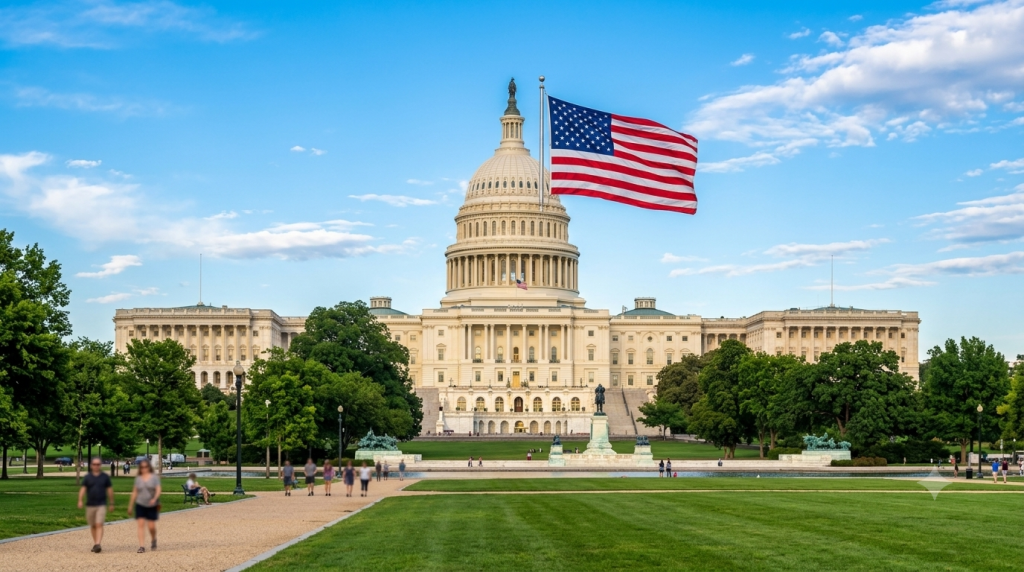
The United States has one of the world's most closely watched political systems. Presidential elections attract international attention, congressional decisions influence the global economy, and Supreme Court rulings can reshape American law.
Yet understanding American politics requires more than following the president or the two major political parties.
The United States is a constitutional federal republic with democratic elections, a separation of powers and a system of checks and balances. Political authority is divided among national, state and local institutions.
This structure was designed to prevent power from becoming concentrated in a single office or institution.
It also explains why American government can be complicated, why laws sometimes take years to pass and why political disagreements often involve the Constitution.
Here is how the U.S. political system works, from its constitutional foundations to elections, Congress and everyday government decisions.
What Type of Political System Does the United States Have?
The United States is a federal constitutional republic with a representative democratic system.
Each part of that description has a specific meaning.
A republic is a system in which public authority is exercised through institutions rather than a hereditary monarch.
A representative democracy allows citizens to elect officials who make decisions on their behalf.
A constitutional system places legal limits on government authority.
And federalism divides political power between the national government and the states.
The United States combines these principles rather than relying on a single political institution.
Citizens elect members of Congress, the president is selected through the Electoral College process, and federal judges exercise judicial authority under the Constitution.
State and local governments also make decisions affecting public services, taxation and everyday life.
Why Is the U.S. Constitution So Important?
The Constitution is the foundation of the American political system.
Written in 1787 and brought into operation in 1789, it establishes the structure of the federal government and defines important limits on its authority.
The original Constitution contains seven articles.
The first three establish Congress, the presidency and the federal judiciary.
Other articles address relations between states, constitutional amendments, federal supremacy and ratification.
The Constitution has been amended 27 times.
The first ten amendments, known as the Bill of Rights, protect important liberties and establish limits on government power.
Later amendments abolished slavery, strengthened citizenship and equal-protection guarantees, and expanded voting rights.
The Constitution does not provide a detailed answer to every political question.
Many aspects of American government have developed through legislation, court decisions and institutional practice.
For a closer look at its history and structure, read our guide to the U.S. Constitution.
What Are the Three Branches of the U.S. Government?
The federal government is divided into three branches: legislative, executive and judicial.
Each has distinct responsibilities.
| Branch | Main institution | Principal role |
|---|---|---|
| Legislative | Congress | Makes federal laws |
| Executive | President and federal agencies | Implements and enforces federal laws |
| Judicial | Supreme Court and lower federal courts | Interprets and applies federal law in legal cases |
The branches are separate, but they are not completely independent of one another.
The Constitution gives each branch certain powers that can limit actions by the others.
This arrangement is known as checks and balances.
The Legislative Branch
Congress makes federal laws, authorises spending and oversees government activities.
It consists of the House of Representatives and the Senate.
Both chambers generally must approve the same legislation before it can become law.
The Executive Branch
The president leads the executive branch.
Federal departments and agencies carry out laws, administer government programmes and perform national responsibilities.
The president also has important duties involving diplomacy and national defence.
The Judicial Branch
Federal courts resolve legal disputes within their jurisdiction.
They interpret statutes and the Constitution and may determine whether government actions violate constitutional requirements.
Our article on why the U.S. government has three branches explains how this division of authority developed.
How Do Checks and Balances Work?
Checks and balances are intended to prevent any branch from exercising unchecked authority.
For example, Congress can pass legislation, but the president may veto a bill.
Congress can override that veto if two-thirds of both chambers support the override.
The president nominates federal judges, but appointments to the federal judiciary generally require Senate confirmation.
Federal courts may rule that laws or executive actions violate the Constitution when such questions arise in cases properly before them.
Congress also controls federal appropriations and has powers of investigation and oversight.
These mechanisms do not guarantee that political disagreements will be resolved quickly.
In fact, they can make government decisions slower.
That is partly a consequence of requiring institutions with different responsibilities to participate in important decisions.
The system prioritises divided authority and accountability rather than unrestricted executive or legislative action.
How Does Congress Work?
Congress is the national legislature.
It has two chambers because the Constitution's authors sought to balance representation based on population with equal representation for states.
The House of Representatives has 435 voting members, with seats allocated among states according to population.
The Senate has 100 members, with two senators representing each state.
House members serve two-year terms, while senators serve six-year terms.
Senate elections are staggered so that approximately one-third of seats are normally contested every two years.
The two chambers share most legislative responsibilities, but some powers differ.
The House has the sole power of impeachment and the constitutional responsibility for originating revenue bills.
The Senate conducts impeachment trials and provides advice and consent for specified presidential appointments and treaties.
Neither chamber can normally enact federal legislation by itself.
Read our comparison of the House of Representatives and Senate for more detail.
How Does a Bill Become a Federal Law?
Federal legislation usually begins when a member of Congress introduces a bill.
The proposal may be referred to a committee, where lawmakers examine its contents and consider amendments.
If it advances, the bill may be debated and voted on by the relevant chamber.
The other chamber must also consider it.
If the House and Senate approve different versions, those differences must be resolved.
Both chambers generally must approve identical legislative text before it is sent to the president.
The president may sign the bill into law or veto it.
Congress can attempt to override a veto with the required two-thirds majorities.
This process creates several opportunities for scrutiny and disagreement.
It also means that a political promise made during an election campaign does not automatically become government policy.
A president may propose legislation, but congressional approval is often necessary.
What Powers Does the U.S. President Have?
The president is both head of state and head of the federal executive branch.
The office carries significant responsibilities, including implementing federal laws, directing executive agencies and conducting foreign relations.
The president also serves as commander in chief of the armed forces.
Presidents can issue executive orders and other directives within the scope of their lawful authority.
However, executive orders are not equivalent to unlimited legislative power.
They must comply with the Constitution and applicable statutes.
Congress can establish or amend laws, control appropriations and exercise oversight.
Courts may review presidential actions when a legal challenge falls within their jurisdiction.
The president therefore occupies a powerful position within a system of constitutional limits.
The extent of presidential authority can also be a subject of disagreement among lawmakers, courts and legal scholars.
How Do U.S. Elections Work?
Americans vote in federal, state and local elections.
Presidential elections occur every four years.
All voting seats in the House of Representatives are contested every two years, while Senate elections follow staggered six-year terms.
Presidential elections have an additional feature: the Electoral College.
Voters participate in a process through which electors are appointed to cast the formal votes for president and vice president.
There are 538 electoral votes, and a candidate normally needs at least 270 to win.
Most states award all their electoral votes to the candidate who wins the statewide popular vote.
Maine and Nebraska use different allocation arrangements.
Because of this system, the candidate receiving the most votes nationwide does not necessarily win the presidency.
States also have substantial responsibilities for administering elections.
Registration procedures, early voting arrangements and ballot-processing rules can vary.
Our guide to how U.S. elections work explains the process from primaries to certification.
What Are Midterm Elections?
Midterm elections take place halfway through a president's four-year term.
They determine every seat in the House of Representatives and the Senate seats scheduled for that election cycle.
Many states also elect governors, legislators and other officials during midterms.
These elections can change which political party controls one or both chambers of Congress.
That can have a significant effect on the president's legislative agenda.
For example, a president whose party controls the White House but not the House of Representatives may find it harder to secure approval for major legislation.
Midterms also provide voters with an opportunity to influence federal policy without waiting for the next presidential election.
The next regularly scheduled federal midterm elections are on 3 November 2026.
Why Are There Two Major Political Parties?
American politics is dominated by the Democratic Party and the Republican Party.
However, the Constitution does not require a two-party system.
The dominance of two major parties developed through electoral institutions, political history and competition for public office.
Many American elections use single-member districts in which one candidate wins the seat.
This structure can make it difficult for smaller parties to gain representation.
Presidential elections also encourage broad political coalitions.
Third parties and independent candidates can participate, subject to applicable ballot-access rules.
However, they generally face significant organisational and electoral challenges.
Political parties help recruit candidates, organise campaigns, develop policy positions and coordinate activity within Congress.
They are important institutions, but they are not themselves branches of government.
What Is the Difference Between Democrats and Republicans?
The Democratic and Republican parties have different political traditions, policy priorities and voter coalitions.
In contemporary American politics, Democrats generally favour a more active federal role in areas such as social programmes, environmental regulation and certain economic protections.
Republicans generally place greater emphasis on lower taxation, deregulation, market-oriented policies and conservative approaches to many social and constitutional issues.
These are broad descriptions rather than fixed rules.
Individual politicians may disagree with their party on particular questions.
Party positions also change over time.
Neither party represents a completely uniform set of beliefs.
For readers outside the United States, it is useful to distinguish political parties from the permanent constitutional institutions in which elected officials serve.
Congress, the presidency and the judiciary continue to exist regardless of which party controls elected offices.
What Is Federalism?
Federalism divides authority between the national government and state governments.
The federal government has powers involving national defence, foreign relations, immigration and interstate commerce.
States retain extensive responsibilities over matters such as education, licensing, public safety and many public services.
Both levels of government can collect taxes and make laws within their respective constitutional authority.
The Constitution's Supremacy Clause establishes that valid federal law takes priority when it conflicts with state law.
However, the federal government does not possess unlimited authority over every state matter.
Its powers remain subject to constitutional limits.
State governments also have their own constitutions, legislatures, executives and courts.
For a detailed comparison, see our article on federal versus state government.
What Role Do State and Local Governments Play?
State and local governments influence many aspects of everyday American life.
States establish laws governing areas such as driving, education, business licensing and criminal justice.
Local authorities may operate schools, maintain roads, manage waste collection and provide emergency services.
Their powers depend on state constitutions and legislation.
This produces substantial variation across the country.
A rule applying in California may differ from one applying in Texas or New York.
These differences do not necessarily indicate a conflict with federal law.
They often reflect the authority states possess to make policy choices within constitutional limits.
American government is therefore more decentralised than a system in which a single national institution controls most public services.
What Role Does the Supreme Court Play?
The Supreme Court is the highest court in the federal judicial system.
It hears selected cases involving federal law and constitutional questions.
The Court's decisions can influence how government institutions exercise their authority.
For example, the Court may consider disputes involving individual rights, congressional powers or the limits of executive action.
Its authority is not unlimited.
The Court generally acts through cases brought before it under applicable jurisdictional rules.
It does not independently draft federal legislation or administer government programmes.
Supreme Court justices are nominated by the president and appointed with Senate advice and consent.
They generally serve during good behaviour, a constitutional arrangement designed to protect judicial independence.
The Court's decisions can be controversial because constitutional interpretation sometimes has significant political consequences.
Nevertheless, the judiciary's formal role is legal rather than electoral.
How Does the U.S. Political System Affect Everyday Life?
The American political system influences taxation, employment, healthcare, education, transport and public safety.
Congress may establish a federal programme.
The executive branch may administer it.
Courts may resolve disputes about how the programme operates.
State governments may also have responsibilities involving implementation or related services.
Consider a federal infrastructure initiative.
Congress might authorise funding, executive agencies could establish programme requirements, and state governments might plan or manage individual projects.
The result depends on cooperation among institutions operating at different levels.
This helps explain why policy announcements do not always lead to immediate changes.
Government decisions often require legislation, funding, administration and legal review.
What Are the Strengths and Weaknesses of the System?
The American political system was designed to distribute authority and provide mechanisms for accountability.
Its supporters often emphasise constitutional protections, elected representation, judicial independence and limits on concentrated power.
Federalism also allows states to develop different approaches to public policy.
However, the same institutional structure can create difficulties.
Separate elections and divided government can lead to legislative gridlock.
Complex procedures may make political decisions difficult for voters to follow.
The Electoral College and equal state representation in the Senate also raise continuing debates about democratic representation.
Supporters and critics disagree about whether particular arrangements provide necessary stability or create unequal political influence.
These questions are part of the continuing discussion about how American democracy should function.
Understanding the system does not require accepting every feature as ideal.
It requires recognising the constitutional rules and political institutions that shape government decisions.
Frequently Asked Questions
Is the United States a democracy or a republic?
It is both a constitutional republic and a representative democracy. Citizens elect officials, while the Constitution establishes government institutions and limits their authority.
Who has the most power in the U.S. political system?
No single institution has unlimited power. Congress, the president and federal courts exercise different constitutional responsibilities.
How many branches of government does the United States have?
The federal government has three branches: legislative, executive and judicial.
Can the president make laws without Congress?
The president cannot independently enact ordinary federal legislation. Executive actions must operate within constitutional and statutory authority.
Why does the United States have only two major political parties?
The two-party system developed through political history and electoral arrangements. The Constitution does not require it.
Can state laws differ from federal laws?
Yes. States have their own legislative authority, although state laws must comply with the U.S. Constitution and controlling federal law.
Final Thoughts
The U.S. political system is built around a central principle: political power should be distributed and subject to constitutional limits.
The Constitution establishes the federal government, divides authority among three branches and preserves important responsibilities for the states.
Congress makes laws, the president leads the executive branch and federal courts resolve legal disputes.
Elections allow citizens to choose representatives and influence political leadership.
Political parties organise competition, while checks and balances provide mechanisms for institutional accountability.
The result is a system that can be both resilient and difficult to navigate.
Its complexity is not accidental. Many of its institutions were designed to prevent decisions from being controlled by a single individual or governing body.
Understanding these foundations makes it easier to follow American elections, evaluate political claims and recognise how government decisions are actually made.
Sources and Further Reading
National Archives — The Constitution: What Does It Say?
Official overview of the Constitution and the structure of federal government.
USAGov — Branches of the U.S. Government
Explanation of Congress, the executive branch and the federal judiciary.
Congress.gov — Constitution Annotated
Official constitutional reference covering federal powers, rights and judicial interpretation.
Congress.gov — The Legislative Process
Guide to how federal legislation moves through Congress.
USAGov — Presidential Election Process
Official explanation of presidential nominations, elections and inauguration.
National Archives — Electoral College
Explanation of the Electoral College and its constitutional foundations.
United States Senate — About the Senate
Official information about Senate membership, elections and responsibilities.