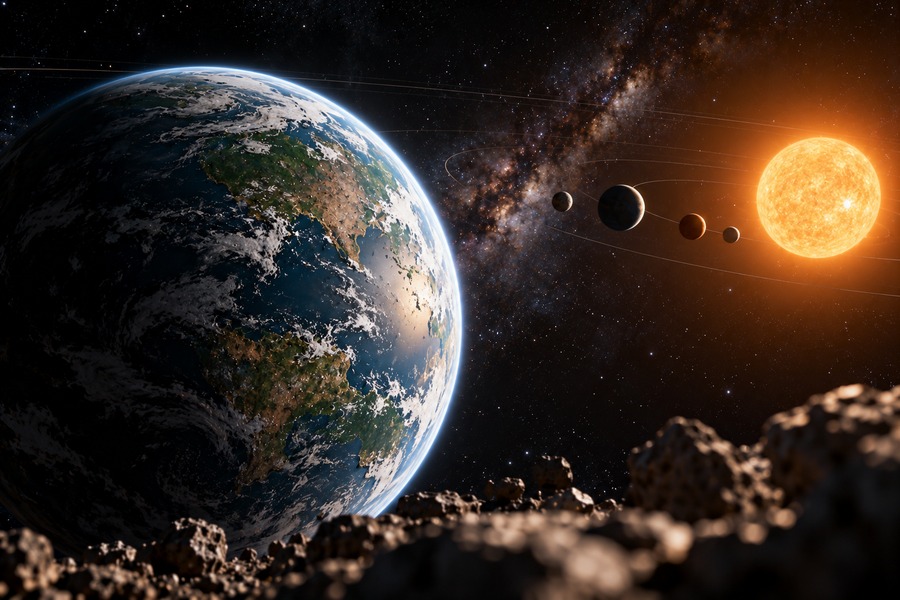
A planetary system might appear chaotic at first glance. Several worlds travel around the same star, each following its own orbit at a different speed. Their gravitational fields constantly interact, subtly changing one another's movements. Yet some systems display a surprising degree of order. One planet might complete three orbits while another completes two. In more complicated systems, several planets participate in a connected sequence of orbital relationships. These arrangements are known as orbital resonances. They are not perfectly synchronised dances in the ordinary sense, and they do not require planets to line up every time they complete an orbit. Instead, their orbital periods maintain relationships that can shape how the system evolves. For astronomers, those relationships offer something unusually valuable: a record of the system's history.
What Is Planetary Resonance?
Planetary resonance occurs when the orbital periods or other repeating motions of celestial bodies maintain a relationship involving small whole numbers. A simple example is a 2:1 orbital resonance. In this arrangement, an inner planet completes approximately two revolutions around its star for every one revolution made by an outer planet. Another common relationship is 3:2, where one body completes three orbits while another completes two. These ratios matter because gravitational interactions recur in a structured way. Rather than producing entirely unrelated disturbances on each orbit, the planets can repeatedly influence one another at particular stages of their motion. The effects may accumulate, helping maintain the resonance or, under different circumstances, destabilising it. Resonance is therefore not simply an interesting numerical coincidence. It can influence the long-term architecture of a planetary system. Understanding what an exoplanet is provides a useful starting point for exploring how planets form and interact in distant star systems.
Why Doesn't Gravity Pull Resonant Planets Apart?
Gravitational interactions do not always push planets into unstable orbits. In some resonant systems, repeated gravitational influences help maintain an arrangement that prevents dangerously close encounters.
However, resonance is not a guarantee of stability. Certain orbital relationships can increase eccentricity or produce chaotic behaviour, depending on planetary masses, orbital spacing and the geometry of their interactions.
Astronomers therefore distinguish between planets whose orbital periods happen to form simple ratios and systems whose motions are dynamically linked. Understanding that distinction is essential when investigating how planetary systems evolve.
TRAPPIST-1: Seven Planets in an Extraordinary System
One of the most remarkable examples lies around TRAPPIST-1, a small, cool star approximately 40 light-years from Earth. Seven known planets orbit this star, and their movements are connected through a remarkable chain of orbital relationships. The planets are packed into a region much smaller than our Solar System's inner planetary neighbourhood. Despite their close spacing, their orbital periods follow patterns that help researchers understand how the system operates. TRAPPIST-1 is especially interesting because the planets participate in a complex resonant chain rather than a collection of unrelated two-planet pairings. Astronomers have used the planets' orbital timing to study their masses and gravitational interactions. The system also raises questions about how several planets could migrate into such a tightly organised arrangement without colliding or being scattered away. Its present configuration offers clues about events that occurred long before the system was discovered.
HD 110067: Six Planets with a Remarkable Rhythm
Another striking example is HD 110067, a star located roughly 100 light-years away in the constellation Coma Berenices. In 2023, astronomers reported six sub-Neptune-sized planets orbiting the star in a resonant chain. Their orbital periods follow an unusually orderly sequence of relationships, including neighbouring ratios close to 3:2 and 4:3. The discovery was important partly because the orbital pattern helped researchers identify planets whose signals were initially difficult to interpret. Once the underlying relationships became clearer, astronomers could predict where additional planets should fit. Follow-up observations helped confirm the broader system. HD 110067 is considered particularly valuable because its orbital architecture may have remained comparatively undisturbed since the planets formed. That does not mean the system has experienced no changes. Rather, its present configuration appears to preserve important evidence of its early development.
How Do Planets Become Locked into Resonance?
Planets do not necessarily form in the exact locations where astronomers observe them today. During the early stages of planetary-system development, young planets interact with the disc of gas and dust surrounding their star. Those interactions can gradually change their orbital distances. This process is called planetary migration. If two planets migrate at different rates, their orbital periods may approach a simple numerical relationship. Under suitable conditions, gravitational interactions can capture them into resonance. The planets may then continue evolving while maintaining that relationship. In systems containing several planets, the process can produce a resonant chain. Later events, including gravitational encounters, changes in the surrounding disc or interactions with additional planets, can disturb or destroy the arrangement. That is why astronomers are interested in systems where resonances have survived.
Does Our Solar System Have Orbital Resonances?
Yes, although its planetary architecture differs from tightly packed resonant exoplanet systems. Neptune and Pluto provide a familiar example. Pluto completes approximately two orbits around the Sun for every three completed by Neptune. This 3:2 resonance helps prevent dangerous close encounters, even though their orbital paths overlap in distance from the Sun. Orbital resonances also appear among moons. Jupiter's moons Io, Europa and Ganymede participate in a famous three-body relationship known as the Laplace resonance. Their orbital motions are linked through repeating gravitational interactions. These interactions help maintain the orbital conditions that contribute to tidal heating, particularly within Io and Europa. Resonance therefore influences more than orbital timing. It can affect the internal environments of planetary bodies.
Can Orbital Resonance Heat a Planet or Moon?
Under the right conditions, yes. When gravitational interactions maintain an elongated orbit, the strength of tidal forces can change throughout each revolution. The resulting deformation can generate internal heat. This is especially important for certain moons orbiting giant planets. Io, for example, is the most volcanically active body in the Solar System. Its intense geological activity is driven largely by tidal heating associated with its orbital interactions. Europa also experiences tidal forces that may contribute to maintaining its subsurface ocean. Resonance is not the only factor controlling internal heat, but it can help sustain the orbital conditions that make tidal heating possible. This creates a remarkable connection between celestial mechanics and geology. A repeating gravitational pattern can influence what happens deep inside a world. This connection is especially relevant to cryovolcanism, where internal heating can contribute to the movement and eruption of material on icy moons.
How Do Astronomers Detect Planetary Resonance?
Astronomers first need reliable measurements of orbital periods. For many exoplanets, these measurements come from the transit method. When a planet passes in front of its star from our viewpoint, it produces a small decrease in observed brightness. Repeated transits allow researchers to estimate how long the planet takes to complete an orbit. If several planets orbit the same star, their measured periods can be compared. Ratios close to small whole numbers may suggest resonance. However, orbital-period ratios alone do not prove that planets are dynamically locked. Researchers may also study transit timing variations. Because planets gravitationally influence one another, their transits can occur slightly earlier or later than a perfectly regular schedule would predict. These deviations help astronomers estimate planetary masses and investigate whether the orbital relationships are genuinely resonant. Other observational techniques allow scientists to study exoplanet atmospheres, providing additional information about the physical characteristics of distant worlds.
Could Resonance Affect the Possibility of Life?
Orbital resonance can influence conditions relevant to habitability, but it does not make a planet habitable by itself.
Gravitational interactions may affect orbital eccentricity and tidal heating. In some environments, internal heating could help maintain liquid water beneath an icy surface. In others, excessive heating could contribute to intense geological activity.
Whether a world can support life depends on many additional factors, including its composition, atmosphere, energy sources and long-term environmental stability.
Our guide to the habitable zone explains why receiving suitable amounts of stellar energy is only one part of planetary habitability.
Can Resonant Systems Remain Stable for Billions of Years?
Some resonant systems can remain stable for billions of years, although their survival depends on their particular orbital configurations.
The six planets around HD 110067 are especially valuable because their resonant chain appears to preserve important information about the system's early history. Researchers use numerical simulations to investigate whether such arrangements could persist over long periods and how gravitational disturbances might disrupt them.
A surviving resonance can therefore reveal something about the past, not merely describe how planets move today.
Why Planetary Resonance Matters
Planetary resonance reveals that gravity can create order as well as disruption. The repeating orbital relationships found around TRAPPIST-1 and HD 110067 provide evidence about planetary migration, gravitational interactions and the early histories of distant systems. They also give astronomers practical tools for predicting planetary movements and interpreting transit observations. Perhaps most importantly, resonant systems challenge the idea that planetary orbits are simply independent paths around a star. Each planet can influence its neighbours, and those interactions may persist for enormous periods of time. The result is not a perfectly choreographed cosmic performance. It is something more interesting: a physical system in which gravity repeatedly shapes the movements of entire worlds.
Sources and Further Reading
ESA — Cheops Helps Unlock a Rare Six-Planet System
Nature — A Resonant Sextuplet of Sub-Neptunes Transiting the Bright Star HD 110067
NASA Science — TRAPPIST-1 System Orbit Comparison
ESA — Orbital Geometry of HD 110067