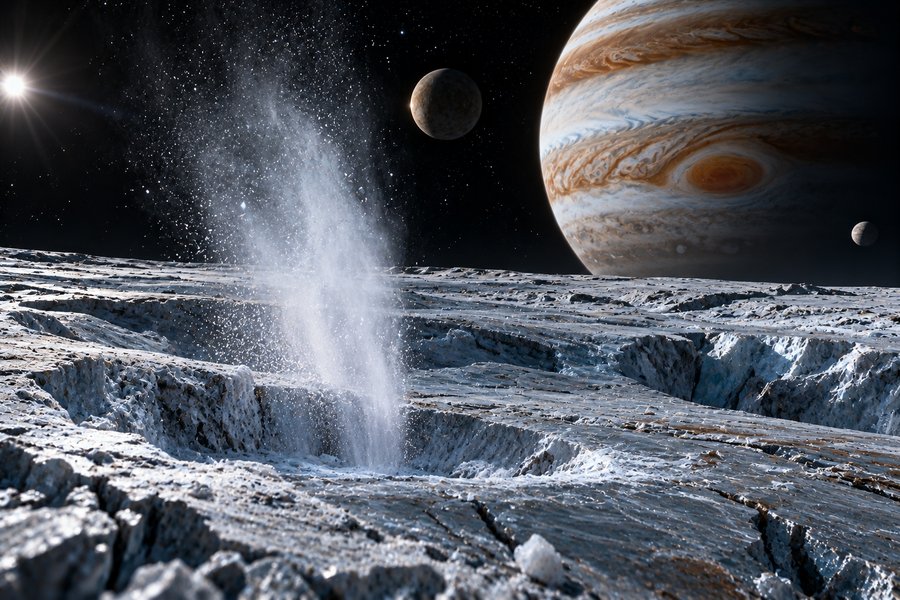
When we imagine a volcano, we usually picture molten rock rising through the ground, followed by an eruption of lava, ash and gas. On Earth, volcanoes are unmistakable signs of heat escaping from a planet's interior. But travel far enough into the outer Solar System, and the familiar definition begins to change. Some frozen worlds release water vapour, icy particles and other volatile materials through cracks in their surfaces. These eruptions can resemble geysers or volcanic plumes, even though the surrounding temperatures are far below freezing. Scientists call this family of processes cryovolcanism. The word combines the Greek term for cold with volcanism, but the science is more complicated than simply replacing hot lava with frozen water. On worlds such as Enceladus, Triton and possibly Europa, unusual eruptions provide clues about underground activity that spacecraft cannot observe directly. They also reveal something important about planetary geology: a world does not have to be warm on the outside to remain active underneath.
What Is Cryovolcanism?
Cryovolcanism describes geological processes in which volatile materials, such as water, ammonia or other substances, erupt or move onto the surface of a cold planetary body. Unlike ordinary volcanism, which involves molten rock, these processes may involve liquids, gases or mixtures that behave differently under extremely low temperatures and pressures.
However, not every plume observed above an icy world is necessarily cryovolcanic. Some eruptions may result from gas escaping beneath surface ice, while others may be driven by solar heating rather than material rising from a deep interior reservoir.
Scientists therefore distinguish between directly observed eruptions and the physical mechanisms proposed to explain them. This distinction is essential when studying distant moons where spacecraft cannot directly inspect the source.
Why Can Frozen Moons Remain Active?
Distance from the Sun does not necessarily determine whether a moon is geologically active. Several icy satellites orbit giant planets whose gravitational fields exert powerful forces on them. As a moon follows its orbit, the gravitational pull of its parent planet and neighbouring moons can repeatedly deform its interior. This process is known as tidal heating, and it can be influenced by the gravitational relationships described in our guide to planetary resonance. Repeated flexing produces friction and internal heat, potentially helping maintain liquid water beneath an otherwise frozen exterior. Enceladus provides one of the clearest examples. Despite its small size and extremely cold surface, the moon releases material from fractures near its south pole. Its activity demonstrates that a small, distant world can possess a remarkably dynamic interior.
Enceladus: The Moon That Sprays Water into Space
Saturn's moon Enceladus became one of the Solar System's most intriguing destinations after NASA's Cassini spacecraft observed enormous plumes emerging from its southern polar region. The eruptions originate near long fractures nicknamed the tiger stripes. Cassini flew through the plume material and detected water vapour, ice particles, organic compounds and other substances. Subsequent analysis also provided evidence of salts and chemical processes associated with a subsurface ocean. The observations suggest that material from inside Enceladus can reach space without scientists needing to drill through its ice shell. That makes the plumes unusually valuable. Instead of examining only the frozen exterior, researchers can analyse samples connected to the moon's internal environment. The eruptions are not evidence that life exists there, but they provide an extraordinary opportunity to investigate the chemistry of an ocean beyond Earth. The search for life on Enceladus therefore depends on understanding whether its underground ocean contains the chemical conditions necessary to support living organisms.
Does Europa Have Ice Volcanoes Too?
Jupiter's moon Europa is another important candidate for cryovolcanic activity. Scientists have strong evidence that a global salty ocean lies beneath its icy crust. Observations from the Hubble Space Telescope have suggested possible water-vapour plumes, although their existence, frequency and exact origin remain uncertain. That uncertainty matters. Europa is not simply another version of Enceladus. Its surface geology, radiation environment and internal structure differ considerably. A plume detected above Europa could potentially provide access to material from beneath the surface, but researchers would first need to establish where it originated and whether it was connected to the ocean. NASA's Europa Clipper mission is designed to investigate the moon's habitability, ice shell, ocean and geology. Understanding possible plume activity is one part of that wider scientific investigation. The possibility of life on Europa makes these investigations particularly important, although an underground ocean alone cannot establish that organisms exist.
Triton: A Different Kind of Frozen Eruption
Neptune's largest moon, Triton, offers another striking example of activity on a cold world. When Voyager 2 passed Triton in 1989, it photographed dark plumes rising above the surface. The spacecraft observed material being carried several kilometres upward before winds transported it across the thin atmosphere. These eruptions are generally interpreted differently from Enceladus's ocean-connected plumes. One proposed explanation involves sunlight warming translucent nitrogen ice, causing pressure to build beneath the surface until gas and dark particles escape. The resulting activity resembles a geyser more than a conventional lava eruption. Triton shows why the term cryovolcanism covers several distinct physical processes. Two moons may both produce plumes while having entirely different sources of energy and erupting material.
What Do Ice Volcanoes Actually Release?
The answer depends on the world. On Enceladus, water vapour and ice grains dominate the observed plumes. Cassini measurements also identified additional compounds that provide clues about the moon's ocean chemistry. On Triton, nitrogen gas and dark particles appear central to the observed eruptions. Other icy bodies may involve mixtures of water, ammonia, methane or other volatile substances. The composition matters because different materials freeze, melt and evaporate at different temperatures and pressures. An eruption can therefore reveal information about conditions hidden beneath the surface. For scientists, the material is not merely debris thrown into space. It is a chemical record of processes occurring somewhere they cannot yet reach directly.
Could Cryovolcanism Change a Moon's Surface?
Yes, and sometimes dramatically. Repeated eruptions can deposit fresh material over older terrain, alter surface brightness and create distinctive geological features. On Enceladus, particles escaping from the south polar plumes contribute to Saturn's E ring. Some material also falls back onto the moon, helping maintain its exceptionally bright surface. Other icy worlds display unusual domes, fractures and smooth regions that researchers have investigated as possible signs of past cryovolcanism. However, appearance alone is not enough to confirm an eruption. A rounded mountain or unusual surface marking might have formed through several different geological processes. Researchers compare spacecraft imagery, topography, composition and physical models before assigning a likely origin.
Are Ice Volcanoes Connected to Extraterrestrial Life?
Cryovolcanism matters to astrobiology because eruptions can carry material from environments that may contain liquid water, chemical nutrients and potential energy sources.
Enceladus is especially interesting because Cassini detected organic compounds and other chemical evidence in its plumes. However, organic molecules can form without life, and no extraterrestrial organisms have been confirmed there.
The main scientific opportunity is to analyse material from otherwise inaccessible environments. Our article on life beneath ice on other worlds explores these habitability questions in greater detail.
Could Scientists Fly Through an Ice Volcano?
Cassini has already demonstrated that a spacecraft can travel through plume material and collect valuable measurements. Future missions could carry instruments specifically designed to analyse particles for complex organic chemistry and other possible indicators of biological activity. Such missions would need to distinguish potential biological signals from non-biological chemistry and contamination. They would also need to account for how particles change while travelling from their source to the spacecraft. A plume sample may provide valuable information about an underground ocean, but it is not necessarily a perfect representation of the entire ocean. Careful interpretation would remain essential. The wider search for extraterrestrial life requires scientists to distinguish potentially biological chemistry from natural processes that can produce similar signals.
Why Cryovolcanism Matters
Cryovolcanism challenges the familiar idea that geological activity requires a hot, rocky surface. Frozen moons can remain active through gravitational heating, internal pressure and the behaviour of volatile materials. Their eruptions reveal hidden processes that would otherwise be extremely difficult to study. They also remind us that different worlds can produce superficially similar phenomena for very different reasons. Enceladus, Europa and Triton are not interchangeable examples of the same mechanism. Each has its own geological history and unanswered questions. The next discoveries may come from improved spacecraft observations, new plume measurements or missions designed to investigate icy surfaces more closely. For now, cryovolcanism offers one of the clearest demonstrations that the cold outer Solar System is anything but geologically dead.
Sources and Further Reading
NASA Science — Enceladus: Facts
NASA Science — Europa: Facts
NASA — Europa Clipper
NASA Science — Triton: Facts
NASA — Cassini Mission
NASA Science — Ocean Worlds