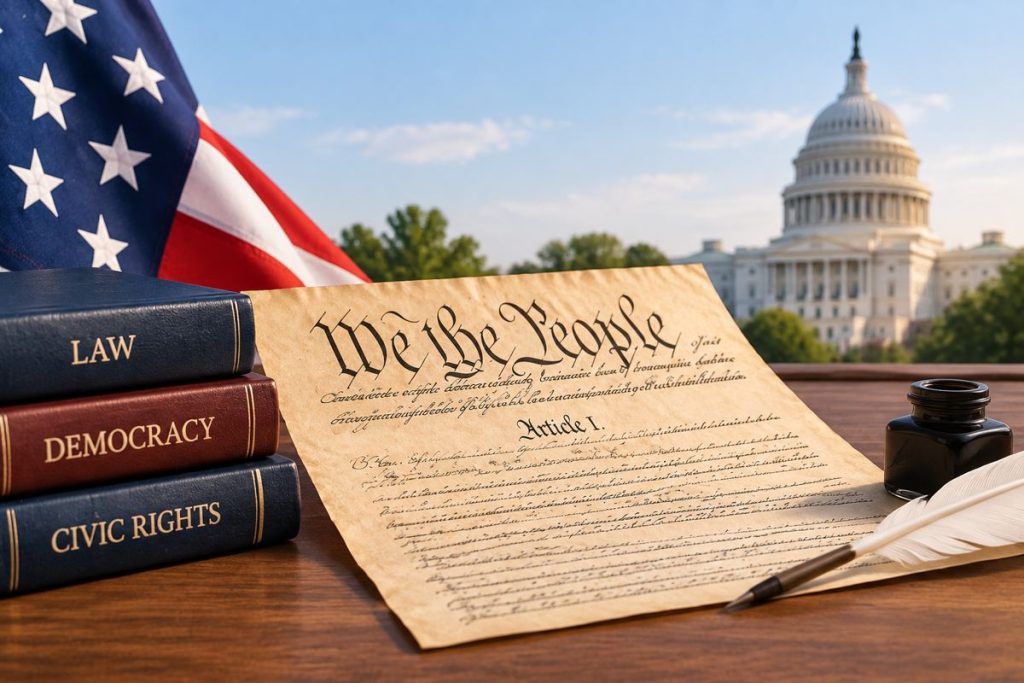
The U.S. Constitution Explained: How America's Government Works
The United States Constitution is one of the most influential legal documents in modern history. Written in 1787, it established the framework of the American federal government and set limits on how political power could be exercised.
More than two centuries later, it continues to shape elections, legislation, individual rights and the relationship between the federal government and the states.
Yet the Constitution is often discussed through complicated legal arguments or political disputes.
Its basic purpose is much simpler: to establish a system of government, distribute authority and prevent power from becoming concentrated in a single institution.
Understanding the Constitution helps explain not only how American government operates, but also why disagreements over its meaning remain central to public life.
What Is the U.S. Constitution?
The U.S. Constitution is the supreme law of the United States.
It establishes the federal government's structure, defines its powers and provides rules governing its relationship with the states.
The document contains a preamble and seven original articles.
It has also been amended 27 times.
The first ten amendments, known as the Bill of Rights, protect fundamental liberties and establish important limits on government authority.
Unlike an ordinary law, the Constitution cannot be changed through a simple vote in Congress.
Its amendment process requires unusually broad agreement, making constitutional changes relatively rare.
The Constitution provides the legal foundation for American government, but many details of how that government operates are developed through legislation, court decisions and established practices.
Why Was the Constitution Written?
After declaring independence from Britain in 1776, the American states initially operated under the Articles of Confederation.
That system created a relatively weak national government.
Congress had limited authority to raise revenue, regulate commerce or enforce national decisions.
These weaknesses became increasingly apparent during the 1780s.
In May 1787, delegates gathered in Philadelphia to discuss reforming the existing system.
Rather than making minor changes, they developed an entirely new constitutional framework.
The delegates disagreed over representation, executive authority, the balance between national and state governments, and slavery.
Compromises were necessary to secure agreement.
The final document was signed on 17 September 1787.
It became binding among the first nine ratifying states in June 1788, and the new federal government began operating in 1789.
The Constitution was a major institutional achievement, but it also reflected the limitations and inequalities of its era.
Its original provisions included compromises that protected slavery, and many people were excluded from meaningful political participation.
Later amendments and legal changes would address some of these injustices.
What Does the Constitution Actually Say?
The Constitution begins with a preamble describing the purposes of the new government.
These include establishing justice, maintaining domestic peace, providing for defence and protecting liberty.
The preamble is followed by seven articles that establish the government's principal institutions and legal framework.
| Article | Main subject |
|---|---|
| Article I | Congress and legislative powers |
| Article II | The president and executive powers |
| Article III | Federal courts and judicial powers |
| Article IV | Relations between states |
| Article V | The constitutional amendment process |
| Article VI | Federal supremacy and constitutional obligations |
| Article VII | Ratification of the Constitution |
The first three articles are particularly important because they establish the three branches of the federal government.
Each branch has its own responsibilities and constitutional limits.
How Does the Constitution Divide Government Power?
The Constitution divides federal authority among the legislative, executive and judicial branches.
This arrangement is commonly known as the separation of powers.
Legislative Branch: Congress
Article I establishes Congress, which consists of the House of Representatives and the Senate.
Congress makes federal laws, approves federal spending and exercises other powers granted by the Constitution.
The two chambers have different structures and responsibilities.
Members of the House represent congressional districts, while each state has two senators.
For a detailed comparison, see our guide to the House of Representatives and the Senate.
Executive Branch: The President
Article II establishes the presidency.
The president leads the executive branch, oversees the implementation of federal laws and serves as commander in chief of the armed forces.
Presidential powers are significant but not unlimited.
The Constitution assigns certain responsibilities to Congress and the courts, and some presidential actions require Senate approval.
Judicial Branch: Federal Courts
Article III establishes the federal judiciary and provides for the Supreme Court.
Federal courts resolve cases arising under federal law and the Constitution when they have jurisdiction.
Through judicial review, courts may determine that government actions conflict with constitutional requirements.
This principle became firmly established in American constitutional law through the Supreme Court's 1803 decision in Marbury v. Madison.
Together, the three branches form a system designed to distribute authority rather than concentrate it.
Our article on why the U.S. government has three branches explains this structure in more detail.
What Are Checks and Balances?
Checks and balances are mechanisms that allow each branch of government to limit certain actions by the others.
For example, Congress passes legislation, but the president may veto a bill.
Congress can override a presidential veto with the required two-thirds majorities in both chambers.
The president nominates federal judges, while the Senate provides advice and consent for appointments.
Federal courts may also rule that laws or executive actions violate the Constitution.
These arrangements are intended to prevent any single branch from exercising unchecked power.
They can also produce disagreements and delays.
Such tensions are not necessarily evidence that the constitutional system has failed.
They often arise because the branches have different responsibilities and competing interpretations of their authority.
What Is the Bill of Rights?
The Bill of Rights consists of the first ten amendments to the Constitution.
They were ratified on 15 December 1791, following concerns that the original document did not provide sufficiently explicit protections for individual liberties.
The amendments address important rights and limits on government authority.
| Amendment | Main protection or principle |
|---|---|
| First | Religion, speech, press, assembly and petition |
| Second | Right to keep and bear arms |
| Third | Restrictions on quartering soldiers in private homes |
| Fourth | Protection against unreasonable searches and seizures |
| Fifth | Due process and other protections in criminal proceedings |
| Sixth | Rights of defendants in criminal prosecutions |
| Seventh | Jury trials in certain civil cases |
| Eighth | Limits on excessive bail, fines and cruel punishment |
| Ninth | Recognition that enumerated rights are not exhaustive |
| Tenth | Reservation of undelegated powers to states or the people |
These rights have been interpreted through centuries of judicial decisions.
Many protections originally restricting the federal government have subsequently been applied to state governments through the Fourteenth Amendment.
The meaning and scope of particular rights continue to be debated in American courts and public life.
What Are Constitutional Amendments?
An amendment is a formal change to the Constitution.
Since the Constitution took effect, 27 amendments have been ratified.
Some of the most consequential were adopted after the American Civil War.
The Thirteenth Amendment abolished slavery and involuntary servitude, except as punishment for a crime following conviction.
The Fourteenth Amendment established important guarantees concerning citizenship, due process and equal protection.
The Fifteenth Amendment prohibited denying voting rights on account of race, colour or previous condition of servitude.
Later amendments expanded voting rights and changed government procedures.
The Nineteenth Amendment prohibited denying the vote on account of sex.
The Twenty-Sixth Amendment lowered the voting age to 18.
These changes demonstrate that the Constitution has developed substantially since 1787.
Its original text remains important, but the amendments are equally part of the nation's constitutional law.
How Can the Constitution Be Changed?
Article V establishes the amendment process.
The most commonly used method begins when two-thirds of both the House of Representatives and the Senate propose an amendment.
The proposal must then be ratified by three-fourths of the states, usually through their legislatures.
Article V also allows amendments to be proposed by a convention called upon the application of two-thirds of state legislatures.
That proposal method has never been used successfully to produce a constitutional amendment.
The high approval thresholds make constitutional change difficult.
Supporters of this arrangement argue that it promotes stability and broad consensus.
Critics contend that the process can make necessary reforms unusually difficult.
Both perspectives reflect an enduring tension between preserving constitutional principles and allowing institutions to adapt.
What Is Federalism?
Federalism is the division of authority between the national government and state governments.
The Constitution gives the federal government specified powers, including important responsibilities involving national defence, interstate commerce and foreign affairs.
States retain substantial authority over areas such as education, local government and many aspects of public safety.
The Tenth Amendment reinforces the principle that powers not delegated to the federal government, nor prohibited to the states, are reserved to the states or the people.
However, the division is not always straightforward.
Federal and state laws can overlap, and disputes may arise over which level of government has authority.
Article VI establishes that the Constitution and valid federal laws are the supreme law of the land.
This means conflicting state laws may be displaced when federal law is constitutionally controlling.
Our guide to federal versus state government explores these differences in greater detail.
How Does the Constitution Shape U.S. Elections?
The Constitution establishes the foundations of federal elections, although many practical details are governed by federal and state laws.
It sets qualifications and terms of office for members of Congress and the president.
The original Constitution also established the Electoral College system for selecting the president.
Subsequent amendments changed aspects of presidential elections and expanded voting rights.
States administer most elections, subject to federal constitutional and statutory requirements.
This produces differences in voting procedures between states.
The Constitution does not require the United States to have only two major political parties.
The dominance of the Democratic and Republican parties developed through political history and electoral institutions rather than a constitutional rule.
For a fuller explanation, read our guide to how U.S. elections work.
Why Is the Constitution Still Debated?
The Constitution establishes broad principles, but it does not answer every question about modern government.
Some provisions use language that requires interpretation.
Courts must consider how those provisions apply to circumstances the original authors could not have anticipated.
Disagreements also arise over methods of constitutional interpretation.
Some legal scholars emphasise the original public meaning of the text.
Others place greater weight on precedent, institutional practice and the application of constitutional principles to changing circumstances.
These debates influence decisions involving executive authority, individual rights and the relationship between federal and state governments.
The Constitution's continued relevance comes partly from this interaction between a relatively stable written document and a changing society.
Understanding that distinction helps readers separate the constitutional text from political arguments about what it should mean.
Frequently Asked Questions
When was the U.S. Constitution written?
The Constitution was drafted in Philadelphia in 1787 and signed on 17 September that year.
How many articles are in the Constitution?
The original Constitution contains seven articles, together with a preamble.
How many amendments does the Constitution have?
The U.S. Constitution has 27 ratified amendments.
What is the Bill of Rights?
The Bill of Rights consists of the first ten constitutional amendments, ratified in 1791.
Can the president change the Constitution?
No. The president cannot unilaterally amend the Constitution. Formal changes must follow the procedures established by Article V.
Final Thoughts
The U.S. Constitution is both a historical document and the legal foundation of American government.
Its seven articles establish the structure of federal institutions, while its amendments protect rights and reflect major changes in American society.
The Constitution divides authority among three branches and between federal and state governments.
It also provides mechanisms for resolving disputes and making formal changes.
Understanding these principles offers a clearer view of how American political institutions operate, why conflicts over government authority arise and why constitutional interpretation remains important today.
Sources and Further Reading
National Archives — The Constitution: What Does It Say?
Official explanation of the Constitution's seven articles and government structure.
National Archives — The Constitution of the United States: A Transcription
Complete transcription of the original constitutional document.
National Archives — The Constitution: How Did It Happen?
Historical background on the Constitutional Convention and ratification.
National Archives — The Bill of Rights: What Does It Say?
Explanation of the first ten amendments and their protections.
National Archives — Constitutional Amendments 11–27
Official texts and ratification dates of later amendments.
Congress.gov — Constitution Annotated
Congressional legal reference covering constitutional provisions and judicial interpretation.