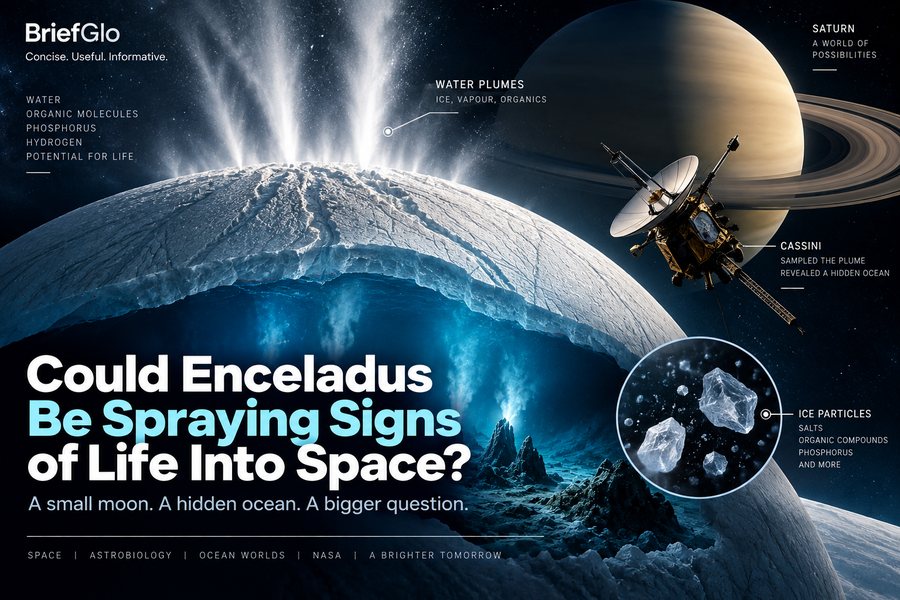
Deep beneath the frozen surface of a small moon orbiting Saturn lies an ocean that scientists cannot see directly. Yet some of its material is escaping into space.
Enceladus, a moon only about 500 kilometres across, releases enormous plumes of water vapour and icy particles from fractures near its south pole. These jets have allowed spacecraft to investigate the chemistry of an ocean hidden beneath kilometres of ice.
What researchers have found is remarkable: water, organic compounds, essential chemical elements and evidence of an energy source that microorganisms could potentially use.
It raises an extraordinary question. Could Enceladus be releasing evidence of life into space without us knowing it?
The answer remains uncertain. No organism has been discovered there, but the moon has become one of the most promising places to investigate whether life could exist beyond Earth.
What Makes Enceladus So Unusual?
Enceladus is one of Saturn's many moons, but its appearance hides an unexpectedly active interior.
Its surface is covered in bright ice, making it one of the most reflective objects in the Solar System. Temperatures are extremely low, and sunlight provides little warmth at Saturn's distance from the Sun.
For many years, such a small, frozen world seemed an unlikely place to find liquid water.
NASA's Cassini spacecraft changed that understanding.
During its exploration of Saturn, Cassini discovered powerful jets erupting from long fractures near Enceladus's south pole. These fractures are commonly called tiger stripes.
Further observations revealed that the moon possesses a global ocean of salty liquid water beneath its icy crust.
This ocean is not exposed to sunlight, but it may contain the chemical ingredients and energy needed to support microbial life.
That possibility makes Enceladus important to astrobiology, the scientific study of life's potential beyond Earth.
Why Is Enceladus Spraying Water Into Space?
The jets originate from fractures in the moon's icy exterior.
Water vapour and ice particles escape through these openings, creating plumes that extend far above the surface. Some material eventually contributes to Saturn's diffuse E ring.
The activity is possible because Enceladus has an internal source of heat.
As the moon travels around Saturn, gravitational forces repeatedly deform its interior. This process, known as tidal heating, helps generate energy that can maintain liquid water beneath the ice.
Scientists are still investigating how heat moves through the moon and how the fractures remain active.
The crucial point is that Enceladus does not need to be close to the Sun to possess a liquid-water environment.
Its ocean is maintained by processes very different from those that keep Earth's surface oceans liquid.
This makes it an important example of habitability beyond the conventional habitable zone.
How Cassini Sampled an Ocean Without Landing
Cassini was not designed to search directly for life on Enceladus.
When the spacecraft arrived at Saturn, scientists did not yet know that the moon was releasing material from its interior.
Once the plumes were discovered, mission researchers used Cassini's instruments to investigate their composition.
The spacecraft flew through the escaping gas and icy particles, collecting measurements with instruments capable of identifying different molecules and chemical components.
These observations revealed water vapour, salts, organic compounds and several other substances.
The discovery was particularly valuable because it offered a way to study material connected to an underground ocean without drilling through the moon's ice.
Rather than landing on Enceladus and attempting to reach the water directly, Cassini could analyse material already travelling into space.
The mission ended in September 2017, but scientists continue to study the data it collected.
Could the Ocean Provide Energy for Life?
Water alone is not enough to support life.
Organisms also require a source of energy and suitable chemical ingredients.
On Earth, sunlight powers much of the living world, but some microorganisms survive in complete darkness by using energy from chemical reactions.
Enceladus may offer a comparable possibility.
Cassini detected molecular hydrogen in the moon's plume. This finding supports the idea that water is interacting chemically with rock deep inside Enceladus.
Researchers have also identified tiny silica particles whose properties are consistent with hot water interacting with rocky material.
Together, these observations provide evidence for hydrothermal activity beneath the ocean.
On Earth, hydrothermal environments can support microbial communities without sunlight.
Certain microorganisms obtain energy from reactions involving hydrogen and carbon dioxide.
Similar reactions could potentially provide energy on Enceladus.
However, scientists have not directly observed hydrothermal vents on the moon's ocean floor.
The available evidence supports their possible existence, not the presence of organisms living around them.
What Organic Compounds Have Scientists Found?
Organic compounds are carbon-containing molecules that play important roles in living organisms.
Their presence is scientifically interesting, but organic chemistry can also occur without biology.
Cassini detected organic material associated with Enceladus's plumes, including compounds containing carbon, hydrogen, nitrogen and oxygen.
In November 2025, researchers published a new analysis of Cassini data revealing additional organic compounds in freshly ejected ice particles.
The particles had been collected during a close flyby in 2008.
Unlike some earlier samples taken from Saturn's E ring, these particles had spent relatively little time exposed to the space environment.
That distinction matters because radiation and other processes can alter molecules after they leave their source.
The newly identified compounds included members of chemical families associated with esters and ethers.
These findings strengthened the evidence that complex organic chemistry is occurring within or is connected to Enceladus's ocean.
They did not demonstrate that the molecules were produced by living organisms.
Organic compounds can form through non-biological reactions, and scientists must examine those possibilities before considering a biological explanation.
Scientists Also Found Phosphorus
Another important discovery emerged from a 2023 analysis of Cassini measurements.
Researchers identified phosphate salts in ice grains associated with material originating from Enceladus's ocean.
Phosphorus is an essential element for life as we know it.
On Earth, it plays important roles in DNA, RNA, cell membranes and the molecules organisms use to store and transfer energy.
Finding phosphates therefore added another significant piece to the picture of Enceladus's chemistry.
Scientists had already identified water, organic compounds and evidence of chemical energy.
The phosphorus finding showed that another important biological ingredient was available in the ocean system.
But the discovery did not establish that the ocean contains living cells.
Chemical ingredients can exist in an environment where life has never developed.
The challenge is determining whether those ingredients have ever been organised into biological systems.
Does Enceladus Have the Ingredients for Life?
Enceladus appears to possess several conditions commonly associated with habitability.
It has a global liquid-water ocean, organic chemistry and evidence of chemical reactions capable of providing energy.
The discovery of phosphates has further strengthened the case that its ocean contains important elements used by terrestrial organisms.
Yet having these ingredients is not the same as demonstrating that life exists.
Scientists do not fully understand how life first emerged on Earth, and they cannot assume that similar ingredients will inevitably produce organisms elsewhere.
The ocean's temperature, chemical balance, long-term stability and history may all influence whether life could develop and survive.
It is also possible that Enceladus has remained uninhabited despite possessing potentially suitable conditions.
For now, researchers can make a strong case for studying its habitability.
They cannot make a scientifically confirmed claim that its ocean is inhabited.
Could the Plumes Contain Evidence of Life?
If microorganisms exist in Enceladus's ocean, some evidence of their activity might become incorporated into material escaping through the plumes.
That evidence could take several forms.
Scientists might search for complex organic patterns, unusual chemical distributions or combinations of molecules that are difficult to explain through non-biological processes.
These possible indicators are known as biosignatures.
A future spacecraft might also investigate whether plume particles contain structures or chemical features consistent with cells.
However, finding a suspicious molecule would not be sufficient.
Geological processes, radiation and chemical reactions can produce substances that resemble biological products.
Contamination from a spacecraft would create another major concern.
A convincing discovery would require several independent lines of evidence and careful testing of alternative explanations.
Cassini's instruments were not designed to perform such a comprehensive life-detection investigation.
Its measurements have shown why the search is worth pursuing, but they have not answered whether life exists.
How Could Future Missions Investigate Enceladus?
One of Enceladus's greatest advantages is that its plumes provide access to ocean-related material without requiring a spacecraft to penetrate the ice.
A future mission could fly through the plumes with instruments specifically designed to search for complex organic chemistry and potential biological signatures.
More advanced mass spectrometers could distinguish molecules in greater detail than Cassini's instruments.
Other instruments might examine the size, structure and composition of individual ice particles.
Researchers would also need to account for how material changes as it travels from the ocean, through the ice fractures and into space.
A plume sample is not necessarily an unchanged sample of the ocean itself.
Any life-detection mission would also require strict contamination controls.
Preventing terrestrial microorganisms and organic material from interfering with measurements would be essential to the credibility of its findings.
Although various Enceladus mission concepts have been studied, scientific proposals should not be confused with a confirmed mission launch.
The next decisive step would be to send instruments designed specifically to test whether the ocean contains evidence of biology.
How Does Enceladus Compare With Europa?
Enceladus is not the only icy moon with a potentially habitable ocean.
Jupiter's moon Europa is also believed to contain a large body of liquid water beneath its frozen surface.
Both moons may experience tidal heating, and both are important targets in the search for environments where life could survive.
The difference lies partly in how scientists can investigate them.
Enceladus regularly releases ocean-related material into space, making direct sampling of its plumes possible.
Europa's ocean is more difficult to access, although spacecraft can investigate its surface, ice shell and surrounding environment.
Neither moon has provided confirmed evidence of extraterrestrial life.
Their importance comes from the possibility that liquid-water habitats may exist far from the warmth of the Sun.
If such environments can support organisms, the range of potentially habitable locations throughout the universe could be much wider than scientists once assumed.
Is Enceladus Spraying Signs of Life Into Space?
Enceladus is certainly spraying material connected to its hidden ocean into space.
Cassini's observations have revealed water, salts, organic compounds, phosphorus-bearing material and evidence of chemical energy.
These discoveries make the moon one of the Solar System's most compelling astrobiological targets.
But scientists have not identified a confirmed biological signal in its plumes.
The substances discovered so far can exist without living organisms, and the conditions needed for life do not guarantee that life has emerged.
The most important question is therefore not whether Enceladus contains interesting chemistry. That has already been established.
It is whether any of that chemistry has a biological origin.
Answering that question will require instruments designed to distinguish life-related processes from ordinary geology and chemistry.
Until then, Enceladus remains a remarkable possibility rather than a confirmed inhabited world.
Its greatest scientific promise is that an ocean hidden beneath a frozen surface may already be sending samples of itself into space, waiting for us to investigate them more carefully.
Sources and Further Reading
NASA Science — Enceladus
Overview of the moon's subsurface ocean, active plumes and potential habitability.
NASA Science — Cassini at Enceladus
Details of Cassini's discoveries and the evidence for a global salty ocean.
NASA JPL — Building Block for Life Found in Enceladus' Ocean
Research on the detection of phosphate salts in ice grains originating from Enceladus.
NASA — Cassini Study Finds Organics 'Fresh' From Ocean of Enceladus
November 2025 findings on newly identified organic compounds in freshly ejected plume particles.
NASA Science — Enceladus Hydrothermal Activity
Evidence supporting water-rock reactions and possible hydrothermal activity beneath the icy crust.